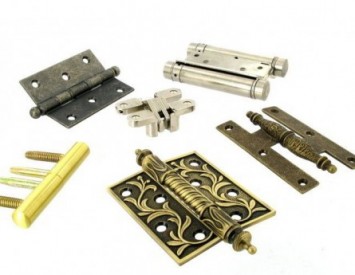
Loops for interior doors are that spare part by which the door opens and closes. This item is needed for fastening the door itself to the box. It is desirable that the hinges are harmonized with decorative elements of the door accessories used during installation and, at the same time, were characterized by perfect functionality.
Content
The most widely used types of loops
By the type of door canvase

When choosing a loop, you need to consider the type of door canvase. So, for an ordinary web with a direct end, elementary overhead loops can be selected, and the web with a trigger requires a specific structure loop with a rectangular bend of the card (angular). The map is a moving plane with holes for screwing the loop with self-draws.

Door with a festival
In the direction of movement of the door canvase
Unilateral
One-sided loop is created for the movement of the door leaf only in the only direction. There are right-hand or left. Plus this option is the comfort and speed of removing the door with the loops in the event of the need (although this occurs extremely rarely).

One-sided loop
Bilateral
This type of loops is equipped with three cards connected by massive rods, each of which has springs that provide a dense fitting of the hinges to the door canvase. Such compounds are characteristic of the dual-sized doors "A La Western". In the apartments they are used extremely rare.

Spring bilateral loop
Universal
They are used for any doors, regardless of the direction of movement of the door plane. In construction stores you will find 4 or 5 inches along the length of the wing loop. Card dimensions for such loops will be 100x25mm or 125x30mm, respectively. The more massive door, the larger loop you need to choose. Sometimes (if the door is too heavy), there are three loops at once: two in the upper and one at the bottom of the door design. These loops are composed of several bearings on the rotary axis.

Universal loop
By way of connection with the door
Overhead loops for interroom doors
They do not deliver any difficulties when assembling. For consupporting clarity, they should be called non-cut loops for interior doors. Their cards are simply superimposed and fastened to the plane of the door and to the log. The most widely represented on sale such products from steel (ordinary and stainless) and brass. For arranging outer doors, usually choose brass or stainless samples, due to their resistance to temperature differences and other atmospheric influences. But, when installing internal interior doors (where special complaints are presented to physical characteristics) often choose conventional steel loops, because The price of such copies is much lower than that of wear-resistant analogs.
Loops for interroom doors butterfly - These are the same overhead loops, owned by their name a special form resembling a moth. Maps such a loop are made so that when closing the door, "add up" into one.

Patch
Cutting loops for interroom doors

Screw loop
- Screw loops - An example of products suitable for the door with a focus (with a quarter). In these designs, the functions of the wing cards are made of pins, some of which have threads and screws into the logbook and in the canvas. The rest are simply inserted into the pre-cooked holes. Then the parts of the loops are connected by dusting cylinders. The visible part of this design is covered for aesthetics cap, which can be chosen under the color of the handle or closer. In addition, the position of individual parts of such loops can be adjusted in the future, which is very convenient when aligning the door plane relative to the box. Fantasy Loops for interior doors - a type of whipped loops, widely used for the doors of the lungs and medium in gravity. Ideal for poorly installed doors with the presence of blocks of boxes that visually can be adjusted to the position of the loop.

Facial loop
- Hidden Loops for interior doors are a sample of non-standard mortise loops, which become almost imperceptible when closing the door. These hinge loops for interior doors can be made both in one-sided variation and in universal. Separate samples of such products, like screw loops, can be adjusted. But their structure is more complicated than the design of the models described earlier, so that it is not so easy to install them.

There will be needed maximum accuracy and diligence at all stages of editing. Regarding the price of such alternative internal loops on interior doors, it can be said that the cost of these models is several times higher than the classic, so the mass media is not yet used.

Hidden loops
What should pay attention to when choosing a loop?
- Performance quality (type of coating, presence of untreated sections, burstles, etc.).
- The presence of grease in friction places.
- Reviews about the manufacturer. Italian and Spanish manufacturers, such as Morelli, Archi, Agb, Armadillo and Amig, are most popular today. Their products are durable and wear-resistant. But, it is worth an additionally to interview friends and relatives on what loops are standing with them, and how satisfied they are.
- Price. Products from eminent manufacturers will cost you 5 times more expensive than an analogous to an unknown company. It is important to be able to catch the permissible price / quality ratio.