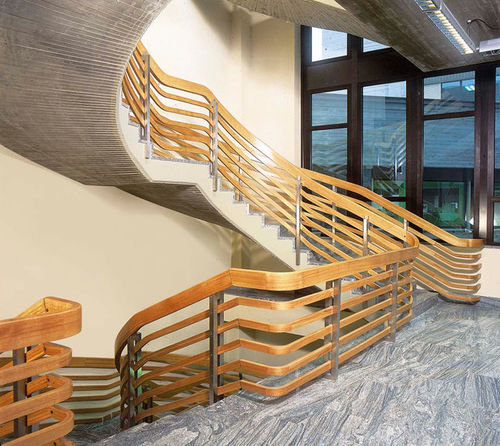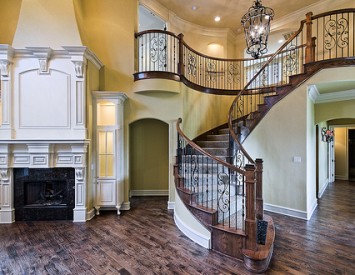
Railings are an important part of the stairs. They strengthen the design and serve as a support for people. Properly executed railing will decorate the staircase and the interior of the house. They are made from different materials and, in accordance with its design, have all sorts of shapes and sizes.
Content
Railing for the stairs do it yourself - preparation for work
Instruments
When installing the railings should prepare tools in advance:
- chisels;
- hacksaw and chisel;
- hammer;
- screwdrivers;
- screwdriver;
- drill;
- drill;
- lobzik;
- level;
- placement tools - roulette, pencil, marker.

Material
Selecting the material for the railings, several factors should be taken into account:
- features of the design;
- interior style;
- mounting complexity - this moment is especially important when independent work.
Materials from which the staircase railing is performed:
- wood;

- metal: steel, aluminum, chrome metal;

- worn iron;

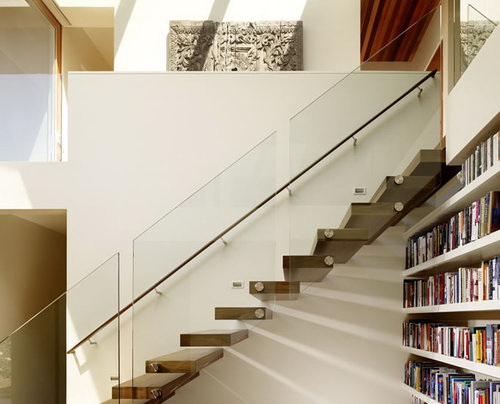
- glass;
- plastic.
Design details
Elements from which there are any staircase railing:
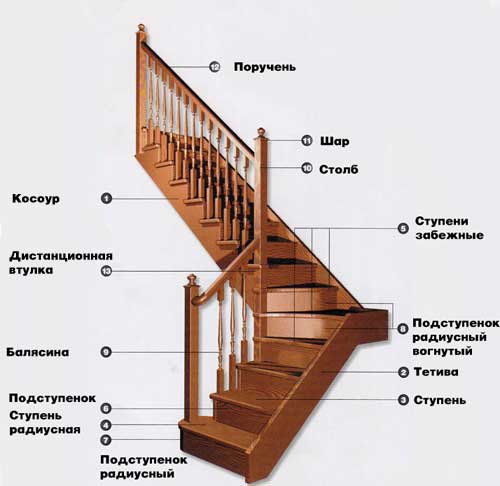
- Tubes - supports - installed at the beginning and end of the staircase march. They account for the main load, so they should be very stable. For reliability, the couches are often installed on an additional platform. Its height is 80-90 cm. This is an average parameter at which a person is comfortable to climb the stairs, but if desired, it can be changed.

- Balaasins - columns that are installed along a staircase and support the railing. They are of any form: round, square, flat or curly.


Wooden balasins are often decorated with manual carvings.

The distance between the columns is different, but it should not exceed 20 cm. One of the options is a solid baluster.

- The handrail is the upper part of the railil, the size of which corresponds to the length of the stair march. It happens round, rectangular and even carved, but the main purpose of this detail is the convenience of users. It is he who is supporting when moving around the stairs.

How to make a railing for the stairs
Wooden railing for stairs
Selection of material
For the manufacture of railings, various wood breeds are used: spruce, fir, poplar, nut, etc. But the most reliable is the products from oak, ash or teak. Solid rocks allow you to create fine, but safe parts, and the railing of them has a lightweight, elegant look.

Installation of ladder fence
- At the end and beginning of the march, the cabinets are installed. To test the selected height between them, the cord is stretched and a test climb and a descent on the stairs is carried out. The cabinets are attached and checked for stability - their "tenting" is unacceptable.
- The string (lower support) is fastened with screws to the staircase march and stands.
- The BALASIN frequency is calculated, and the holes are drilled on them.
- End edges balusters saw off at an angle of inclination of the stairs. When attaching racks to the steps, their lower part leaves straight.
- Balaasins are installed using studs that screw in their base and are inserted into the prepared hole in the stairs. They tightened nuts on the underside of the structure. Another option attachment - the use of studs and grooves in the string and handrail.
- On the balusters are installed and fixed railing.
- Ready enclosures are cleaned from dust, shpaklyuyut all visible defects on the surface and varnished.
Mounting railing with nails is the easiest way to build them. But he and the most unreliable, since a short time, the design becomes unstable. Special studs, spikes or self-tapping screws planted on the glue composition will provide a more durable fastening of parts.
Metal railing for stairs
Material
Metal railings are purchased ready or ordered in the workshop - it is very difficult to make them independently. These designs are performed from various material, which has its advantages and cons.
- Aluminum - has a low weight, affordable cost. The railing from this material is diverse in form and configuration, but not very durable.
- Stainless steel - beautiful, durable and resistant to moisture. It has one drawback - high cost.
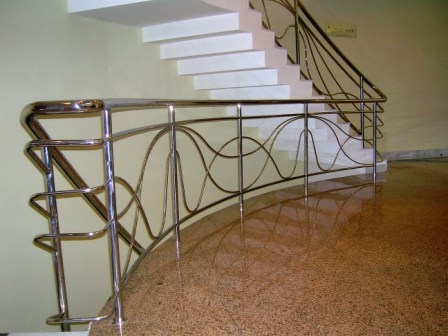
- Painted pipes are reliable and available at cost, but require regular coating updates.
- Nickel plated tubes are beautiful and not very expensive, compared to the "stainless steel", but are subject to corrosion.
Mounting railing
- On the steps of the stairs, in the places of the BALASIN installation, markup is made.
- In the marked places the holes are drilled.
- The dust appeared is blowing out by an industrial vacuum cleaner.
- Two-component glue poured into the resulting hole, and the studs are inserted.
- With the help of the screw or welding on the studs are attached racks. With the help of the level, their vertical position is controlled.
- The handrail is attached to the supports of the bolts. Welding is rarely used, because it requires certain skills.
- Welded seams are cleaned and grind.
Worn railing for stairs
Worn railing is mounted using welding. Elements for them are sold in stores or workshops. But the best option is to order a railing at the blacksmith. Upon the proposed drawing, the masters revealed a unique product that will be uniquely decorated at home.

Welding work on the installation of Rail does not require special professionalism - it is enough to have small skills on them. But it is very important to carefully approach the finishing of the finished design. With properly selected materials for primer and painting railing, they will serve for many years without changing the appearance.
Railing for stairs, photo: