A very important stage of construction and repair of the house, like vapor barrier, sometimes it does not take into account. This is done sometimes in order to save money, sometimes from lack of information. In fact, vaporizoation of the walls of the house is no less important item than insulation and waterproofing. You can make it with your own hands, examining in detail the instructions.
Content
The difference of vaporizolation from waterproofing
These two concepts are very often confused, because the difference between both the same is essential, but the functionality is still similar: and steam, and waterproofing is opposed to the penetration of moisture. But the main function of vaporizolation is to prevent condensate, while passing air. 
Often under the sight of moisture is insulation. Waterproofing materials that are protected, only do not allow water from entering the insulation layer, but the steam through them passes. Humidity in the apartment is also quite high due to bathing, washing dishes, washing. This moisture also needs to go somewhere. Of course, open windows help well, but not everyone can physically hold windows. Therefore, it is important to ensure proper ventilation of the walls, while not to subjected to the danger of their "insides": heat-insulating and other materials.
The main task of steam-insulating materials is to protect against water in a gaseous state, that is, in a state of steam. Thus, vaporizolation is the extension of the life of building materials that it protects.

Materials for vapor insulation
There are several basic types of vapor insulation materials:
- polyethylene film with a thickness of 0.1 mm. This cheap paosoolence method has its own essential drawback - it does not miss not only steam. In the room there is no movement of air, the walls "do not breathe". Some "specialists" are offered to perflect the film by handicrafts, but in such cases it completely loses its vapor insulation properties and the insulation remains again without protection;
- special vaporizolizing mastic. Application of mastic is also carried out before the finish finish. Their functional is also in transmitting air and pair delay, protecting the insulation;
- the membrane film is a new generation in vaporizolation. It passes the air in sufficient volume, while not missing steam, so that the insulation in the wall patty is completely protected.
Parosolation of the walls of a wooden house
The house built from the tree also requires paying close attention to the installation of vapor barrier. The only case in which there is no need to - to make vaporizolation when the house is built of a rounded, glued bar, which is dried properly in production, has clear sizes of joints and the groove, which creates absolute tightness, becoming a natural barrier pair.

A tree that comes to build houses, dries very long. The term of complete drying is 5 years, especially in the first year after construction with a tree, basic deformations occur:
- cracks are formed in the walls;
- the walls are gradually sitting;
- logs gradually change their shape;
- also changing log sizes.
This process is natural, but leads to defects. It is possible to protect the walls from the penetration of moisture using vaporizolation laying. Here are two options here:
- external insulation. Old wooden houses prefer to separate from the outside to give the house updated, well-groomed and modern species;
- internal insulation. When building a new wooden house, it is important to keep the beauty of its facade, because all work is carried out inside the house.
Parosolation of walls of a wooden house outside
Wooden house insulation technology outside involves the design of a wall cake in the following sequence:

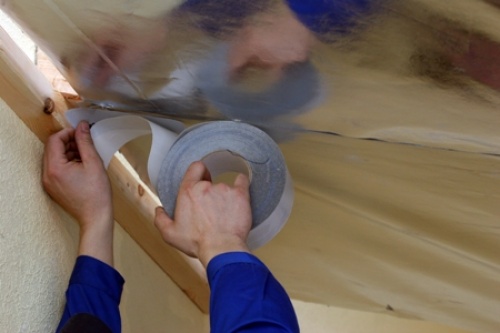
- a layer of vaporizolation material is spilled on the log. Regardless of which material it will be, it must be putting the brass, the edges must at least 2 cm come to each other. All joints should be well sealed with self-adhesive ribbon, and foil must be sealed with metallized tape;
- the next layer will be a frame, usually it is made from a bar to which the insulation will be attached;
- the insulation is protected by waterproofing;
- the last layer is the finish finish of the house.
Depending on the log type, vaporizolation is attached in different ways:
- on a round log, vaporizolation must be attached directly on the tree, the ventilation clearance is not needed. This is done with the help of an ordinary construction stapler;
- square and rectangular logs require ventilation gap. For this, the raks of about 2.5 cm wide, the step between them is approximately 1 m. On the rail data and the layer of vaporizolation is attached.
Parosolation of the walls of a wooden house from the inside
With the inner warming of a wooden house, the structure of the structure will look like this: 
- the lamp is up to 5 cm wide, which will provide ventilation gap;
- a layer of waterproofing film that is attached on this crate. The gap between the film and the wall will provide good ventilation;
- then the metal profiles are attached;
- layer of insulation;
- a vapor barrier film that is fastening the mustache and well-sealed on the joints;
- finishing, such as plasterboard.
Parosolation is necessary for a wooden house because the tree has excellent air permeability and steam, respectively, there is a great risk to harm the insulation. To extend the service life of the insulation and walls, it is necessary to include a layer of vapor barrier in the wall structure.
Variazolation of the walls of a frame house
The walls of the skeleton house at least three-quarters consist of insulation. That is why high-quality vaporizoation of the walls of a frame house is very important. Saving on vaporizolation, you can lose not only the functional of the insulation, but also to ensure the walls of destruction.
Standard wall cake frame home should look like this: 
- outer cover house;
- layer of hydro and wind insulation;
- insulation, which is stacked between frame racks. Its width is usually about 150 mm;
- frame;
- vaporizolation membrane;
- interior decoration (OSB-plates, plasterboard).
Parosolation is attached to the ribs of the frame and the strapping using a construction stapler. The sealing of the joints is ensured by tape. Fastening a vapor barrier film, it is important to remember several rules:
- the membrane must be installed only on the insulated side of the insulation layer. This will provide free "breathing" walls, ventilation of the house and the desired microclimate;
- it is impossible to mount the vaporizolation layers on both sides. The outer layer should be protected from water, but not from steam. The vaporizolation and inner side of the waterproofing film passes the air and provide ventilation for the insulation, providing its bread and ventilation;
- if eco-water or foam is used as the insulation, it is believed that vaporizolation is not needed, since these insulation have good resistance to moisture and condensate. This is true, but by eliminating the vaporizoation layer, the inner layer of the trim is exposed to risk. It is there that steam stops and a condensate layer falls on it, contributing to the destruction of the house.

Making vaporizoation of the walls of the house with your own hands - the task is quite simple, the main thing is to fulfill the basic requirements for the installation technology. In any case, if you yourself decided to sneak the walls, then it is originally better to consult with professionals and take into account all the advice.