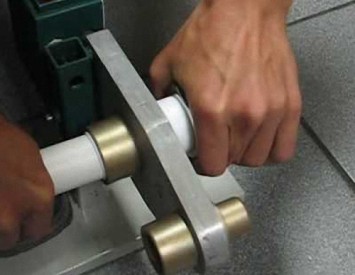
Plastic pipes are a practically ideal solution if you wish to build a reliable pipeline. They are durable, possess good strength and differ in low cost. Nevertheless, such pipes also periodically give leaks. It is mainly due to a violation of the pipe soldering process and errors allowed. If there is a soldering iron and the appropriate tool, the soldering of polypropylene pipes will be even a newcomer.
Content
Required tool for pipe soldering
The main thing that will be needed for work is a special soldering iron for polypropylene pipes, with which they produce soldering and welding. The device must be selected based on the specifics of the work. If one-time or infrequent use of the device is planned, it makes sense to take it for rent. 
Besides him, the following will be required:
- Teflon nozzles of the required diameter for mounted pipes.
- Special cutter or scissors for cutting PVC pipes. It is advisable first to make sure that the pipe is unnecessary cut, that the tool is well sharpened. This is necessary in order to avoid the appearance of burrs or deforming on trimming pipes.
- Means for degreasing and cleaning the surface of PVC pipes from contamination.
- Ribs for wiping.
- Flame with fine-grained coating or several suprails.
- Shoe or mounting knife. It is made of metal trimming 10 cm wide, which should be cut at an angle of 45 ° and sharpened.
- To apply marks, you will need a pencil or a thin marker. To make it easier to remove, an ordinary marker is applied. If there is a need to maintain marks, then you need to purchase a permanent marker, which is practically not erased without special means.
- For accurate installation and proper trimming, a roulette and a square is required, with the help of which it will be performed accurate laying of pipe segments relative to each other.
The process of pipe soldering is technically simple, but it is necessary to perform a compound with special accuracy, since it is often defects with a soldering entail further problems.
Components for connecting pipes
Pipes of pipes are connected using fittings, which are the connective part of the pipeline. They are installed in places of turns or branching pipes, but also serve for a hermetic connection or overlap. Depending on the purpose, the fittings are divided into several varieties:
- taps allowing to change the direction of the pipeline,
- tees are formed by a branch in one direction from the main pipe,
- crosses allow you to make a removal in two directions from the main pipe,
- adapter fittings are able to securely combine the pipes of different diameters among themselves,
- plugs are used in cases where it is required to ensure the sealed seal of the ends of the polypropylene tube,
- in the event that the welding of polypropylene pipes involves the subsequent connection of pipes with a flexible hose, then apply connecting fittings.

Fittings are distinguished by their reliability and durability. Due to this, they are widespread in the market as elements of compound for water supply systems with a different temperature of undergoing water. Polypropylene compounds differ from plastic fittings by the fact that they are not so sensitive to the water temperature and are able to withstand the exposure to high temperatures up to 100 ° C and chemically aggressive media.
The material is capable of listening to 50 years, and even simple plastic fittings are not subject to corrosion or rust, and will not require substitutions due to wear. In addition, their final price will be another significant advantage in the direction of choosing just such an element of fittings.
What methods of connecting pipes from PVC exist
Experts distinguish several types of polypropylene pipe compounds, each of which is suitable for certain requests:
1. The pipe compound is used in those pipes whose manufacturers provided them with sealing rings from rubber. Such gaskets allow you to make the joints of the pipes with hermetic, and the work itself on the installation of the water supply is greatly simplified. The connection method is as follows:
- the chamfer is removed from the pipes, and the input of the pipe segment in connection is applied to the connection,
- on the sealing ring applies the adhesive composition on silicone basis,
- next, the elements of pipes are connected to each other so that the axes coincide in the marks,
- pipes are connected to each other.

2. The flange compound implies the use of a connecting fitting. The process itself takes place in this order:
- prepared pipe segments are cleaned at the ends,
- a flange and rubber gasket are dressed on the cutting pipe,
- the flange is moved to the gasket itself and then connects to another segment of the pipe with a bolt with a response flange,
- all bolts are tightened evenly, not fully in force, so as not to shift the design, but before, to set the level. Next, the finishing tightening of all elements is already performed.

3. Cold welding of polypropylene pipes implies a connection of pipes using fitting and adhesive composition. This method allows you to produce a high-quality connection of pipes without the use of the soldering iron. But you need to remember that it is a soldering that will ensure the reliability of the structure, especially if it is assumed that the system will be subject to loads. As such, it is usually high pressure in a water supply or a large water temperature. Installation consists of the following steps:
- from the ends of the pipes is removed by the chamfer. Scrolls are carried at an angle of 15 ° to prevent further scraping adhesive composition with a fitting thread,
- measuring marks are applied to the pipes, due to which visual control of the installation will be carried out,
- using alcohol-containing cleaning products, removal of contamination and plastic parts from the pipe connecting part,
- further over the entire surface of the gluing and the inner part of the fitting, glue solution is applied using an ordinary brush,
- cut pipes are inserted into the fitting and turn to ¼ turns in order to more evenly distribute the glue over the surface of the pipe. This will safely fix the pipes in the fitting,
- with the help of a car or rags, removal of glue residues that could move beyond the connecting elements,
- at the end of the process, the adhesive composition is allowed to dry naturally, without exposing the collected part of the pipeline by any loads.

These compound methods are well suited for systems with minor loads or low pressure and low temperature of undergoing water. Polypropylene tubes are able to withstand high temperature, unlike plastic. But it is important to remember that the adhesive itself when exposed to heating is capable of collapse from time to it or melted, which will lead to a violation of the integrity of the system and its subsequent rupture. To avoid this, the pipes must be connected with a soldering or welding. These two ways have a lot of common and often under them imply the same actions.
Technology soldering polypropylene pipes
Any work implies the need for a preliminary preparatory phase of work in which such actions include:
- Pipes in places of compound are subject to careful cleaning and degreasing. This is performed using alcohol-containing cleaning products.
- In the field of entering the pipe in the fitting, with the help of a pencil or marker, marks are applied. It is visually controlled by the correctness of the segment of the pipe in the fitting.
- From the ends of the polypropylene tube, at an angle of 15 ° are the chamfer. This is necessary so that the pipe is tightly entered into the connecting fitting.

After the preparatory work was produced, it is necessary to start connecting pipes. In essence, it consists of four steps:
- cutting
- heating to the desired temperature,
- connection of pipe segments among themselves in fitting,
- cooling.
Cutting pipes are carried out using a special tool called Truboresis. It is a well-sharpened scissors with blades that are more reminiscent of a secator scissors for horticultural work. Spike is carried out by a soldering iron.
The temperature of the soldering of polypropylene pipes is 250 ° C, while the work should be carried out with due reference so that the connection elements do not have to cool. It is important to carefully examine the time specified in the instruction on the heating of the elements, since when they are overheated, the coating is deformed. The ends of the pipe and fittings are dressed on the soldering iron nozzle and warm up during the specified time. After heating, the elements are simultaneously removed from the soldering iron and inserted into each other. The pipe connection itself is fixed, after which no loads are attached to it. After that, the finished connection is allowed to cool, and the work is performed. Soldering of polypropylene pipes, the video lesson of which shows its ease, still requires a certain accuracy. 
Frequent errors when soldering by polypropylene pipes
Despite the technical simplicity of the soldering process, there is a sufficient amount of common mistakes, more often allowed in the absence of experience and hurry:
- Incorrect combination of connecting elements is the main reason for the appearance of defects. If the pipe will be introduced into the fitting not to the end, then the gap resulting will have less pressure and wall thickness. More often such a situation occurs if, after heating the pipe was not tight enough to fitting. This does not mean that when performing a soldering, the pipe must be inserted with significant effort. In this case, the appearance of another error is realistic: when there is an excess of molten material between the end of the pipe and internal emphasis, which is also called "graphic". It will reduce the flowable properties of the fluid flow and will interfere with it, at the same time an increase in the load on the connecting element.
- Incorrectly exhibited soldering temperature. The optimal value is 260 ° C, with a permissible analysis of values \u200b\u200bon plus / minus 10 ° C. Moreover, this value is equivalent to all pipes, regardless of their diameter. It is important to prevent the soldering iron overheating to maintain the required voltage in the material. In addition, it is important to prevent and cool the material before all the elements are connected.
- Incorrectly selected equipment for soldering also serves as one of the errors. There is a certain pattern of the power ratio of the power used relative to the pipe diameter. For a pipe spike with a diameter of 50 millimeters, a 500 watt heater is needed, a diameter of 100 millimeters is a 1000 watt heater.

Useful advice
In order for the work to be completed successfully and on time, it makes sense to adhere to the specified tips to help:
- pipes and connecting elements must be one manufacturer. In this case, inappropriate savings, if you wish to buy budget connecting elements, and the pipes on the contrary - expensive. This is important because the melting point in this case is often not the same, which is fraught with the monolithic of the finished design,
- the soldering iron must keep the declared temperature of 260 ° C, while not working in a larger temperature mode to save time. It will be dubious, but the probability of damaging the material is high,
- connecting elements must be carefully cleaned and degreased from contamination. Even a small amount of dirt particles can disrupt the quality of the connection,
- before starting the installation and soldering, it makes sense to practice on pipe sections to hone the skills and the desired enclosed force for the connection. Since insufficient effort and on the contrary, excessive power insert in the fitting - a common error,
- savings are always inappropriate if desired to build a reliable system. Do not save on materials, equipment and tools, in any case. Quality products will last longer,
- work on the soldering cannot be carried out at temperatures below + 5 ° C heat. Otherwise, the efficiency of work falls noticeably. In this case, the compounds become fragile, and larger heating of the connecting elements is required. It is dangerous by their deformation and excessive melting.

As in any work, the soldering must be carried out by adhering to the main subtleties:
- desire for quality
- accuracy,
- attentiveness,
- careful performance of preparatory work.
In this case, the soldering of polypropylene pipes, the price of which is so pleasant for the budget, will not force additional costs when rewarming and detecting defects in the system.