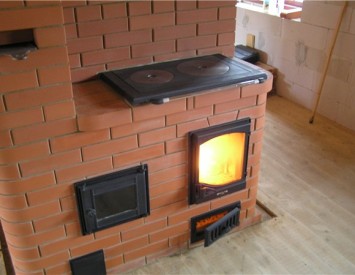
In conditions of lack of gas and interruptions in the supply of electricity in some regions, the wood-burning furnace remains the only alternative not only for the heating of the room, but also for cooking. A solid fuel furnace, which is equipped with a hob, should have a special design. Just make a sheet of metal to a conventional plate and try to cook on it - do not work out. The fact is that the release of heat when burning solid fuel in various parts of the furnace occurs unevenly, so cooking on such a stove will not be too comfortable and productive. A special problem in the use of such heating devices occurs in the summer, when the furnace should give more to the cooking surface, and not heat the room. Otherwise, the kitchen on hot days will turn into "hell".
Content
Currently there are a large number of projects of solid fuel furnaces, which are adapted for cooking. Each experienced Licker offers its design, but it often happens that it is not tested by time and cannot give good results. On how to choose a project of a cooking solid fuel furnace and to mount it yourself - further in the article.
Types of cooking furnaces

Due to the problems with temperature control, the cooking furnaces on solid fuel are found only in places where there is a problem with the coolants traditional for these purposes. For cooking, as a rule, the furnace is laying out so that it has a small niche under which the furnace is located. In the summer, when the furnace is not completely warmly focused on the cooking surface, which allows to reduce the heat transfer in the furnace channels so as not to heat the room. With the onset of cold weather, thermodynamic resistance is shifted towards the furnace channels, due to which the heating of the room itself occurs. When using an oven as a heater, the amount of fuel used allows you to warm up the cooking surface for comfortable cooking.
The most common models of cooking solid fuel furnaces are Swedes. They are laid out of refractory bricks with a complex channel system that allows you to more rationally use heat.
According to the manufacturing material, the most popular species are ovens of heating and cooking bricks. However, more advanced metal models have recently appear. Thanks to the combustion system of pyrolysis gas, which is allocated when the fuel is heated, the operation time of such a furnace on one load increases significantly. Due to the normal distribution of heat, the efficiency of such furnaces is quite high, which allows them to be used for both cooking and heating the room. When building a heating-cooking furnace, a slightly smaller amount of chamotte bricks is used in the total mass of materials. The fact is that chammatory brick has a very greater heat capacity and small thermal conductivity. Because of this, it works as a heat accumulator, which is very good for heating stoves and not too for heating and cooking.

In addition to the material from which the furnace is constructed, these structures are divided according to the degree of mobility.
- Stationary furnaces. As a rule, stationary ovens are embroidered from refractory brick indoors. Build such devices on a separate foundation, so they are worth it for a very long time. The advantages of stationary ovens are their high efficiency, as well as the strength of the structure. However, they are pretty bulky and occupy a large area.
- Transported. Such furnaces can be transported by their place to place without the analysis of their main design. Usually manufactured from steel. The essential advantage of transported furnaces is their mobility. If necessary, they can be delivered and installed anywhere. Among the disadvantages, large ovens, which do not allow you to carry them without special lifting mechanisms and trucks.
- Collapsible furnaces. Also mainly represented by steel models. Thanks to the collapsible case, it can be easily transported and installed even on an unprepared place. The disadvantage of such furnaces is their low efficiency by facilitating the design.
The cooking surfaces of any furnaces are made of ferrous metal. In order to prepare food and warm it, various temperature modes are needed. It is achieved by the use of different metals for the cooking surface. It is made of cast iron with special steel inserts. Since cast iron has a lower thermal conductivity, it is used only for heat heating. In the cast iron plate make special holes in which steel rings forming burners are inserted. The heat conduction has become much more, due to which the surface of the burner is heated much more intense. Due to this, the mistress has at least some kind of temperature adjustment.
Swedish heating and cooking furnace

A distinctive feature of the Swedish is the presence of an oven. Noteworthy remains the development of this design in the 18th century, Swedish academicians were engaged. The oven in such furnaces is a kind of switch from winter on a summer course.
The oven in the design of heating-cooking stoves acts as an aerodynamic barrier for waste gases that are raised from the furnace. Due to this, they are completely roasted under the arch of the furnace and go to the channels of the furnace with high temperatures. That is why, in such furnaces, you can arrange a double wall outside the oven, in which you can place heat exchangers for water heating.
In Swedish furnaces in winter, the cooking surface is not heated excessively, which allows you to prepare normally. In the summer, due to the placed oven, the hot gases do not fall into the channels of the furnace, but only heating the cooking surface, which increases its efficiency. This is achieved thanks to a small fuel tab.
When using this furnace, it is necessary to take into account the fact that each of the burners is heated unevenly. That of them, which is directly above the furnace, heats up much stronger, and is suitable for frying, the second is perfect for cooking.
In winter, such a furnace works perfectly on any form of solid fuel, both on firewood and on coals. But in the summer period it is better to use small portions of coal or wood briquettes. The firewood is not too suitable, since the dried material burns too quickly, giving less heat, which leads to a large fuel consumption. With the right masonry and design of the Swedish furnace, the room in the summer is heated no more than when using gas.
One of the main stages of the construction of a Swedish furnace is the fill of the foundation. Since the weight of the furnace is rather high, over the construction of the base must be worn. A cement-sand tie is built into the flooring flooring. A layer of asbestocarton is laid on the screed with a thickness of at least 4 mm. It should go to the oven: from the side of 300 mm, from the front side (before the furnace) at least 600 mm.
Then the foil layer or thin galvanized sheet is stacked, and a layer of asbestos or mineral cardboard is again. Then the layer of roofing iron is stacked, and on it - felt. Before laying it, it is necessary to soak in the clay milk - a liquid clay solution. He serve as a kind of protection against heat loss.
The laying of the heating and cooking furnace is made in several levels, each of which has its own scheme.
For the construction of medium "Swedish" will need:
- Brick full-time M150 - about 600 pcs.
- The clay and sand mixture for oven masonry is about 200 kg.
- Steel corner 40x40 mm - 2 m.
- Steel strip 50 mm width, 5 mm thick - 1 m.
- Roofing sheet.
- Flat slate sheet.
- Special furnaces (grate grid, doors for fuel and cleaning chambers, valves, cooking surface, burner).
Simple heating and cooking oven with your own hands

Such structures do not have special gas feeding channels, therefore are not suitable for the heating of the room. Usually they are built on dachas, country houses, which have summer kitchens.
Thanks to such a design, you can save a brick to significantly. For all construction it will require no more than 250 pcs. Taking into account the stock in case of battle. The weight of this furnace is not too high, which does not imply an additional burden on the foundation of the house. When building a furnace only for cooking, refractory layers of the foundation are in a different order. The first layer fit felt to which steel is stacked. On the steel sheet and start laying. Asbestos in this case is not too suitable, as it has a bad clutch, because of what the stove can simply "go."
This design perfectly warms up the oven, in which you can even bake pies.
Due to the good efficiency in such a furnace, you can install heat exchangers for water heating. In the houses, which sometimes plan to stay in cold times, you can install a heating flap that will contribute to the distribution of heat inside the room.
Design of cooking furnaces
Although, at first glance, the construction and design of the cooking furnace is not difficult, the matter is not quite easy. Without knowledge of thermodynamics, the conditions of combustion of one or another fuel, to draw up such a project will be problematic. For each individual house, it is necessary to make its conditions so that the combustion of the fuel gave the maximum return. That is why the typical projects of solid fuel furnaces, which can now be found in the literature, may not be suitable for a particular home. It is better to contact your experienced burning with this problem, then you can be sure that the oven will work for a long time, efficient and safe. When preparing projects of heating and cooking furnaces, it is necessary to know all the rules of SNiP, so that the house is commissioned not to have problems with the controlling authorities.
Heat and cooking furnaces: Photo