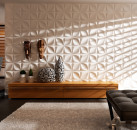
Repair in the kitchen is a troublesome business and at the same time enjoyable. In order for after the work carried out, it became a favorite place to collect the whole family, it is worth considering the decoration of the walls with full responsibility, since the specifics of the kitchen work involves the mode of elevated temperatures and humidity. Thus, if you gathered the walls of the kitchen wallpaper, you will need a finishing material of suitable quality. Improving the idea of \u200b\u200blife, you can achieve excellent results for decorating the premises. In such an arrangement, it will be nice to cook, as well as gather at the kitchen table to have a cup of tea or coffee and chat.
Content
How to pick up a kitchen wallpaper
With the help of a well-selected this finishing material, it is easy to give the interior design of the kitchen room uniqueness and originality. Competent design of a kitchen wallpaper will help to hide small irregularities of the walls of the walls, will enter the kitchen interior of the notch comfort and comfort. Thanks to the rich selection presented on sale, it is easy to choose this finishing material so that the most successful way and with low costs to use the wallpaper for the kitchen in the interior of a particular room.
Useful advice
When selecting wallpaper for the kitchen, you should proceed from their practicality. If you are actively cooking in the kitchen, it is unlikely to be expected that the wallpaper will remain perfectly clean, as the kitchen evaporation, oil, oil and soot can leave their traces on them. If you separate the kitchen not too suitable materials, they will have to be changed shortly, clouded new repairs. Therefore, it is worth picking up dense, mechanically resistant to mechanical impacts that are not disturbed, vapor-permeable and moisture-resistant wallpapers (withstanding wiping with a moistrated with a sponge or tissue napkin). It is also desirable that they are washing (for such wallpapers is allowed repeated washing, including with the use of household chemicals). Supervisory wallpapers are also available - such kitchen wall covering withstands even brushing.

Next, it will be necessary to decide on the design of wallpaper - pick them up so that they harmoniously looked in the interior of a particular kitchen room. Designers do not advise in the interior of a small kitchen to use dark color wallpaper and with a large pattern, since such a color color can additionally optically reduce the room. To enlarge the room, it is worth choosing a light shade cloth with a nonsense pattern. If the kitchen goes north, wallpaper is suitable in warm colors. If desired, the kitchen walls are easy to separate with wallpaper, which can be repeatedly repainted in different colors. It is quite original to combine the wallpaper in the kitchen, it is easy to zonate space with it, highlighting a comfortable working and cozy dining area indoors.
Before buying a finishing material, it is recommended to verify the number of the party - it is desirable that it be the same for the same type of rolls, since the products from different parties can significantly differ with shades.

Wallpaper varieties for kitchen
The following types of wallpapers are presented on sale:
- paper - are the cheapest and short-lived. As the advantages of such a finishing material, it is worth mentioning environmental friendliness and high air permeability. Paper wallpaper with impregnation or minimum vinyl layer is suitable for kitchen room with minimal load, otherwise, under the action of steam and kitchen contaminants, such a finish will be unfasteless enough. Before sticking, such wallpapers will be required to highlight the walls, since thin paper canvases may emphasize the existing surface defects;
- vinyl - these wallpapers are a polymer coating for walls, applied to the base of technical paper or phlizelin. Vinyl wallpapers provide ample opportunities for decorating the kitchen room, while wear-resistant and durable, not exposed to burnout, do not absorb moisture, it is easy to wash them away from any contamination and stains with various household chemicals, sponges or brushes. Wallpapers with vinyl coated on a nonwoven fliesline basis do not give shrinkage on the walls, since phlizelin is distinguished by significant elasticity. By purchasing vinyl wallpapers with micropores, you will get washing and "breathing" coating for walls, characterized by increased breathability and at the same time not absorbent moisture - thus, the condensate will not be accumulated on the walls under these wallpaper and the mold will not appear. If you are going to glue cheaper, not "breathable" wallpapers, the wall will be pre-treated with a special antifungal impregnation;
- glassworks under painting will give the wall the desired texture and relief, they can be painted into any colors like. Such wallpaper looks stylish and effectively, with vapor permeable, differ in moisture and fire resistance, durability and durability. As the backs of such a decoration of walls in the kitchen, wallpaper can be mentioned that it is almost impossible to separate this coating;
- fliseline wallpaper is made of acrylic and polyester with the addition of natural compressed cellulose fibers or viscose. Such canvas are easy to glue and help to hide some surface defects. Flislinic wallpapers for kitchen are distinguished by moisture resistance and fire resistance, high elasticity and almost not exposed to strain, provide reliable sound insulation. If you are tired of the color of the walls in the kitchen, it will be easy to update, since the phlizelin wallpaper is maintained to 7-10 staining cycles;
- liquid wallpaper - appeared on the finishing materials market relatively recently, and are a textile coating consisting of various threads and fibers (cotton, cellulose, viscose, acetate silk, etc.), as well as adhesive composition. Decorating the kitchen with liquid wallpaper allows you to create various patterns on the walls - such a coating is applied to the walls like plaster. With this finishing material, it is easy to treat walls with a complex relief, hide any cracks and smooth out the irregularities of the walls without leaving the seams. Liquid wallpapers are characterized by high heat and soundproof properties, dust are not attracted, it is easy to wash them, moreover, if necessary, a fragment of such a finish is easy to replace. The advantages of using liquid wallpapers for the kitchen should include their wear resistance, a wide selection of colors, and with all this quite a democratic price;
- bamboo wallpapers are made of dried bamboo planks, which are attached to the tissue base with the help of special glue or seams from natural or piping threads. Such wallpapers do not paint in order to preserve the natural view of the surface of the bamboo. Among the advantages of using bamboo wallpapers in the kitchen, it is worth noting their resistance to temperature drops and inherent in the kitchen of the high humidity regime, the ability to absorb noise, strength and durability. Bamboo wall covering does not fade in the sun. Such wallpapers are antistatic and do not accumulate dust, which is especially important for people with a tendency to allergies.


How to salary kitchen wall wallpaper
To understand independently in the intricacies of the process and learn how to shove wallpaper in the kitchen is not too difficult. Decorating the walls of the kitchen room in this way it is quite realistic to do with your own hands. It is convenient to do this together by enhancing the support of the helper.
For kitchen pasting, wallpaper may need the following tools and materials:
- putty knife;
- scissors;
- stationery knife;
- roller;
- painting brush;
- construction level or plumbing;
- simple pencil or marker;
- primer liquid;
- wallpaper glue;
- pure rag;
- wallpaper.

Preliminary preparation
In order for the wallpaper to keep the walls as much as possible, it will be necessary to pre-prepare the surface surface. To do this, it is necessary to get rid of the old finish, including wallpaper residues - if they are firmly glued, they are recommended to moisten with a roller or brush and after softening remove the metal spatula. It will also be necessary to consider the plaster and turn the walls from the surface, as well as close the small potholes and cracks with the help of starting putty, deep - cement-sandy solution. Then it will be necessary to wipe the walls from dust with a wet tissue napkin and wait for their bur. After that, deep penetration fluid is applied to the walls - this measure will prepare a base for watering with wallpaper and will further avoid the appearance of fungi and mold under them. After that, it may be necessary to align, processing the surface of the kitchen wall with a layer of putty with a thickness of 1-2 cm - the plane of the walls should be checked using the construction rule or a long wooden rail. The total surface under the flooding wallpaper should be dense and solid. Align it to the perfectly smooth condition, most likely, you will not need, since most types of wallpaper for the kitchen will completely effectively hide small defects and eye errors.
After drying the walls, it is necessary to carry out a vertical line on the surface of the wall on the wall surface, which will be necessary to navigate when sticking the first wallpaper panels. Airproof wallpapers can only be glued on completely dry walls. To verify that they are completely dried, you can stick a small piece of polyethylene on them at night. If there is condensate under it, it means that it is necessary to wait until the final drying of the walls.

Next, you need to prepare suitable glue for wallpaper. It should be borne in mind that for each of their species, a certain adhesive composition may be required - the quality of the shocking of wallpaper and their further operation will be dependent on its proper selection. It is important to note that glue for conventional paper wallpapers will not suit, for example, for glasses, since such a textured wall covering is characterized by a large weight and for its high-quality clutch with a wall will need to be applied to another adhesive composition. For bamboo wallpaper, the glue "Liquid nails" is suitable or a special vinyl adhesive composition, to fasten them on the surface of drywall, chipboard or fiberboard, you can apply a stapler, as well as decorative nails for wallpaper. Typically, manufacturers offer specially balanced wallpaper adhesive under a certain type of finishing material. Carefully read the instructions and follow its instructions in the process of cooking the adhesive mixture.
Wallpaper Waters
Many masters begin to glue the wallpaper from an angle, online either with a small gap compensating for the coincidence of the pattern on the canvases. Some professionals also recommend glue wallpaper, starting with the walls most removed from the window opening, gradually moving towards it. At the same time it will be necessary to avoid drafts, as well as direct sunlight on the walls, close all windows, turn off the fans and air conditioners. If you have chosen glass, then you will need to protect yourself from getting into the body of glass particles - for this you need to wear clothes with long sleeves, as well as protective gloves.
You can measure the wallpaper directly on the wall or on the table, the floor, not forgetting to leave a small allowance (about 10 cm). If you want to choose a drawing in height, the wallpaper is dismissed taking into account the pattern of the pattern (step of a repeating image). The number of bands must be counted taking into account the joints, protrusions, niches, as well as, if necessary, selection of the picture. The sliced \u200b\u200bcanvas are folded into the stacks with a slight offset.

Next, for salable walls of the kitchen wallpaper, you will need to perform the following steps:
- application of glue - the quality of wall gluing will largely depend on this stage. First, the glue is applied to the wall under the first cloth. Read the information specified on the packaging of the wallpaper used. Sometimes the glue mixture is missing only the walls, in other cases it is necessary to be treated with glue surface, as well as the wallpaper canvas;

- walking on the stepladder, the prepared bands are laid onto the walls and rolling with a roller or a spatula from top to bottom and defects with smooth movements to remove air bubbles from under them;
- the edge of the clouds at the ceiling is necessary to complete a slightly token so that the glue does not blurred the wall. After that, you should press wallpaper to the wall and smooth them with the help of a brush. If the plinth is not previously dismantled, downstairs laid in the joints between the plinth and the floor;
- speaking at the edges of the wallpapers surplus glue, it is necessary to safely remove with a clean dry cloth or a sponge;
- in places with a complex relief (for example, in niches), cuts should be made on the wallpaper for bending them from above and below. The canvas wrap in the right places and tightly pressed for reliable gluing, excess material is gently cut off;
- by gluing the canvas, it will take to crop hanging edges of the finishing material using a sharp knife or scissors. At the same time, it is necessary to try to slice to be as smooth as possible and smooth.


Special attention in the wake-up kitchen will require hard-to-reach places. The heating radiators are recommended to start the wallpaper canvas for no more than 20 cm below the top of the batteries. To press wallpaper to the wall in hard-to-reach places, it is convenient to use a narrow roller with a long handle. Switches and sockets before the walls of the walls are pre-dismantled, the wallpaper canvases are gluing from above - and waiting for the adhesion of glue, gently cut the necessary holes with scissors. After completing the work, the sockets and switches must be screwed into place.
Applying liquid wallpapers for kitchen walls

Liquid wallpapers are perfect for the conditions of the kitchen room - such a seamless durable surface will look in it harmonious and original. Technology of wall decoration with liquid wallpaper is simple. First, it is necessary according to the instructions to dilute with water dry mixture, mix thoroughly and leave for swelling within a few minutes. Next, the prepared mass with the help of a wide spatula is required to apply and distribute on the surface of the walls. In case of damage to the section of such a coating, you will need to apply a small amount of this mixture.