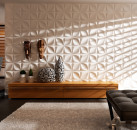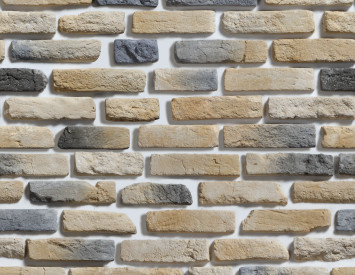
Stone is one of the best finishing materials, which is still used quite often. Often, the stone will use for the decoration of facades, fountains, the porch, as well as other objects located outside the domestic dwelling space. The thing is that this natural material is best combined with other objects. Moreover, over time, the stone begins to turn moss. This creates a peculiar atmosphere, which is difficult to implement by many specialized materials.
Content
However, today we will talk about decorative stone, which is often used within the dwelling. Given that this material is artificial, you can get a variety of product variations. Thus, we can transform the living room, make it colder, or vice versa - warm and attractive for residents and guests of the apartment. In the home interior, the stone can be used almost everywhere, especially if this product has a neutral appearance.
In this article we will talk about the use of decorative stone for finishing the kitchen walls. The trend on such design solutions appeared relatively recently, but it has already managed to conquer the hearts of many owners of apartments. The thing is that with the proper approach, we receive a really unique design in which the stone emphasizes the solidity and irrevocability of the kitchen space.
Features of the use of decorative stone for wall decoration
Many people mistakenly believe that on the basis of decorative stone there is only a couple-triple wall finishing options. However, it is completely wrong. You can find hundreds of sites on which thousands of wall finishing options are represented, and this is without the slightest exaggerations. The thing is that on sale you can find a huge number of diverse decorative stone. Accordingly, we have the ability to create an original design using one or another form of stone, its color, as well as a unique texture.
Also, many think that when finishing, you need to cover the entire wall with a stone. Obviously, this is a serious misconception, as it is more expedient to produce stone installation only in separate parts of the wall. This will allow emphasize the subtlety of the designer solution being created. However, there may be exceptions. It all depends on the selected design or scope of work.
As for the living rooms, here decorative stone often emphasizes fireplaces, aquariums, doorways, as well as places where houseplants are located. Approximately the same way you can decorate any other object located in the room. The main thing is to do it in moderation not to spoil the room.
There are some limitations of the use of decorative stone, and first of all it concerns the kitchen. The bottom line is that the narrow rooms are very poorly combined with large decorative stones. In such cases, it is better to restrict ourselves to the usual finishing materials. A large stone in a modest room can significantly reduce the space (visually), after which the room will look even more compact, and, consequently, uncomfortable and limited.

Advantages and disadvantages of decorative stone
Positive sides:
- Original appearance. It is quite possible to talk with the manufacturer about the creation of a decorative stone on the basis of its own ideas. This is a great solution, as in the end we can get the unique style of the kitchen. In any case, each company has a huge catalog, which presents a variety of varieties of decorative stone.
- Strocessability. Even a decorative stone, in contrast to many other finishing materials, practically does not respond to strikes. On the material there is no scratch, nor dents. Even if the stone succeeds to damage, this is not an appearance of the room will not affect. It is likely that some people will perceive damage as a good designer move. Surely in this and there is the main advantage of the stone - it looks great in any condition.
- Ecology. Obviously, the stone is a safe material that can be used in completely different rooms. This can not but rejoice, since many finishing materials have many drawbacks in this matter.
Negative sides:
- Life time. In this case, many compare the decorative stone with natural material. Indeed, artificial stone will last much less than the present. However, it should not be thought that the service life is too limited. It can be dozens of years, while natural stone has no restrictions in terms of use period. But do not forget that natural stone is not so cheap.
The remaining flaws of the decorative stone are not so serious. However, it must be said that in many respects the artificial product is inferior to natural stone, and it must be remembered.

Preliminary surface treatment
Before starting laying the decorative stone, it should be borne in mind that we first need to qualitatively treat the surface of the wall. At this stage, the process does not differ from the fact that we have during the cladding of the walls with ceramic tiles. Accordingly, first need to align the surface of the wall.
Since we are repaired in the kitchen, you need to keep in mind that it is necessary to submit to alignment, not all the wall, but only those sites that will be separated by a decorative stone.
At the same time, many builders admit some curvature of the surface (small), which positively affects the final result of the work. In addition, you need to pay attention to the strength and reliability of the wall, since under the weight of the stone, the created finish can simply collapse.
First you need to turn plastered walls. It is recommended to use reinforcement in the form of a construction grid. Such a decision will significantly strengthen the wall. Accordingly, you can not be afraid about the weight of stones, there should be no special restrictions in this regard.
You can also take the wall with plasterboard, but the thickness of the material should not exceed 12.5 mm. Material sheets should be attached immediately in three places, it will significantly increase reliability.
As for the fastening of the decorative stone itself, it most often for this is used tile glue, which without problems keeps the considerable weight of the material. You can also look at the silicone glue, which has recently been activated in construction more and more. Special efficiency is distinguished by liquid nails. Many people know that this glue is practically tightly attached by certain construction elements, so no restrictions in terms of using liquid nails can be.
In many cases, it is possible to observe the use of a classic cement solution. It is also a good option, but only if the stones used in the process are relatively small. Often, various plasticizers add to the mixture, as well as PVA glue (construction). This solution significantly increases the strength of cement. If everything is done correctly, then the solution is obtained homogeneous and sufficiently thick.
Other preliminary actions:
- It is necessary to create a small sketch, with which we will approximately navigate with the existing volumes of work. Obviously, it is better to take care of this in advance, as the amount of the necessary stone, as well as building materials depend on it. Also at this stage you need to decide exactly what kind of finish will have. In some cases, the stones are embedded, and sometimes a small seam is created. Much depends on this, for example, the number of stones required. If we speak frankly, then the second option looks a little more pleasant outwardly. Moreover, it is really a reliable option for fastening the stone on the wall.
- Also, the sketch will not prevent transfer to the wall itself. It should be borne in mind that here the most important thing is the accuracy and correctness of the application of all components of the finishes, otherwise unexpected problems may result in the process.
- It is also necessary to limit those places where the wall finish ends. For example, in the area of \u200b\u200bthe decorative stone plinth should not be, so you need to create a small border in order to prevent an error. Often, special profiles are used for this, which are located around the entire workspace. With this scenario, it will not be wrong. Profiles are attached directly to the wall, and after the end of the work they can be easily removed.
Next immediately proceed to the wall decoration.

Decorative Stone Wall Decoration
In this case, the minimum of the necessary tools and materials will be required. First of all, we are talking about the spitel, with which we will apply cement mortar on an artificial product.
In the event that the stoning of the jack occurs, it is necessary to tightly press the building items to each other, while you can turn the stone slightly so that it is tightly settled in a particular place.
If it is decided to create a small seam between the decorative stones, it is best to use plastic crosses. Surely many used such during the masonry of the facing tiles. Here everything is approximately the same, but the size of the cross should be larger, otherwise it will not be very harmonious. Of course, it should be monitored that the distance between the stones is the same, otherwise it will negatively affect the overall composition.
The process of finishing the wall with decorative stone begins with the very first row, which should be located at thenime. Accordingly, for a start, it is necessary to apply cement mortar to the width of the row.
Subtleties of the styling of decorative stone:
- It should be borne in mind that the decorative stone often resembles a brick, so the laying must be made approximately by the same principle. Accordingly, the rows are located with a slight displacement, which looks very good within the dwelling.
- If the decorative stone resembles natural material, it should also be separated by a small displacement wall. It should be borne in mind that the dimensions of the elements of a number must be approximately the same. Only in this case can be confident in a qualitative result.
- Often it is required to cut a stone. Here you need to use the most ordinary grinder. In this case, it is necessary to ensure that the cutting of the material does not affect the overall decorative component of the created finish. It is advisable not to resort too often to similar manipulations, since the appearance of the finish can change significantly.
The stone is put on with rows, but it should be borne in mind that the prepared cement mortar is enough for about 15-20 minutes, and then it becomes unsuitable for use. Therefore, cement should be missed by small volumes.

It is especially serious to treat the laying of a decorative stone with a lot of weight. In this case, the rows can be somewhat shifted under the action of large weight of the material, so the process must not be carried out too quickly. It is best to make a laying of two rows and stop. Already later, when the cement is collapsed, the process can be continued.
After the laying of all rows of decorative stone occurred, it is necessary to wait for some time before the cement solution is dry. Often it takes 2-3 days. Further, you can safely remove the subference profile that kept the first row, as well as the crosses necessary to create seams.
Accordingly, the last stage of work is putting seams. To do this, it is best to use the grout of about the same color as the stone. Material application occurs with the help of a sponge (the easiest and most reliable option). Of course, it is impossible to allow the presence of no gaps or lumen between the stones. Also does not prevent primer to the decorative stone, since this material is not protected from external negative effects.