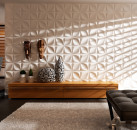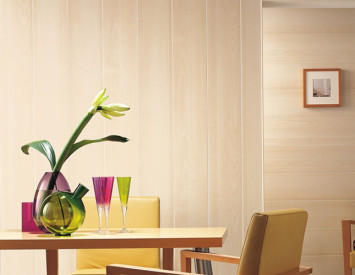
The kitchen panels are a popular and easy-to-use finishing material, with which you can decorate the walls and ceilings of the kitchen room. Thanks to excellent decorative properties, high functionality and accessible to most consumers, such panels are widely used to perform repairs, including economy class. They are easy to mount and dismantle, and can also be used again elsewhere. With the help of finishing, the panels are easy to transform the kitchen interior at will.
Content
Advantages of kitchen panels
Thanks to the largest assortment of finishing materials, a lot of discerning options for decorating the kitchen room. Among them are especially popular with the kitchen panels, because such a decoration of the walls and the kitchen ceiling is very practical and functional.

Thanks to the presented variety of colors and textures, suitable panels can be selected for any interior design. With their help, it is easy to perform high-quality cosmetic repair of the kitchen room without special financial investments. You can install the ceiling and wall panels for the kitchen quickly, it will not be necessary to apply special equipment. In addition, no longer preliminary preparation of walls in the form of removal of old finishing, leveling and priming will be removed. Experts are not recommended to combine simultaneously wall and ceiling finish with panels, otherwise associations with stay in a close box may occur indoors.
The kitchen decoration panels looks very aesthetic and will last long enough. When using its sound insulation of the kitchen room increases significantly. To finish the walls in the kitchen, the panels do not need special care, sufficiently rinse them from dust and contaminants. Due to the significant surface area of \u200b\u200bthe panel, using this material is easy to perform finishing works in a short time.

Varieties of the panels for the kitchen
Currently, the following varieties of kitchen panels are presented:
- plastic - they are made of solid polyvinyl chloride (PVC) with a minimum of softeners. PVC panels are inexpensive and practical finishing material for designing the interior of the kitchen room. Panel data differ in low weight, moisture resistance and durability with careful operation. Such panels are easy to cut and conveniently mounted. It is worth noting that the plastic panels are melted with high-temperature exposure, so they should not be placed near the cooking surface, in addition, this finishing material can be damaged due to mechanical exposure. It should also be taken into account that the plastic panels are not recommended to be brushed with abrasive agents. Due to the wide range of color scheme, you can choose the colors of PVC panels for every taste. The drawing on this finishing material is applied by printing and covered with a special protective layer. On the top on the panel can be applied by a matte or glossy varnish coating. PVC panels with photo printing are very spectacular;
- wooden panels, as well as veneer veneer, are quite expensive finishing material. To make moisture resistance of the wood panel are etched and treated with special wax either varnish. As the basis of veneered panels, inexpensive wood (for example, pine) can perform, it is covered with veneer from the wood of more valuable rocks, then the facial coating is fastened with the basis of the pressing method, after that the panel is polished and varnished or wax. In appearance, veneered panels are difficult to distinguish from made from natural wood - you can find the difference only with enough close examination. These types of finishing material are characterized by environmental friendliness, as well as high price;
- panels made of chip material (chipboard and fiberboard) are manufactured by pressing from sawdust and wood chips or wood and vegetable fibers - with the addition of special binding chemicals. Wood-chip panels are covered with varnishes that protect them from moisture exposure. This wall finish can be washed. It should be noted that this finishing material does not differ in significant strength, in addition, it is not necessary to establish such a finish in places where its direct contact with water is possible;

- panels from MDF - are made by pressing with high-temperature heating from fine-sided wood chips, i.e. In fact, the wood is distinguished from wood dust, while the wood highlights the lignin, tightly binding the mannerly manufactured by the stove. As a result, dense and durable, with natural composition, finishing material is formed. The kitchen finishing of the MDF panels can withstand significant loads, provides high-quality heat and sound insulation. When heated, the panel data is expanded, but slightly compared to the Fiberboard. This finishing material is profiled, i.e. Equipped with special grooves and spikes suitable for easy assembly, it is easily in handling (panels can be cut, while they do not crumble and do not break), the convenience and practicality of operation. With this finishing material is easy to hide the errors of the walls. In addition, it is worth considering that when installing such panels, it will not be necessary to remove the old wall decoration in the form of wallpapers, paints or plaster. To finish the kitchen, use moisture-resistant panels from MDF. Laminated or painted variants of similar products are available on sale, as well as veneer-covered, in a variety of shades and with different drawings. The decoration of the kitchen panels under the tree or marble is widely popular;
- glass - Data panels for the kitchen are made of durable tempered glass with a thickness of 4 mm, resistant to the effects of temperature drops. Wall panels made of glass are shockproof, able to withstand various mechanical loads, as well as the effect of aggressive chemicals. Another bonus of the use of glass is that kitchen contaminants do not accumulate on the smooth surface of such panels. During the operation of this finish, it should be noted that the glass panels are not recommended to be cleaned by abrasive means, in addition, a direct effect on them is not allowed. As a lack of use in the kitchen of glass panels, some hostesses mention that they remain spots from entering water droplets. So that in the future I did not have to wash such a finish of the walls, you can buy glass panels with a matte surface, on which the traces of moisture are noticeable.

Featuring the appropriate material, it is easy to complete the kitchen ceiling finish with panels, as well as walls yourself. Selecting the appropriate panels, you should ask the degree of moisture resistance, and also pay attention to the method of their attachment. In addition, it is necessary to look at the texture of the material and the quality of the pattern. Products are available with glossy or matte surface, smooth or embossed. The price of the kitchen panels is quite affordable for a wide range of consumers. The most successful option is to purchase this finishing material together with the necessary component fasteners - in the form of hardware, corners, rails, clamps, etc.
Methods of fixing panels
Consign the panels on the base surface can be using various techniques. When choosing a method for performing work in the first place, it should be repeated from the material of the manufacture of panels, as well as on the specific status of the walls.

For fixing panels, you can apply the following ways:
- if there is a smooth base surface under the final finish, you can carry out the mounting panels with a slight weight with the help of glue for the Fiberboard and MDF. For this, the adhesive mixture is applied from the wrong side of the panels, and then fix them on the surface of the walls;
- mechanical fastening on a pre-mounted wooden crate using curls or brackets. The fixation of self-drawers is quite strong, but due to the high humidity and temperature drops in the kitchen room, the surface of the panels may be expanded and deformed;
- ease of implementation, the most progressive method of attachment of panels is distinguished by at the moment - with the help of curvators to the plastic crate. In this case, the finishing material is fastened to the frame of plastic. If necessary, they can be dismantled, after that such a crate and finish can be used elsewhere.

How to mount the kitchen panels yourself
Consider how to install in the kitchen yourself panels from MDF on a wooden crate. Such finishing works can be made without preliminary skills.
First you need to choose the most suitable option and buy a kitchen panels. The calculation of the required amount of material should be carried out with regard to the specific width of the walls (it is recommended to purchase a finishing material with a small reserve). In addition, it will be necessary to prepare wooden bars of 20x40 mm for facilities on the walls of the crate frame, liquid nails, as well as additional and fastening elements - corners, plinth, dowel, self-tapping screws and beammers.

Next, you will need to perform the following sequence of actions:
- Mount the wall horizontal crate. To do this, determine the most protruding part of the wall, drill on the sides of the hole with a drill, insert the screws into them and pull the rope between them - it will be necessary to navigate it in the future when installing the crate.
- Next, it will be necessary, applying a wooden bar to the wall, drill holes in a half-meter step. Having reached the wall, the bar is laying off and drill holes further deep. Inside they need to insert a dowel, and then attach the bar to the wall and consolidate it with the help of self-tapping screws. In this way, it should be sequentially fixed on the walls of the rail, ranging from the floor, with a step of 50-60 cm.
- The panels are mounted from the angle - this is allowed to reduce the cost of cutting material. The first panel is deployed with a spike toward the angle and set at a distance of 2-3 mm from the beginning of the wall. At a distance of 1 cm from the edge of the panel, it is necessary to consolidate it on the crate of self-drawing.
- Next, it will be necessary to mount a panel at a perpendicular wall symmetrically, having it also spike towards the corner. Subsequently, the slot between these elements of the finish will be required to cover with a decorative corner.
- From the side of the grooves, the panels should be recorded with the help of pre-fixed on the crate of small cloves of curvators.
- Next, inserting the spike subsequent panel in the grooves of the previous one and fixing the grooves from the grooves, it is necessary to assemble a one-piece wall structure.
- The last panel is most likely necessary to fit into size - for this it is necessary to cut it off, and then fix it with self-drawing from the corner.
- Next, it will be necessary with the help of glue to fix a decorative corner at the junction of the walls. After grazeing the glue, it should be removed by a bump.
- After installing the panels, you can start the installation of the plinth.
Kitchen panels - Photo