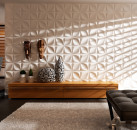
The diverse range of biocamines allows you to add any interior today, whether it is a cottage, an apartment or an open gazebo. However, the choice of a fireplace is associated with certain subtleties, which at first glance seem absolutely insignificant.
Content
Biocamine in the interior
Modern fireplaces are performed both in classical and futuristic design, so you choose the ecocamine, the most fit in any interior, will not work. In addition, the walls of the fireplace are constructed only for security purposes, which allows harmoniously combine glass, ceramics, steel, wood, stone.
Today, even biocamines in the apartment are a frequent decor element. Embedded, wall and desktop fireplaces are in the greatest demand for accommodation in small areas. At the same time, dimensional models prevail for use in cottages, on the contrary.
Types of ecocamines
An important role in choosing a suitable fireplace plays the place of its future location and the area of \u200b\u200bthe room, since when combustion, biofuels are decomposed on carbon dioxide and water vapor. Based on the method of placement, there are 5 types of biocamines.
1. Outdoor - despite the bulky of models, are quite mobile. The lower part of the fireplace is practically not heated, eliminating the risk of damage to the floor covering, so it is freely installed on the carpet, laminate, linolyum.
- wounded biocamines are characterized by the presence of three opaque parties made of stone, ceramics, marble, while the overview of the decorative focus is viewed from the front side. Unlike island fireplaces, have a more stable lower part, so without problems are installed outdoors;

- island - differ in the presence of glass surfaces, allowing you to enjoy the game of fire from any room angle. Among the island type models, quite compact biocamines are often found, which make it difficult to use them in the open space due to poor stability on the uneven surface.

2. Wall biocamines have slightly smaller dimensions relative to outdoor structures. There are 2 subspecies of wall fireplaces possessing:
- the open fuel block - has, mostly, the shape of a shelf, fenced from one or more sides with glass panels or original lattices. However, the extraordinary beauty of this model is associated with a significant disadvantage, since it is necessary to place a wall ecocamine with an open burner at a distance, at least 1 m to furniture, curtains, any flammable items;

- a closed fuel block - located on the wall instead of the picture. They are made in the form of a block of different sizes with a glass or a lattice front panel.

3. Desktop biocamines differ from previous models compactness, the presence of mini-burner. A characteristic feature of such fireplaces is a reliable protection against fuel leakage in case of tipping.

4. Built-in - subject to installation in niche, portals in the presence of a closed vertex produced from fire-resistant tiles or stone.

5. Street - characterized by the presence of a steady base, open space near the burner, allowing to observe fire from either side.

Selecting the heating block
The combustion zone directly depends on the length and size of the heating unit. Currently, there are 2 alternatives to devices that support combustion in biocamine:
1. The burner for the biocamine - is performed as a glass of refractory material.

Advantages and disadvantages:
- lack of restrictions during decorating;
- the ability to create an original shape of the flame by merging in one fireplace of several burners;
- low cost;
- ease of operation;
- fire harvesting occurs through a special blade.
2. Fuel block - produced in the form of a closed block of various sizes.

Advantages and disadvantages:
- the presence of a valve that allows you to adjust the intensity of fire, a fastening means to extinguish the flame, which prevents dust to the fuel tank;
- high price.
When choosing any heating unit, you must pay attention to:
- seam tightness;
- metal thickness;
- build quality;
- the shape and size of the block.
Fuel selection
Based on the model of the device and the design of the heating unit, the fuel for biocamines is produced in two types:
- The liquid composition of ethanol - gained more distribution, due to the lack of soot and the possibility of using in overall devices.
- The gel composition of ethanol is more convenient to use, because there is no unpleasant smell and it is impossible to shed. However, in the process of combustion, nothing is formed, so it is often used in desktop biocamines.
Benefits and flaws of biocamines
Like any device, ecocamine has a number of advantages and disadvantages, especially with respect to the wood chimney fireplace.

Advantages:
- lack of soot, smoke, smell;
- the presence of mobile models;
- moisturizing air;
- visual appeal;
- lack of permits;
- ease of operation;
- no need to redecessing;
- easy installation.
Disadvantages:
- limited work hours;
- slow premises;
- during the ignition there is a smell of alcohol.
Thus, on any biocamine price is under the influence of the materials used in the device, the type of burner and the additional possibilities of the acquired fireplace, for example, the presence of an automatic fuel supply system, carbon dioxide control sensor, remote control. High-quality companies have biofireplaces Autofire, Bioteplo.
Knowing all the details of the constituent elements of the device, choose and buy Bio Fireplace is quite simple.