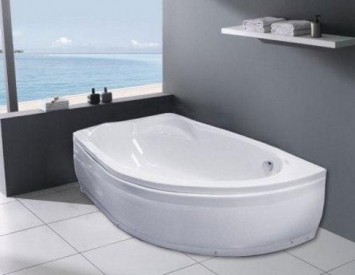
Recently, plastic baths are becoming increasingly popular in the plumbing market. They became a decent substitute for heavy cast-iron and metal models, besides that, plastic baths have one significant plus - low cost.
Content
Advantages
Each product, including plumbing for the bathroom, has both advantages and disadvantages. Therefore, before you go to the store and buy a plastic bath, you need to explore all the nuances.
Specialists in the installation of plumbers recommend paying attention to such advantages:
- compared to metal or cast-iron products, plastic bath is much easier. This largely facilitates its transportation, as well as installation. It weighs almost thirty kilograms;
- the surface of the bath has a special coating that protects against the effects of detergents and mechanical wear. If small cracks and scratches appear, the restoration of the plastic bath can be performed in just a few days;
- unlike cast iron and metal surfaces, plastic does not accumulate dirt and dust, so you do not threaten the reproduction of pathogenic bacteria;
- despite the seeming brittleness, plastic bath, as well as the cast iron, long retains heat. In addition, plastic supports the same temperature as indoors. Water in such a bath will not cool quickly;
- even after a year of operation, stains and divorces appear on the surface of the product, and the bath color will always be clean;
- plastic bath, in contrast to acrylic - absolutely not slippery;
- when water is recruited into it, plastic coating can smooth out extra noises;
- caring for such a bath gives a solid pleasure - it is not necessary to be cleaned by abrasive means, it is enough to walk with a soft cloth moistened in any liquid detergent;
- the product made of plastic has an affordable price. The sale contains a wide selection of baths, both in shape and in color.
Specific features
Buying a plastic bath, you make the right choice. Nevertheless, there are some features of the product operation.
These include:
- Experts do not recommend cleaning the plastic coating with abrasive means (powders), because they can scratch the coating. Alternative powders can be gels that well purify the product from pollution and do not leave scratches.
- Plastic bath fragile. From hitting a heavy item, the coating may be damaged. This is especially true for the rules for transporting plumbing and installation.
- If you pour very hot water into the bath, then it can deform. But this deficiency can be questioned, because the temperature at which the plastic can start melting will not be able to withstand both the person. Therefore, it makes no sense to gain too hot water into the container.
- Also, the plastic bath is not distinguished by durability, in contrast to cast iron or metal, which can serve twenty years. It is true, but with careful operation of the bath, you can increase its service life of up to ten or more.
How to choose a good plastic bath?
Buy plastic bathing container can be in any plumbing store.
When choosing a product, pay attention to such aspects:
- the thickness of the plastic (top layer) should be at least five to six millimeters. If the coating is thinner, then the product can last for a short time;
- look at the edge of the side - if you see a divorce, remotely resembling the log house, this is a layer of reinforcement. The more such layers will be, the more reliable and the stronger will be your bath;
- inspect the inner and then the outer part. On the surface there should be no scratches and tubercles;
- also pay attention to the product color. Traditional coating color - white, it should have a gloss to be uniform with no stains;
- standard bath length of 150 to 180 centimeters depth - 50-60 centimeters, and the maximum height - 70 centimeters. Choose the size based on your height, so you will not feel discomfort.
What are the plastic tubs you can see in the photo:


How to install
Installing plastic tub - the process is quite simple and will not take much time and effort. A bath to put much more easily than cast iron or metal.
For mounting, prepare the following tools:
- a drill and a drill for metal (may be a screwdriver);
- marker or pencil;
- line;
- screws;
- building level;
- isolent;
- plugs;
- sealant;
- metal corner.
Conventionally, the installation plastic tub can be divided into six stages:
- Preparation. If necessary, the first room is dismantled old plumbing and performed walls: glued wallpaper, laid ceramic tile or plastic trim is done bathroom. In addition, should take care to hold the sewer and water pipes. Simultaneously with these works to align the floor and prepare to connect new plumbing sewer drain.

- Anchoring legs. Bath to be made in the room and turn up to attach the legs. For this marking is performed for the metal framework (and it will keep the support). Should withdraw from the sink 15 centimeters (holes) and otchertit marker or pencil line - it will be a guide. The second line is scheduled at a minimum distance from the edge of the font. Then, an electric drill holes are drilled and set screws. They will be supported metal rails. Experts recommend to do so: Take a drill bit, back 5 mm from the edge and wrap duct tape on it. It will serve as a mark, which will provide the desired depth of the hole. When this part of the work will be performed, you need to put on the guide bracket and fix them with screws. Now on the frame can be set in advance collected bathtub feet.

- Collect tube. Together with a plastic tub in the kit includes the pipe. Collect them easily. Usually in the enclosed instructions for details on how this is done.

- Installation. We turn the bath and install it on the legs. So that it is located correctly, you should use the water level. The tool is applied as follows: one end must be separated from the left upper leg, and the second is from the bottom right. The level will show how many millimeters will need to adjust the legs of the bathroom. Similarly, and with the second fastener pair.

- Installation of devices that will not allow the bath to turn over. Such hooks can be included or sold separately. They are fixed to the wall on a dowel, and the bath "is satisfied" right on them.

- Connect to sewer pipes. The joints of the wall and bath must be missed by sealant (for plumbing works). After it serves a bit, you can perform a trial start of the system. If everything is in order and does not flow water - the bath is installed correctly.

Important! If the bathroom will use people who have a lot of body weight, then the bottom of the product must be additionally enhanced by brick masonry.
How to distinguish a plastic bath from acrylic
Most buyers, falling into the plumbing shop, do not know what the difference between the plastic bath from acrylic. At first glance, both products seem absolutely the same, because modern plastic baths are covered with a thin layer of acrylic. Its thickness does not exceed one millimeter, and the upper layer of the acrylic bath is five or more than millimeters. The rest of the bath is made of fiberglass reinforced plastic.
The photo shows an acrylic bath.

When buying a bath, specialists advise to pay attention to the product cut. If you see three or more layer of material - in front of you plastic bath. The first top layer is acrylic, medium plastic, lower - reinforced fiberglass.
Most buyers begin to doubt, acquire or no plastic bath. Often they can even dissuade unscrupulous sellers, arguing that such products are not durable and durable. In fact, it is not.
The product consists of durable polymeric materials, which are difficult to damage. An exception can be a blow to the edge of the bath with a sharp heavy subject.
Also, people say that in case of cracking or chipping, it is better to throw a bath. They are mistaken, because the product is subject to repairs, and the restoration does not take much time and if desired, this work can be made independently.
But the talk about the fact that over time the plastic bath can change its color slightly and lose the shine, are quite substantiated. But this happens if it is incorrectly exploited. It is also possible if the bath was cleaned with abrasive detergents.