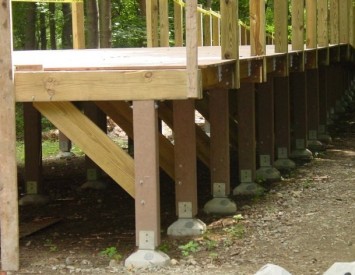
The construction of any house begins with the construction of the foundation, and if you decide to choose a support-columnar foundation, first it is necessary to study all the nuances before starting work.
Content
General characteristics
Most people choose this type of foundation due to its low cost. The price of the supporting foundation is several times less than any other monolithic type. Another advantage is that such a foundation can be easily built with your own hands in the presence of elementary skills of circulating materials.
The support and columnar foundations can be erected on any types of soil, even on bunched soils. This is a universal design, which is distinguished by long exploitation and does not require costly thermal insulation and waterproofing work.

Varieties of supporting base foundations
The material from which you will build a support-columnar foundation with your own hands, you must choose already at the design stage.
Depending on the material, the foundations can be divided into the following types:
- concrete;
- boot-concrete;
- boot-tight
- brick;
- stone.
In some cases, for construction, strong wood rocks are chosen, but the wooden columnar foundation requires special treatment with solutions that protect against rotting and corrosion.
The most common types of columnar foundations are made of bricks and concrete. These are monolithic structures that are not subject to corrosion and have long exploitation. The brick column foundation easily eats about a hundred years, however, this type has its small flaws.
Disadvantages of brick foundation:
- the complexity is the construction of a supporting basement, judging by the reviews, will require more strength and time than the construction of any other type;
- the risk of deformation - if your site is on a very brushed soil, it is better to be a featherfund from concrete or stone, because the brick design may not withstand the soil displacement;
- financial costs - To build a brick-column foundation, it is necessary to purchase a high-quality checked brick, otherwise the foundation will last long.

Also, the columnar foundations can be divided according to the deepebility in the soil:
- the finely remedy is laid at a depth of 50-70 cm in soils with a sufficiently low level of groundwater;
- frozen - relevant for wet bunched soils. Such a foundation must be boiled to a depth of at least two meters.
How to make a refiner foundation
The construction of any foundation should be carried out on a predetermined soil, and the support-column type is not an exception.
The following main stages can be distinguished. Construction of a support-columnar foundation:
- Pre-preparation of a plot for development. Remove the entire garbage from the territory and align all irregularities (hillocks, pits, etc.). If your site is located on the clay soil, it is necessary to provide a gravel intro.
- Marking of the construction site. Mark with the help of pegs the location of each post of the future foundation. Earthworks can be carried out on their own or using a tractor or excavator if there is such an opportunity.
- Installing columns. If the pillars of your foundation are rather short and do not exceed the meter length, dug down to strengthen the recession. If the pillars are long, then you need to drill a well expanding to the top, then install in each of them a few spacers from boards or bars. In order to guarantee the future building from drawing up, it is recommended to make a reinforced concrete "pillow" at the bottom of the pit.
- Production of formwork. The formwork design is made of 15 cm wide with a thickness of 4 cm. To perform a non-removable formwork, it is necessary to build shields from asbestos-cement or iron pipes, the diameter of which will be greater than 10 cm.
- Reinforcement of the foundation base. To reinforce the base base, it is necessary to purchase fittings with a cross section from 12 to 14 mm. Stoping the bars should be longitudinal method using a solid wire to create horizontal jumpers. It is recommended to leave the ends of the reinforcement to 20 cm with no flooded mortar. This is useful for a comfortable ligament of the heads as paint.
- When the armature is connected, it is time to pour the foundation by concrete solution. To prevent the formation of emptiness during the fill, try the mixture most tightly. High-quality waterproofing will also not be superfluous, especially if the house is built on wet soils. As a waterproofing material, the rubberoid is perfect for two layers. For normal and dry soils, one layer of waterproofing will be sufficient.
- Construction of woodwork. Scarlet is the top of the foundation in the form of a plate or lattice, the main task of which is a uniform distribution of the load throughout the area of \u200b\u200bthe foundation. For the construction of a frame on the support-column foundation, make a frame from the reinforcement, connecting the jumpers with the same reinforcement. After creating a frame, install the formwork and fill the concrete into the resulting form. After hardening concrete, Rollock will be ready.
- The final stage is laying a layer of brick. During work, do not forget to leave the openings for communications and ventilation. When the walls of the brick or foam blocks are erected, do not install the elements directly on the poles, otherwise the cracks may occur.
Foundation from pipes
Many prefer to build a dot support-column foundation from pipes, because this method takes less time and does not require any specific skills.

Stages of construction Foundations from pipes:
- drill a well for the foundation, the bottom is thoroughly tamped;
- in the hole of the wells insert pipes with a diameter of slightly less than the level of the well;
- ensure reliable fixation of pipes in a vertical position, falling asleep well with dense soil;
- pour the inner space of pipes to a third of the concrete solution, lift the pipe up so that the solution filled the freed space;
- pour the solution into the pipe again, leaving empty only 10-15 centimeters at the top of the pipe;
- timing the concrete mix in the pipe with a bayonge method, setting the reinforcement rod in the middle of the pipe;
- after a complete pouring of the solution to tie the foundation by attaching the anchor elements to the lower edges of the walls of the walls and immersing them into an unneous cement of pipe space;
- carefully concrete the foundation.
Surface Type of Fundament
Surface support-columnar foundation is suitable for small structures of wood, timber or frame-type houses with a size that does not exceed 6x6 meters. This type is a foundation for the construction of which monolithic concrete stands are used.
Surface foundation can be built on sand or large-grade soil. The pillars are installed on the corners of the house, where the inner walls intersect with outdoor and at points where heavy carriers are installed.

Foundation supports are powerful concrete blocks, the number of which is determined by the characteristics of the plan of the future at home. On each support leaves from 4 to 6 blocks, interconnected using a cement mortar. Dimensions of block blocks - 200x200x400 mm.
There are a number of restrictions for the construction of a surface column foundation from blocks:
- this type of foundation is categorically not recommended to erect on wet and bunched soils or "weak" soils (clay, peat);
- block foundation will not withstand the massive structure;
- difficult covering of the basement under the house, erected on the batch foundation.
As a rule, surface columnar foundations are chosen for building baths or cabins. The construction is pretty simple, cheap and does not require additional waterproofing.