The fire grilled in the fireplace is traditionally the personification of comfort and comfort in the house, the gathering near such a source of heat have a calm conversation and peace. An important step in the arrangement of the family focus is his finish - to create an atmosphere of harmony in the room, you will have to work hard. Imagine a dream to life quite realistically, by completing the work on the facing of the fireplace alone. The finish will help to give a fireplace a certain style and will directly affect the durability of its service.
Content
Popular ways to finish fireplaces
Depending on the style of the interior of the room, your desire and taste, as well as the funds spent, the finish of the fireplace can be strict and laconic, or literally affect luxury. It is worth considering that when choosing a facing material, not only its aesthetics, but also operational characteristics should be guided. It is necessary to choose a material resistant material characterized by high heat resistance and mechanical strength.

Plastering and facing by plasterboard
The simplest and more economical ways of finishing the fireplace are plastering, as well as trimming by plasterboard. Using these finishing materials, you can achieve various decoring effects. Having treated the finishing layer of plaster with a sponge or a wavy spatula, it is easy to create an original surface relief. To enhance the effect, the solution can be squeezed into a suitable shade of water-level paint. To harden the plaster in it add salt and fiber fiberglass.

To bind the fireplace plasterboard, it will be necessary to install a metal framework on which the facing directly will be attached. The benefits of such a finish can be attributed to its low cost, in addition, this method of decorating the fireplace is significantly less labor-intensive compared with the cladding stone or ceramic tiles. Using plasterboard, it is easy to give the design to any desired form. The disadvantages of such a cladding include the fragility of the structure, since this material does not differ by impact resistance.
Stone finish
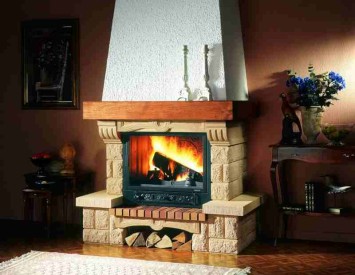
Various types of natural stone are used as the most popular materials for facing fireplaces. This material provides ample opportunities for the implementation of various ideas. Similar finishes of the fireplace looks solid and very aesthetic.

Natural stone is a heat-resistant material, resistant to any mechanical effects and for a long time holding heat. When heated, such a cladding does not allocate any harmful substances for the health, the air in the room always remains clean and fresh. The disadvantages of this type of finishes include its sufficiently high cost.
The following types of natural stone are most popular:
- granite, onyx either marble - such a facing of the fireplace looks solid and noble, characterized by durability and durability. These varieties of stone are characterized by beauty, as well as a unique pattern, thanks to their use you can create a unique interior. It is worth considering that for their processing it is necessary to apply special tools, in addition, it will take the existence of working skills with such material. As a lack of facing of the fireplace marble, its high cost can be attributed;

- sandstone, limestone, the brownstone is characterized by ease of processing, besides it will cost somewhat cheaper;
- talco chlorite or soap stone is widely used for facing furnaces and finishing of fireplaces, as it is characterized by a very high thermal conductivity (2.5 higher than that of the brick), quickly and evenly warms it, perfectly accumulates heat. This material is resistant to melting, it can be used to facing the firebox firebox - such a finish under an older looks luxuriously. It is known that talco chlorite when heating is favorable affects human health.
An artificial stone can also be used for facing the fireplace. It should be noted that according to its technical characteristics, it in many cases is practically not inferior to a natural analogue. Artificial stone looks in the facing of the fireplace very aesthetically, besides, such a finish will cost much cheaper. At home, such a stone can be made from a mixture of cement and sand with the addition of coloring pigment.
Facing ceramic tiles

Various types of facing ceramic tiles are considerably popular for finishing fireplaces:
- mAJOLIKA, covered with multi-colored painted icing, has long been used for decorative facing of fireplaces and furnaces;
- for ceramic facing, fireplaces have long used terracotta. This facing material is a strong unslapted tile of red-brown shades;
- clinker tile - a durable heat-resistant material with a low-pore structure and an extensive gamut of shades (from light sandy to terracotta and chocolate-brown), is widely used for facing furnaces and fireplaces;
- porcelain tile - this facing material is distinguished by high strength due to the monolithic non-porous structure;
- tiens - product data with a form in the form of a box, thanks to which the heat-saving properties of the material are significantly rising.
These materials are different in appearance and laying method. When choosing a tile, pay attention to its heat resistance characteristics, as well as porosity and resistance to mechanical effects.

It is worth considering that for facing the fireplace tiles, it is recommended to use products with a thickness of at least 7-8 mm. For finishing protrusions, shelves and fireplace niches, it is more convenient to use small products.
The result of the work carried out largely will depend on the choice of a suitable adhesive mixture. It is necessary to use heat-resistant glue for facing the fireplace. Such formulations have elasticity, which prevents the emergence of deformations under the influence of heating at high temperatures.
How to bind the fireplace with your own hands
When planning work, it is necessary to take into account that it is possible to fit the fireplace after a complete lining of the masonry, waiting for her shrinkage.
Facing with natural stone: Step by step instructions
First, you will need to pre-prepare:
- moisten the surface of the fireplace with water from the spray and decrease the laying seams to a depth of 10 mm;
- next should be considered a brush from the surface of the fireplace dust and various contaminants;
- small recesses and chips are desirable to close cement mortar. Uneven brickwork will need to stick with a grinder with a special circle.
The prepared surface of the fireplace should be covered with a reinforcement grid with cells of 50x50 mm, fixing it with nails with metal washers or self-drawing in the seams of masonry. Prior to the start of finishing work, a fireplace should be conducted with a small amount of firewood so that its surface is warming up to about 30 ° C.
This method of cladding is simple in the implementation, but quite laborious. When conducting work, it will be necessary to repel from the characteristics of a particular material:
- first you need to fit a fitting stone for styling. To do this, it will be necessary to draw chalk on the floor to the natural size of the contour of the facade of the fireplace, and then decompose the laying material, selecting the tiles in shape, color and thickness;

- next, it is recommended to march them, by signing the serial number in the center and at the edges of the room adjacent to the glands of the tiles - in this case, it will be easy to lay them. It is not necessary to seek the ideal docking of the stone, in any case, the overall picture will be quite harmonious. However, tiles that differ significantly in thickness, it is better to postpone, otherwise, otherwise, it will be necessary to level the surface by changing the thickness of the adhesive composition;
- first, it is recommended to fix the thick tiles on the surface of the fireplace - then according to their level, it will be necessary to navigate when laying the rest of the tile material. Small elements remaining after trimming, it is recommended to be placed in small places;

- stacking starts from the bottom corner of the fireplace, moving up. Having reached an angle from above, you will need to lay the upper horizontal row, and then lay the stone with rows from top to bottom. To fix cladding elements, use S-shaped wire mountings, the hardening design - they are fixed on the reinforcement grid, while the lower end acts as a support for the tile;
- after the stacking is completed, it should be waiting for it - for this you will need at least two days. Next, it will be necessary to start grouting seams. It is recommended to pre-check on a piece of tile, whether it leaves the rapid mixture difficult to outreaches.
This mobile cladding technology can also be applied to lay artificial stone styling.
Finishing with ceramic tiles: step-by-step instructions
Preparation of the surface of the facade of the fireplace to facing tiles is carried out in the same way as for the styling styling described above.
Next, you will need to perform the following sequence of work:
- after fixing the metal reinforcement mesh, the fireplace surface must be aligned with adhesive composition for ceramic tiles;
- next, it should be used by the construction level, put markup. Track the verticality of laying is convenient with the help of a rope with a plumb fixed on a nail;
- after applying markup, you can proceed directly to the facing. Stacking should be started below, building tile elements with rows. Corner elements (if such are used) should be laid first. The adhesive mixture with the help of a toothed spatula must be applied to the wall, processing a small area of \u200b\u200bthe area - for gluing one or two elements of the finish;

- next, it will be necessary according to the markup to install the tile by fixing it on the wall and, if necessary, bother with shocks of rubber xyiya. For alignment of the joints, it is necessary to apply plastic tile crosses;
- in the process of performing finishing works, it is necessary to periodically check that the cladding is located in the same plane (for this you can use a metal rack). Eliminate the lack of facing, as well as wipe the excess adhesive it is necessary to froze the adhesive mixture;

- further, waiting for the masonry, roughly after a day, you can proceed to the grout of the seams using a special mineral composition or using a mixture of clay with sand. The grouting mixture is convenient to apply a narrow spatula or a construction grater. Next, it will be necessary to align the seams with a damp sponge. After 20 minutes, it is necessary to wipe the surface of the facing with a wet cloth.
For final masonry, it will take at least a day. If desired, the surface of the unbalanced tile can be treated with heat-resistant varnish - the lacquered surface of the fireplace will be more convenient to purify from the soot.
Facing a fireplace - Photo