Full formwork for the foundation is used by builders for more than 15 years. They appreciated the universal fast technology on the construction of the foundations of large industrial, residential and private buildings. The main advantage of this method is to minimize the poor quality of work, the factor of the physical process and the participation of a person. Made polystyrene foam blocks for formwork require precision accumulation performers according to drawings.
Content
Advantages and disadvantages of non-removable formwork
The use of the finished form does not change the basic process of filling the foundation, they affect the duration of work, reducing the timing. Classical technology offered such a work order:
- Acquisition of material on formwork.
- Build construction at the construction site.
- Installation of fencing in a specially dug ditch.
- Pouring a concrete cement mixture.

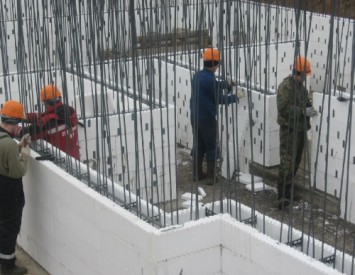
A non-removable form offers to collect from the finished blocks an increasing barrier and install it into the trench.
The advantages of non-removable foundations:
- Non-flammings, have a category of fire safety G2.
- The assembly does not require the cost of time and special knowledge in design.
- Seismic-resistant blocks strengthen the foundation vertically.
- Low block density does not overload the foundation of the construction.
- The assembly does not require the involvement of special equipment.
- Moisture-repellent material. Creates additional protection.
- Does not contribute to the development of microorganisms and fungi.
- Protects from cold.
- Reduces the construction stage of the foundation in 5 or more times.
Disadvantages of technology:
- Failure formwork is designed for one-time application.
Composition of material for non-removable formwork
1. Standard - polystyrene foam. Heat insulation, moisture-repellent, lightweight material. Produced by domestic manufacturers. The cost of formwork $ 1 for a temporon meter.
- benefits of Material: Challenge price. Additional thermal insulation of the walls;
- disadvantages: fragile, has low breathability.
2. Blocks from a mixture of chips and cement - arbolit. For reliability and strength, wood chips are processed by chemical compositions that increase protection against moisture, rotting, fire. The special structure of the material is achieved by the chaotic location of the air spheres around the tree.
- the advantages of building materials: high sound and thermal insulation capacity. Used for the foundation and fill overlaps;
- disadvantages: not an ideal surface, roughness or small grooves are possible.

3. Fibrolite blocks. Move from a mixture of alkaline magnesite, portland cement and wooden chips. The obtained blocks are environmentally friendly, without harmful chemical additives.
- the advantages of the material: boslest, frost-resistant, endowed with high vapor permeability characteristic, durable, fireproof;
- disadvantage: not popular, rarely used due to the characteristics of the production process.
4. Patented technology "Rental concrete" - an optimal solution for low-budget construction. The principle of the technological process is simple and allows you to independently make forms of the usual and complex configuration. In terms of production scale, rental is made on mills and tables using rollers and patterns. Use special molds, which makes it possible to pour any extraordinary or thin shape with a complex profile. Inside lay reinforcement, install mortgages and rolling castle elements. It is the possibility of producing thin-sheet products of a complex profile predetermined the use of the method for the release of a lightweight slider of a non-removable formwork. In the manufacture of cement, water, sand are used. Plasticizers and seals do not apply.
- the advantages of the method: the manufacture of complex thin-profile elements.
Unique material properties: High frost resistance to - 50 0C is not destroyed in climatic conditions with sharp drops of temperatures, high humidity, resistant in aggressive environments. The only material for non-removable formwork, allowing the aesthetic appearance of the outside. It is achieved by adding minvati, basalt, marble crumbs, mineral dyes or pigments.
Non-removable formwork for the foundation with your own hands
With a neat and accurate manufacturer, the non-removable formwork is installed at home.
Materials and tools required for the technological process:
- Buy sheet material that meets the requirements: resistance to rotting, elasticity, strength. The choice is made from plywood, impregnated with special composition, CSP sheets, flat slate.
- Purchase a reusable set for formwork consisting of tie screws and nuts.
- Prepare the stock of cement, sand, water for filling the foundation.

- Purchase rebar.
- Purchase waterproofing material.
- Mineral heat insulator.
- Depth vibrator. Working part of the device up to 40 mm. Or a piece of fittings long, equal to the height of the block, increased 3 times.
Technology of building the foundation for non-removable formwork:

- The base of the foundation is covered by a waterproofer.
- Drive reinforcement bars in the base of the foundation. The distance between the rows is chosen from its own calculations with a reserve to the thickness of Minvati.
- Blocks put on the reinforcement bars.
- A first layer stack. The grooves are placed horizontal reinforcement. Laying produce overlapping produce compound wire bind between fragments reinforcing tabs and the main vertical reinforcement. First layer - core. In accordance with the plan of construction of taps placed at that level for internal partitions, door slopes.
- Fixed form permanent formwork when laying the second layer of the blocks, providing overlapping seams. Monitoring the coincidence of the sides of each layer. The process is similar to laying masonry brick. Also performed a number of displacement, providing the rigidity of the walls.
- Connect blocks vertically grooved to form surfaces. To close enough lung pressure.
- Operate laying a third layer of permanent shuttering. Align the vertical joints.
- Proceed to concrete pouring. Carefully fill the voids and compacts mortar. For sealing use vibrator or manually pressed and impel solution, expelling air pockets piece armature as a bayonet.
For the construction of solid walls, the top layer blocks fill half, whereas in monolithic concrete seam will be located inside the styrofoam.
Carrier characteristic wall depends on the brand of concrete and reinforcement classes.
Erecting monolithic wall immediately points the way laying of utility pipes and electric cables. Do not forget about ventilation, pre-make holes in the blocks and carry out communication and wires prior to pouring.
The finished structure with permanent shuttering looks like a sandwich: between polystyrene placed concrete monolith. Poured walls are initially high rate of thermal conductivity and do not need additional protection.
The foundation of permanent formwork. Video offers to get acquainted with the construction of simple methods:
Permanent formwork for the slab foundation
The most reliable, but at the same time, the foundation is expensive tile. Most often it is called floating. For its production requires a large consumption of materials high-grade concrete, rebar. Its poured for non-cohesive or heaving soil, in the case of another arrangement is impossible under the house foundation. The thickness of the multi-storey house for aged of at least 250-280 mm. For a private two-story structure is allowed thickness of 200 to 210 mm. foundation reinforcement density is not allowed below 100 kg / cu. Under foundation stacked sand and grit pads, each thickness of 100 mm-150 mm.

Increased demands on stability and reliability of the foundation slab impose certain requirements on the use of permanent shuttering. For slab foundation professionals are advised to use only fibrolitovye or cement-bonded units. They allow you to create complex shapes with curved segments or oriel. Fibrolitnaya permanent formwork for the foundation. Price from $ 0.1 up to $ 2 per square. m.
Installation Technology slab foundation begins with the digging of the pit, and the walls are aligned vertically. This is the main requirement that ensures proper follow-construction walls. Permanent formwork is also mounted on the geodesic instrument and levels in the vertical and horizontal planes. Stacking produce rows, simulating masonry. Carefully align the joints vertically and placed in the armature binding grooves.
Install permanent formwork for the slab foundation of their own - a very complex process, requiring the owner's knowledge in the field of planning and construction.
Permanent formwork for the foundation. Reviews craftsmen professionals
House project with the foundation 11.6h11.6 m, with an average bearing wall. The height of the foundation 1.8 m. In the earth 1.3 m and 0.5 m on the surface of the cap. The foundation is designed to freeze the ground, with the heaving soils of humus and loam. Method of erection of casting in earth permanent formwork from + Penoplex.
Drawings for Constructio home users to order in a private company, offering services in the Internet space.

Construction was carried out in an area where everything developers pour concrete into the ground and used formwork. It was decided to do in the land of permanent formwork made of extruded polystyrene and costs $ 0.1 per square meter. m. above the ground, it was decided to perform a low shuttering of boards for the cap. To land there were two options for casting concrete. First with roofing material was immediately rejected: does not lie flat array will not hold moisture. The second option - a foam. The benefit in material durability, it has a service life of 15-18 years. And the material rejected because of mice. They live happily in it, gnaw passages and make yourself warm mink. For rural areas in the mouse housing - this is a disaster. As a result, attention was drawn extruded polystyrene. Its advantages:
- Durable.
- Not fragile, does not crumble.
- It has high thermal conductivity properties.
- Not suitable for housing of small rodents.
The only drawback of the material:
- The cost exceeds the price of foam 3 times.
After analyzing the price of EPPS with a price for the production of formwork height in 1.9 m from the board with a thickness of 50 mm, it was obtained that the extrusion material costs cheaper and in terms of means of insulation.
The second factor in favor of EPPS was that the walls of the foundation are poured into smooth, which means that the soil will not be clinging for it.
Total:
- Dropped by manually trench. The walls immediately attached maximum smoothness and vertical coincidence for the exact and correct installation of EPPS blocks in the ground.
- On the bottom of the trench, all over the perimeter was pillowed with a pillow of sand (it is free in this area). The height of the pillow is chosen 200 mm. The sand was pre-wetted, and then stacked and rubbed in the pit. Purpose of bookmark - Leveling bottom.
- From above on a sandy pillow, a polyethylene film in 200 microns was laid. The joint was glued to scotch. The film was intended to preserve cement milk and to make additional strength concrete.
- Top of put rubberoid. Outlines. To facilitate the mating of reinforcement and movement along the bottom of the trench.
- Next, the blocks of non-removable formwork were installed according to the methods described.
- Poured concrete mixture.
- Installed top wooden formwork for socle. Installation of sheets of EPPS was produced inside the wooden upper formwork using self-tapping screws.
The beginning of the work on the fill was produced 15.06, the end of work 23. 08.
The difficulties faced by the developer:
- Keep the trench needed as early as possible, namely, as soon as the local land allows you to dig. In the summer, due to showers, the work is not only suspended, but also deteriorate. The bottom of the trench is entered with garbage, the walls are washed out with water.
- Hired utility workers spend in winter. In the season it costs more expensive, at best. At worst, you will simply stay without workers.
Facial formwork for the foundation Photo performed on the project under consideration: