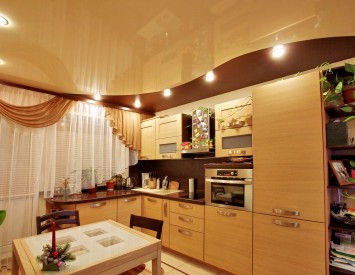
Today, the stretch ceiling can be decorated in various ways. It gives sophistication to any room. The advantages of such a ceiling include its practicality and reliability. In addition, it is quite racks to fungi and malicious microorganisms. It has no contamination for a long time and condensate does not appear. In addition, it is not subject to deformation when exposed to chemical components. Materials from which the stretch ceiling is made in the kitchen are not toxic and not ignited. Robbles and cracks on it appear very rarely. In addition, stretch ceilings do not absorb smells. At the same time, they possess good sound and thermal insulation. As for the warranty period for them, it is usually over 12 years old. Consequently, it is a very durable material.
Content
How to choose a stretch ceiling into the kitchen

When choosing a tension coverage, it is necessary to take into account the style of the kitchen, features of the interior and the location of the furniture. As a classic option, you can give preference to white glossy coating. This option is well suitable for the kitchen decorated in the modern style or high-tech. To visually increase the space space, you can use a special mirror film.
Today, there are so-called glowing stretch ceilings, which even without individual lighting devices allow you to make a lighter room. Such muted light gives an atmosphere of mysteriousness. This ceiling consists of a transit surface of the web and fixed on the base lamp. If the lighting for you seems insufficient, then it can be supplemented with built-in point luminaires.
The combined ceiling will be a good choice in which the suspension and tensioning coating is combined. As for the value of multi-level ceilings, it is almost the same as the price of coating from other materials. In addition, it takes not a lot of time for their installation, as it seems at first glance. To do this, it is enough to make holes and install the fastening profile. It is also worth noting that the film of stretch ceilings is environmentally friendly, which is confirmed by the corresponding quality certificates.
Types of stretch ceilings

Before consider how stretching ceilings stretch, get acquainted with their views. As a material for such a design, glossy, satin, textured and matte film is used.
With the help of a glossy film, the ceiling can be given the effect of reflection, which visually increases the space space. Thanks to satin material, you can get a beautiful and bright surface painted in any color. With matte film, the ceiling seems perfectly smooth. It is worth saying that any of the above materials is quite moisture-resistant and not subject to corrosion processes. For such ceilings it is quite easy to care for. So, in order to remove dust and dirt, you can use any detergent. The main thing is that there is no alcohol and abrasive elements in its composition.
The existing stretch ceilings according to the materials used are divided into:
- textile,
- polyvinyl chloride.
The latter option is a design of vinyl capes, which are fixed using a plate of plastic or aluminum. The width of the finished rolls of the film can reach 4.5-6 m. Usually, the surface is first performed, and then according to the data obtained, the manufacture of a certain amount of material is ordered.

Consider in more detail the characteristics of each type of material for the stretch ceiling:
- Almost under any style of the kitchen interior, be it a modern or ampir, suitable a glossy stretch ceiling into the kitchen. Today there is a large assortment of material that differs in color and texture.
- For small kitchen premises, the ceilings with a mirror surface will be an excellent option. They will be able to visually expand the area. The disadvantage of such crafts is noticeable seam.
- Satin stretch ceilings have similar properties of both matte and glossy cloths. Thus, they also visually make the room wider. But they reflect much less details than glossy.
- If you make a white matte stretch ceiling in the kitchen, the surface will be similar to the perfectly plastered. Although there are other shades of such cloths. In any case, the glare will not be present on the matte canvase and, therefore, the surface color will not distort. In addition, such a ceiling is good because it is almost not visible seam.
- If you want something original, you can make a ceiling in the form of a starry sky. The stars on it will be flicked at the expense of the projector and the filament of the wholesale fiber, summarized to one side of the canvas. The color of the stretch ceiling in the kitchen in this case should correspond to the shade of the starry sky, i.e. It will be black or dark blue.
- Textile stretch ceilings usually look very well in the kitchen decorated in the rustic country style. Such products are solid and seamless fabric cloths. They are made of polyester threads, which are impregnated with polyurethane. In this case, the width of this material is usually about 6 m. For the construction of the ceiling, it is enough to simply cut off the piece of the required value from the roll.
- The PVC film ceilings are not bad to hold back moisture. Such a surface will not lose its appearance, even if the neighbors suddenly flood your apartment from above. The canvas under the weight of water, of course, will resist, but the furniture and the other existing finish here will remain intact. Water then needs to be accurately drained from the surface. To avoid damage to the canvas for this work, you can invite specialists. After draining the accumulated water, the ceiling usually acquires its former look.
In any case, you yourself decide from which material to install the ceiling in your kitchen. Each of them has both advantages and disadvantages.
Installation of stretch ceiling: technology

If you plan to install a two-level design for the ceiling, then you will need a special framework.

The order of installation work will be the following:
- Initially, measurements should be measured and determine the lowest point on the ceiling. It marks the level of crates for plasterboard. At the same time, consider that the ceiling itself will be located below the erected frame. Therefore, it will be necessary to retreat from the top point of the ceiling by about 50-60 mm.
- The height of the stretch ceiling can be adjusted depending on the size of your kitchen room. Using a simple construction level, a label is made in each corner of the room. Between all the marks should be discarded the molar cord of the line to which you will be oriented when installing the frame. At the same time, the UD profile is screwed around the perimeter.
- The next step should be clearly designated in advance what form should eventually take the stretch ceiling. It is best to make drawing on the main ceiling of the corresponding figure. Next, you need to designate the number of profiles and fasteners that will be required to build the structure.
- After you calculated the stretch ceiling and the number of required materials required for installation, go to the construction of the frame. A plasterboard UD or UV profile is mounted on the sequence of the sketch on the P-shaped suspension.
- Then the side planes of the installed profile will need to be confused every 50 mm. As a result, the material will become much more flexible.
- In order for the frame to acquire the necessary rigidity, a jumper from the CD support is installed between the inner and trim profile.
- In any room, including in the kitchen, there must be sufficient lighting. Therefore, it is necessary to provide a place where you can make wire wiring. It is usually located on the same level with plasterboard.
- If you plan to install lamps on the ceiling itself, you will need to make the wires with the corresponding places.
- Wiring, which will be hidden under the plane of the flooded ceiling, should be packaged in a corrugated sleeve and consolidate something to the main frame. In the deaf zone there should be no joints and wire connections. In such a place, for example, the space between the main and suspended ceiling. Because of the twigs, a spark may arise, and with any problem you have to disassemble the entire ceiling.
- Before hanging the stretch ceiling, you need to see the frame of plasterboard and sharpen the surface. The material sheet is screwed in such a way that the mounted ceiling can be set to the base. Plasterboard is usually fixed with 25 mm longs. And between them should be a distance of at least 310 mm.
- The existing surplus on the figure later is simply trimmed with the help of a hacksaw. It is important that the vertical strip is cut out according to the dimensions, after which a paper layer is cut on it every 50 mm. It is necessary in order for the material to be bent. During the twisting of the screws in the sheets of plasterboard, their heads can break through paper. To avoid this, there is a special nozzle. It can be used when mounting.
- Before starting the installation of the stretch ceiling, the plasterboard design is preferably sharpen and sand. Then after installation everything will be ready without any refinement. In addition, you can appoint dotted light sources in advance on plasterboard sheets.

To establish a polyvinyl chloride film, on each wall of the room, first of all, a profile of plastic or metal is attached. Then the air temperature increases to 45 degrees. The film heats up with heat pipe to about 55 degrees. Then the canvas refuel into the baguette. Due to the increase in temperature, the material is stretched until the necessary sizes take place, and when it cools it, it will be squeezed and "will fall into place." Thus, it turns out a beautiful and perfectly smooth surface.
Installation of lamps
If you wondered how to make a stretch ceiling, then, first of all, think about the lighting. Most often, point lamps are placed on such structures, but no one forbids using any lighting at their own wishes. Treat the placement of lighting devices in advance. Wires for setting the lighting must be diluted before the tension of the web. Wiring is necessarily packed in a special corrugated sleeve (corrugation), after which it is attached to the main ceiling.
Stretch ceiling in the kitchen: photo