Lighting devices play a very important role in the decoration of the premises. If they are chosen incorrectly, it can harm the integrity of the style in which the room is framed. On the intricacies of the selection of wall lights and the nuances of their installation will be told further.
Content
Characteristics of wall lights
From all models of wall lamps, plafones and sconces are considered the most common. In addition, current systems and devices that are embedded in the wall surface can also be installed.
Plafones: photo


Plafones are the type of lamps that are attached to the back to the wall without the ability to adjust the light stream. Their main advantage is compact. Indeed, such lighting devices can easily hang even in the very close corner of the room. The installed plaffones allow to obtain dispel uniform light in the room. Thanks to its compactness, they can be placed on the wall of a narrow corridor, in the lobby or in the bathroom.
Branch: Photo


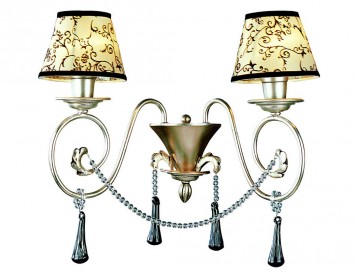
As for the sconium, it is considered a decorative wall lamp. The photo of this type of lighting can be seen below. The sconium is usually chosen for residential rooms, but it is not necessary to limit it.
In general, plafones and sconies are fundamentally different lighting devices. So, the lamps in the first are adjacent to the wall, and in the second - are located at some distance from the surface. All Brake models are usually installed on the bracket. Some devices involve the ability to adjust the head, which allows you to direct the light stream to almost any place. It is convenient, for example, to read text. For the children's lamp of the wall requirement there will be few others.
You can build built-in hanging lamps to the wall. It is possible to implement this in the construction of false walls, with a volumetric surfaces of the surface with panels or during the installation of plasterboard partitions. The head of the lamps can be two types: stationary and mobile. This is one of many than they differ from the ceiling.
There are so-called conductive systems. With the help of them, you can create a design that will look like a ceiling-wall lamp having a smooth transition from the ceiling on the wall.
Types of cartridges and lamps

Most of the score and plafones are available under the familiar screw base. Most often used grounds E27 and E14, on which both incandescent lamps and halogen, luminescent and some LEDs are used. Thus, the cartridges of wall lamps, which are produced today, can be safely called multifunctional. In the specified cartridges it is possible to screw any of the bulbs with the above grounds.
The type of lamps is largely affected by the perception of light from the device. Today, lamps are fairly common on which specialized cartridges are installed. For example, the cartridges of pin-type G can be mounted, intended for halogen lamps. Only the white glow of such lamps is not suitable for all interiors. Therefore, when buying it is worth examining their marking.
There are models of scabs equipped with a mechanism that allows you to adjust the brightness of the light flux (integrated rheostat). However, only incandescent lamps can work in a pair with such a mechanism.
The reduced transformer required by halogen low-voltage lamps is often embedded in the lamp housing. Nevertheless, there are devices that are not equipped with them. Then it will be necessary to purchase it separately. In general, wall lamps Buy today is not a problem.
When choosing an adjustable wall luminaire, it is necessary to remember that fluorescent lamps work only when it is set to the maximum value. Because of which it makes no sense to adjust the brightness.
Light flow

In the wall lights, fully closed diffusers are installed in the wall lights. To direct the flow of light in one direction or another, you just need to open this diffuser from the right side.
Often, there are lamps without a diffuser. For example, classic models from crystal, in which light sources are incandescent bulbs in the form of candles. These lamps typically have an E14 base. For these light instruments it is desirable to choose a light bulb of low power, the flask of which has a matte coating. It will allow the flow of light not to make eyes.
Regardless of which lamps will be installed in a wall lamp, they can perform many different functions. The appointment mainly depends on how the light stream is distributed. But when it is placed, you should know what it will be closer to the wall, the more noticeable on it there will be possible textured defects. Therefore, instead of models with a directional light stream, it is better to choose another type of wall lamp. The price of any of them will be acceptable.
Material diffuser

Today, light diffusers make practically from any material. The main thing is that he has the ability to skip light. So, for example, it can be made of:
- glasses
- plastic
- fabrics.
With the change of the color of the lamp, the shade of lighting in the room will change. Therefore, this should be paid special attention. Any of materials has its advantages and disadvantages. The glass is strongly attracting dust, the fabric can be too hot, and the plastic is easier to care. The choice of material, taking into account its qualities, is especially important when selecting wall-mounted lamps for the bathroom.
Styles of wall lights

Wall lamps are made of various materials and different manufacturers, depending on which style they relate. It is customary to highlight four of them:
- classical,
- modern,
- country
- ethno.
Classic models that are manufactured from crystal and Swarovsky crystals are usually produced by manufacturers from Spain and France.
Wall lamp lamps in Modern style are mostly manufactured by European manufacturers. However, products of each such factory have a national specialization. So, for example, German, Swiss and Austrian manufacturers most often produce lamps LED wall mounted, embodying all the latest achievements of technology. Dutch and Italian masters are often invited to work together well-known designers, which undoubtedly affects the appearance of their products. It is they who often produce models in an ethno-style. Manufacturers of America and England specialize mainly at the production of country lamps.
Installation of wall lights

- Installation of the wall lamp is very similar to installation chandeliers. In particular, it concerns the wall-ceiling lamps. The bases of such devices are usually attached to insert, but in this case will be deepened in the wall. Today there are models equipped with a special plug. It is usually located at the base and allows you to connect it to the plug outlet. Thanks to this design, it disappears the need to mess with wires, which is especially useful when repairing. After all, the device is quite simply removed and dressed.
- If the lamp is installed on the frame wall, the cable can be carried out both above and below the wooden shelves.
- It is advisable to pave the wire on the capitial wall on the surface until the opportunity to remove the groove. So that it does not stand out, you can paint it in the same color as the wall is painted.
- Even before installing new lamps, it is necessary to think about the wiring to be convenient access. If you want to hang the device in the room, which is above the first floor, it will be more convenient to connect the devices to the upper line of the lighting. At the bottom of the connection are made to the bottom or upper line.
- When you decide with the place for attachment, you should check whether there is no old cable in the wall. Otherwise, you can damage it when laying a new one. Checking its presence with the help of a special detector of hidden wiring.
- In some cases, it is necessary not just to hang a new lamp, but add it to the old one. And the network must be general. In this case, you need to make a lap from a new device to the old. Then you can connect it to the zero terminal of the switch. It is usually located on the ceiling in the junction box. It has a network to a new lamp.
- Before connecting a new wall lamp to an already existing lighting wiring, check whether it will endure after that it loads. So, the line should eat a maximum of 12 lighting devices, however, it is recommended to reduce this amount up to eight. If there is a probability of overload, it is recommended to provide for the power of the installed devices from the power chain through the wiring with the fuse.
- The junction box allows you to connect more than two lighting devices to one cable. The veins of this wire should be connected to three terminals inside the box. After that connect the branch cables. In this case, it is necessary to insulate the bare parts.
- If the chandelier is replaced with a wall lamp, you can use the existing wiring. For this you need:
- de-energize and remove the ceiling outlet;
- tighten into the groove above the ceiling network cable and switch wire;
- observing the ceiling outlet circuit, connect them in a new distribution box equipped with four terminals;
- now you need to connect the cable required to power the new lighting device.

For wall lamps, the most suitable height of the installation is considered to be 1.5 meters from the floor level. If the device is required to read, it is better to attach it a little lower so that the flow of light does not blind eyes.
In some cases, connecting the lamp on the wall to the power line is easier than the lighting lines. This concerns the case when the socket is located on the same wall. For this you need:
- Debel the room.
- Remove the socket cover.
- Connect the wire with a cross section of 2.5 kV. Millimeters to a switchable connecting unit with a 3 amp fuse.
- With a cable with a cross section of 1 kV. Millimeter Connect the lighting device.