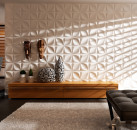
In order to make the room more refined and elegant excellent suitable The use of Venetian plaster as a finishing material for walls. It is this type of plaster that makes it possible to achieve the effect of a marble shiny surface that fascinates his depth of depth. On the technology of application of the Venetian plaster Talk further.
[tOC.]
Content
Venetian plaster - Features and characteristic
The use of Venetian plaster in the process of decoration of residential premises is becoming increasingly distributed, since it is this type of finish that is distinguished by an amazing appearance and long-term operation.

The first use of this technology belongs to the ancient Roman time period. Then the small crumb that remained after the manufacture of monuments was mixed with the gypsum solution and was applied to the walls. Previously, lime, flour and marble came into the composition of the Venetian plaster. Now B. hERE add all sorts of additives that improve her Properties and stability in front of various phenomena. In addition, modern Venetian plaster does not contain lime, protruding the binding element of the mixture, it is replaced by an acrylic that has a higher strength. Yet In the composition of plasters, various kinds of dyes prevail, allowing you to achieve almost any necessary coating color.

As stones, from small particles of which plaster makes granite, quartz, limestone, onyx, malachite. There are two types of mixtures:
- synthetic;
- natural .
To create an art decor, an exceptionally second option is applied, as it will take more than five for this. layerswho interact well with each other.
We offer to familiarize yourself with the main features of the use of Venetian plaster:
- the difference in compositions occurs in a ratio with a variety of plastering, mixtures with heterogeneous or homogeneous particles differ, among the required properties of this type of finish, the quality of plasticity, strength and stickiness are played;
- in the ratio with the type of finishing, the surface is embossed, smooth and artistic;
- to create a smooth mixture, only dust and marble are used, which are associated with lime using such plaster, special skills are required to work with such plaster, as it is only light, and with improper application technology, the wall is covered with spots;
- relief stucco helps to achieve an interesting design effect, it is easier to work with her, since such a type of plaster contains larger marble particles, up to two millimeters .
Venetian plaster marble: advantages and disadvantages
Among the benefits of using Venetian plaster should be allocated:
- Ease Processing a synthetic mixture for which special skills are not required, and the effect of the textured surface appears literally after applying two layers. That's why, for inexperienced bearers, it is better to use the composition of synthetic Origin.

- Materials are present solely natural origin, which are quite safe for humans and the environment. This type of coating does not have an unpleasant odor, characterized by the absence of carcinogens and resins.
- The presence of polymer additives in the composition of plaster avoids the deformation and cracking of the coating. The service life of Venetian plaster is more than ten years.
- Due to the presence of a porous structure, the coating perfectly passes the air and makes the atmosphere in the room comfortable for accommodation.
- The coating is steadily before the formation of fungus and mold, so it is great for finishing children's rooms.
- The appearance of the coating is its main advantage. Venetian plaster is able to skip ultraviolet radiation at different depths, so in the presence of Sun, the surface has a pleasant brilliance, which makes the design of the room with a chic and expensive.
- Venetian plaster perfectly transfers temperature differences and moisture effects. In addition, if you suddenly have problems in the form of spots or other defects, partial surface restoration is possible.
Disadvantages This finishing coating practically does not have. The only thing that should be allocated is the high cost of applying the Venetian plaster and the need for careful surface preparation and alignment of the walls.

Finishing Venetian plaster — Classic option
To apply classical Venetian plaster requires spacure Mass consisting of marble dust, haashed Lime, various pigments and dyes. It should be noted that some manufacturers replace marble dust, material from quartz, granite or onyx, on the quality of products it is practically not reflected.
Thanks to availability haashed Limits in the composition of the mixture, the coating acquires strength and durability. Additional additives help achieve the desired color, increase the stability of the material before ultraviolet, moisture and temperature drop.
For fit The mass of greater plasticity use binders based on acrylic. With their help, even the slightest microcracks are not formed on the surface.
Modern formulations do not require individual layouts, they are already sold in ready for applying. Venetian plaster each of the manufacturers is distinguished by individual preparation recipe, velvety, gloss and mattness. A variant of the individual selection of the desired color using the dye, which comes with plaster in a separate packaging is possible.

To carry out work on the application of Venetian plaster, it will be necessary:
- steel terokthat will help to dissolve and sweat the solution, their width must be from 200 to 250 mm;
- special Spatulas S. rounded edges and polished surface;
- two brushes, classic flat and painting, keep in mind that the last type of brush should have a very thick bristle .
In addition, it will take:
- roulettes;
- level;
- long metal line;
- grinding terks;
- skirts shallow fraction .
The application of Venetian plaster involves the conduct of solid surface preparation. If the preparatory work is carried out incorrectly, the duration of operation of the coating is reduced several times, whereinThe appearance of plaster is very much suffered. Therefore, this process should be given due attention.
As the basis for the laying of Venetian plaster, a wide variety of surfaces are used in the form of concrete, brickwork, drywall and etc.. But, any type of coating is primarily purified from dirt and dust and residues of other finishing materials, if the Venetian plaster is applied to the old surface.

In the presence of Scrols, chips and cracks, it is required to conduct work to eliminate them. After that, all these places are thoroughly polished. Further The procedure of the first solid putty will have. After drying spikel It follows the process her Grinding using eye skins or pumice.
To Remove small particles after grinding, the walls are purged by compressed air or veosh. Further Property to be applied, improving the antiseptic properties of the coating and providing a higher adhesion of the first and second layer spikel.
After the primer is completely dry, proceed to the second solid spatlement. Further Grinding and applying primer. Consider if there are still fine irregularities after the final second putty repeatedyet once.
Special requirements are presented to the finish shit, as the surface should be perfectly smooth. For grinding, the zero skin is used, and the dust is removed using a wet cloth.
This stage differs not only thoughtfulness And painstaking, but also takes quite a long time. Since each layer spikel must carefully dry before applying the following. The average drying time of each layer is 24 hours.
After completion of the wrap, cover the walls of the primer several times and proceed to the execution of the venetian plaster.

Before begin Works turn on top sections with greasy tape. It is removed upon completion of the work before drying the plaster. If this is not done, then after happen The formation of small chips and cracks.
When using a standard non-tinted solution of plaster, you should pre-dilute the entire mass of the dye to obtain a homogeneous texture and colors. Choosing Color should consider the fact that in the closed room, Venetian plaster becomes more dark And bright. When finishing a residential premises, it is better to give preference to calmly tones, as it is too bright in time with time.
The technology of Venetian plaster involves the gradual decoration of the walls. Application is made from the top area. It is recommended to divide the area on the zone one square meter and put the plaster gradually.
As the basic and main layer, it is the first applying of plaster. It is the main thing in determining the color of the future coating. In the process of operation, the Kelma is used, which allows the mass to the spatula. Kelma needs to work using short and rounded Type.

Cover the wall moving on the left side to the right. Apply a thin layer of material and until he managed to dry evenly distribute it according tothe top is an arcuate way. Note that sharp and straight joints — Invalid.
Tightly press the spatula to the wall, keep it at an angle of fifteen degrees in relation to the surface. Exactly thus It turns out to achieve surface texture, which after completing the work becomes similar to natural stone.
The drying time of the first layer varies from four up to eight hours. It is better to clarify this value in the manual for plaster . Available application option of the second layerby expiration SOUTON.
For applying the second layer, torn short movements are used, and the mass after applying is instantly distributed on the surface with a spatula. There is a pair or cruciform movement of a spatula with which one layer overlaps the other. Thus, movement in one direction allows you to apply plaster, and to another her take off. This technology of applying Venetian plaster is called a butterfly. Upon completion this The process, the relief of the first layer and the emergence of residences, the size of which depends on the previously selected application technology is occurring.
To increase the number of living hours, and at the same time the visual effect of the surface has become deeper, it is recommended to produce a large number of intermediate layersMaximum — nine.
The final stage on the manufacture of Venetian plaster with their own hands is the applix of wax, which will make the surface shiny and protect her from external influences. These works are recommended after the week after applying the last layer of plaster.
A variant of applying special compositions that have an additional decorative effect are possible. For example, gloss pearl, gold or silver. To apply liquid wax used special pork glove, and then the final polishing of the wall occurs using special pile Nozzles.

Recommendations for the application of Venetian plaster
- In the Venetian plaster, the flow rate is determined primarily by the type of composition and its manufacturer. In order to learn this reading, you should refer to the instructions and technical parameters of the material.
- With the help of additional universal dyes, the color of Venetian plaster changes.
- It is forbidden to produce a tinting and breed the wax that covers the plaster.
- With the help of wax, the coating acquires moisture resistance, so its application quite possible and indoors with high humidity.
- For drawing follow-up layers Plasters use a flexible spatula that allows you to make the surface of the dwelling.
- Note that the residentials of the previous layer should not coincide with the cores of subsequent layers.
- To enhance the visual effect, the last layer of plaster is treated with circular motions using sandpaper.

- Some manufacturers recommend covering the surface with varnish. It is better not to do that, since with time the plaster is likening.
- Basics and subsequent color layers differ from each other. The base should be or lighter or darker.
Venetian plaster video:
[yframe. uRL=‘http://www.youtube.com/watch?v\u003dUTZ_KEVDYNU.‘]