To date, you can find a huge amount of materials aimed at carrying out construction or repair activities. Fortunately, these goods are located in various price ranges, so every person who wants to acquire appropriate products will easily find for himself exactly what he needs.
Content
Separately, it is necessary to analyze the situation associated with the wall finish. There are simply a tremendous quantity for sale on sale, so make the only correct choice - not always easy. Most often, people who are not confident in their choice turn to those skilled in the art that will share some recommendations that facilitate the choice.
In the case of the acquisition of decorative plaster, the situation is even more intense, as it is necessary to choose among dozens of varieties of surfaces. Some options will better look in small spaces of spaces, while other finishing resources will make it possible to extract a lot of use of large premises.
To make a conscious choice associated with decorative plaster, the types of these products should be analyzed. Of course, it is not always easy to make a choice between dozens of plaster options, however, after familiarization with some information, the task will be significantly erupted.
In this article, we will consider the main features of decorative plasters, as well as analyze the process of applying it on the surface.

Features of modern plaster
Immediately it should be said that the diversity of modern species of plaster allows each owner to implement almost any designer project, which can only come up with. Obviously, this question is often resting in monetary restrictions, since the hosts are extremely rarely ready to spend enormous means for wall decoration.
Of course, there are exceptions when, for example, the owners own a large private house, for the creation of which a lot of money was spent. Obviously, finishing work in such a situation is not a problem. The main task that stands in front of the hosts that has been repaired is related to the implementation of the total attractive style of the room. If a huge private house is created in a concrete style, then the repair should correspond.
If we are talking about finishing works within a small apartment, then it is obvious that to implement some kind of unique and sophisticated style of space - it makes no sense. Often the hosts of small apartments do not have the opportunity to spend large money on such events, so the choice is made in favor of simple and concise styles. Accordingly, such decorative plasters will cost inexpensively, but at the same time they will definitely please their attractive style.
Specialists who are engaged in various repairs in apartments and other premises, recommend choosing decorative plaster, which really correspond to space. This allows you to extract the maximum benefit from the existing situations.
It is imperative to pay attention to the very details related to the repair process. Many people understand that they will not work with their tasks in advance, therefore it makes sense to use the services of specialists. In almost every major city, you can find small organizations that will carry out full repair, or specifically the finishing process. It should be recognized that in certain cases it really makes sense, since the process of applying plaster includes many details, without which it will not be able to get a qualitative result. On the other hand, if we are talking about finishing a small space, it is quite possible to do and own forces. If the budget is limited, then the repair by their own hands will significantly save money. Do not think that in such conditions it is extremely easy to allow mistakes and fully utter repair. This probability is really there, however, if you follow the technologies of plastering, there should be no serious problems. It is obvious that in this process requires attentiveness, as well as responsibility for each action. Additional working hands will not interfere. Assistant is not only the one who makes a specific work. It is able to notice some errors. In addition, the assistant can look at the process a little differently, noticing some subtleties of the process, sharing useful recommendations.
Types of decorative plaster
Next, we will analyze the main types of decorative plaster, and with the help of this material it will be much easier to make a conscious choice associated with the most optimal finish for a particular space.
Structural plaster
This is one of the most popular species of decorative plaster. A non-uniform grainy surface is obtained, which includes various granules and other additives, positively affecting the appearance of the finishing surface. Manufacturers produce this plaster by adding pieces of glass into it, particles of stone, as well as fibers.
The production of this type of plaster occurs based on synthetic laters. In order to repair a small apartment, it is necessary to make a choice in favor of water based material. Good news is that such products do not distinguish any unpleasant odors, so residents can freely be in the apartment during repair.

Builders who are engaged in finishing works adore this plaster because of its excellent plasticity. This allows you to make the mixture as much as possible and get a good result.
Often this products are available in the store already in the finished form, so inexperienced people who are not confident in their actions related to the preparation of products for use will not face difficulties. There are containers with structural plaster, the mass of which range from 15 to 25 kg.
Applying structural plaster
- First of all, the surface is prepared for the main work. It should be borne in mind that our goal is to create a perfectly smooth surface, so if possible, we need to hide significant irregularities, and the mixture can cope with small problem places. It should also be done so that the surface does not have any pollution, as well as humidity.
- The primer is used as a base for plaster. Also, this is a kind of protective layer, which does not allow to occur to moisture exchange between the wall and the most decorative plaster. Only after complete drying of the applied primer can be placed the wall.
- Application of decorative plaster occurs with cells. You can also use a spatula that allows you to apply the material with one layer. As we have said, the texture of structural plaster can be the most diverse, and when applied, you need to ensure that all this looks attractive, but at the same time matched the created style. After about 3 hours after applying, the mixture will take a certain strength. After that, you need to wait about the week before the surface becomes truly monolithic. Here I would also like to note that the texture and the overall appearance of the surface depends not only on the composition of the plaster, but also on the method of its application. The poet needs to carefully study the instructions or other information provided by the material manufacturer.
Venetian plaster
This plaster is performed on the basis of marble flour. After this stucco is applied to the surface, a kind of marble foundation is created. Thus, we are talking about really an attractive finish, which will definitely be the perfect option for large premises with a solid style. Obviously, marble as part of a small apartment will look at at least ridiculous.

Also part of the Venetian plaster includes hawed lime and water emulsion. You can find large banks or buckets with this stucco. The weight of this product may vary from 7 to 25 kg.
The strength of this plaster is waterproof, so it can be used in a wide variety of places. In addition, this material is also environmentally friendly, which allows repair work in a room with tenants. The fact that the material will quickly dry - another essential advantage.
Applying Venetian plaster
- As in other cases, the process begins with alignment of the walls. It should be borne in mind that for the most qualitative imitation of marble on the basis of Venetian plaster, the wall surface should be perfectly smooth. Obviously, some disadvantages can definitely be, however, often plaster copes with them.
- After that, a layer of primer is applied. It is worth paying attention to the fact that in this case it is necessary to acquire special products that correspond to the Venetian plaster. As we have already spoken, on sale a huge range of such goods, so it will not be difficult to find the necessary primer.
- Already after the primer dried completely, you can apply plaster. This process must be carried out with a spatula, applying material with thin layers. Next you need to wait until the surface dry, and start the process of stripping. This is necessary in order to lose obvious irregularities that definitely create problems if they do not get rid of them.
- Next, it is advisable to use small emery paper, with which the final stripping of the surface occurs. It should be borne in mind that there are circular movements in this process, allowing you to get the highest quality result.
- The last stage of work related to the use of Venetian plaster is associated with applying white wax to the surface. This step is necessary, so this event follows the maximum carefully. The layer must be uniform.
Textured plaster
This type of plaster is also common. With this product, it is possible to obtain a really interesting textured surface that will become an excellent decorative component of space.
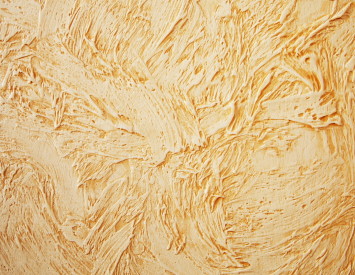
At the same time, it is necessary to separately note that sometimes it is difficult to distinguish texture plaster from structural - not easy. This is due to some conventions of the boundary between these two surfaces. However, it is necessary to recognize that on the basis of textural plaster, real professionals create amazing surfaces. It is not only about the patterns, to create which it is not necessary to make too much effort, but also about whole embossed patterns that are able to create only true art people. The use of various components allows you to work on versatile designer compositions that differ in originality.

Most often, when the repair passes within large private houses, experts analyze in advance the need to use certain components in order to obtain the most acceptable result of the work carried out. Often it is more creative work that requires creativity.
The main component of textural plaster is often limestone flour. If we talk about the special properties, then they can be obtained using other components. Recently, the composition of decorative plaster includes polymer materials substantially changing the relief and the overall density of plaster.
Some other additional ingredients allow you to get rid of cracking and the like factors that negatively affect the durability of the surface.
Application of textured plaster
- As in the case of the rest of the plasters, it is required to highlight the wall as high quality as possible, as well as clean the surface from various contaminants. It is necessary to get rid of moisture.
- Now it comes a turn of the primer. After that, the process should be applied to the surface of the paint-substrate along with sand (for optimal adhesion). Often, we can find products that successfully combines 2 components at once, which significantly simplifies work.
- Next, decorative plaster is applied, and in 1 or 2 layers. For applying, you can use almost any tools, starting by a trowel and ending with a brush. As we have already spoken, the process of creating the relief depends only on what result must be obtained at the very end. Accordingly, the more difficult the relief should be, the more exotic tool is used to apply material. It is also necessary to remember that the layer of plaster should be thick for the production of the volumetric pattern, otherwise it is possible to encounter significant limitations. To create a thick layer of plaster, it is necessary to apply several thin layers of this material. This will allow to get a really high-quality result.
- At the very end, the main task for the owners is to protect the drawing or relief from various external factors. Obviously, it is extremely easy to damage the surface, so it needs to be protected. For this you need to use translucent paint, which for a long time will delight with its effectiveness. As the most recent layer, wax can be used or various materials that are able to soak into the surface of the decorative material.
Decorative plaster and ceiling
Many owners who create in their home the original design style, want to apply stucco on the ceiling. Fortunately, this is possible, and quite often such events are practiced.
First you need to align the ceiling. It must be said that it is often because of this problems arise, since the stoves of the stoves of the ceiling turn out to be more than impressive. Accordingly, sometimes it makes sense to use drywall to align the surface, and after that, and make applying decorative plaster.
It should also be borne in mind that when applied to a large layer of plaster, the material can tritely get off. In this case, you need to do everything possible to prevent it. Therefore, experts advise to create a common layer with a thickness of no more than 5 mm. Obviously, to create a unique and large-scale designer composition in this case will not work, however, for decor and 5 mm enough.
Internal and exterior decoration with decorative plaster
Many owners are concerned about the question associated with the inner and exterior decoration of premises with the help of decorative plaster. It is extremely important to note that it is necessary to use plaster only under the conditions for which it is created. Accordingly, if you use the plaster for the external decoration indoors - no avoid problems.
The stucco for the exterior decoration of the premises is significantly more expensive than that which should be used for interior decoration. The thing is that in this product there are various components that allow the created surface to resist various external factors. For interior decoration it is absolutely no need.
If you use the internal plaster outside, then it will quickly come into disrepair.
Therefore, you should not use the material where it is not needed.

Applying wax and painting
If we are talking about finishing surfaces, then after all measures taken, it makes sense to apply a layer of wax to the plaster. This allows you to get an even more attractive surface, and also positively affect its durability.
Thus, we will need to buy a wax that would have the desired shade. Now in stores such products enough to find exactly what you need. After that, it is necessary to create a certain solution that will consist of the desired amount of wax and 20% of warm water from the total wax. The application of the mixture can be made either with a small sponge, or with a thread roller.
Already after the application was drawn, it will be possible to observe a kind of texture pattern. Therefore, you need to arma us with a conventional wet sponge, with which you can easily dissolve the drawing.
Specialists advise approximately 15 minutes after applying wax to wipe the surface with a wet white rag. Often you can face problems that are in the formation of dark traces in the corners of the room. To remove them, the spatula will be required and the same white rag. Interestingly, the cleaning of the angles should be carried out slowly, and then the result will definitely disappoint.
About a few hours later, when the surface dries completely, you can apply paint, for example, acrylic.