If you have noticed that the windows in the house began to foggy very much, dark spots of molds appear in the corners, and the air is sharp and "heavy," it means to urgently set the exhaust ventilation system. In this article, we will look at what faces the poor ventilation at home and how to install the fan-type ventilation system with your own hands.
Content
Why do you need ventilation?
Venting premises is required not only so that the tenants of the houses can feel comfortable, breathing in fresh air, however, and this is a very important factor. If the "spent" air will have nowhere to go, a person is doomed to feel constant malaise, drowsiness and may even acquire chronic diseases of the respiratory system. In particular, small children whose lungs are still underdeveloped.

But, as we have already said, trouble do not end. In the process of life and life in the house there is constantly evaporated moisture - from cooking, drying things, soul, through the leaves of plants, etc. In hermetic space with "standing" air pairs settled on the walls, ceiling, furniture, significantly reducing the timing of their operation. Due to insufficient or missing wall ventilation under wallpaper or plaster, mold and fungus appear. As a result, not only cladding is destroyed, but also carrying structures. A house from concrete or brick without ventilation just longer than a wooden one, but the result will be one. And that such a minor thing, like evaporation of water, the cause of the destruction of housing should be taken care of the installation of the supply and exhaust ventilation.
Types of ventilation
There are several types of ventilation systems on the principle of operation. Before you decide on the installation of one of them, you need to get acquainted with all the advantages and minuses, as well as the specifics of the installation.
Types of ventilation systems used in private houses and apartments:
- Natural - air movement occurs due to pressure drops. Such a system can be seen in any apartment of a multi-storey house - the ventilation openings in the kitchen and in the bathroom "suck" the spent air with evaporation and output through a special pipe.

- Forced ventilation - air movement occurs due to the work of exhaust fans, which bring it through the ventilation channels from the house.
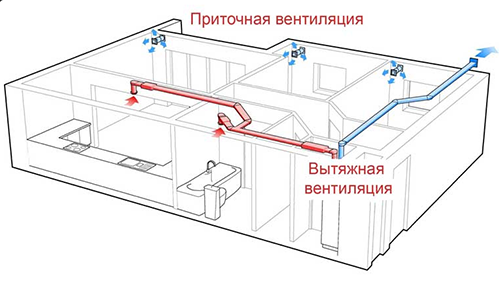
- Supply-exhaust - through one ventilation channels using fans exhaust air is displayed, while other channels "pumped" in the room fresh air from the street. This type of system is the most efficient and popular for private houses, however, the most expensive.


The choice of the ventilation system primarily depends on the materials from which the house is built, its squares, as well as the degree of air purity from the outside (pumping the dirty gas-free air is unlikely to be a good idea). If you live in a house made of wood, ceramzitobetone or bricks in the area outside the city, where the air is clean and harmless, you can make natural ventilation. In all other cases, the last two types are preferred. The financial factor is also one of the dominant, however, to save on arrangement of exhaust ventilation at home should be very careful, so that it is later not to spend a large amount for overhaul.
Exhaust ventilation
In this article, we will look at the exhaust and mixed ventilation systems, since they are more efficient than natural, and more suitable for private houses. The ventilation of the forced type is absolutely necessary in houses from reinforced concrete, polystyrene foamball, as well as modern sip-panels (houses built on Canadian technology). The latter need good ventilating most, since the specificity of the panel mounting causes the full tightness of the internal space (connections without seams and gaps).

Ventilation calculation
There are certain sanitary standards that dictate the conditions for using any ventilation system. According to them, ventilation works fine if the exhaust air in the room is completely replaced by fresh twice an hour or more. Based on this, you must first make the exhaust ventilation, and then buy equipment and make drawings.

At first it is necessary to determine the multiplicity of air exchange. This parameter indicates how many times in 1 hour the air has changed in the room. The multiplicity depends on the square, the functional purpose of the room, as well as the constant number of people in it. For example, for a house of 50 m² and the ceilings with a height of 3 m, the volume will be equal to 150 cubic meters, and at twofold air exchange, the ventilation power should be 300 cubic meters / hour. The multiplicity depends on the number of people, which is written in detail in the corresponding SNiP. For an ordinary home, where a family of 3-4 people lives, there will be more than enough, but for an office with the same quadrature and 30 employees of the air exchange is required at times more.
To determine the desired performance of the ventilation system, two calculations should be made: by the number of people and by multiplicity.
By the number of people indoors: L \u003d N * L norms (L - the desired ventilation performance, is measured in cubic meters / hour; N is the number of people indoors; l norms - air flow by one person).
Here it is necessary to clarify that the air flow rates by man have long been calculated, but, nevertheless, are approximate. So, at rest (sleep, rest), a person spends 20 cubic meters of air per hour, during operation (work at a computer, with papers, etc.) - 40 cubic meters, and during exercise - 60 cubic meters per hour.
By multiplicity: L \u003d n * S * H \u200b\u200b(L - the desired ventilation performance; N - the multiplicity of the air exchange rate (1 - for a residential building, 2.5 - for a small office); S is the area of \u200b\u200bthe room or the total area of \u200b\u200ball rooms; H - Height from floor to ceiling.
When you find both results, select the greater value - this will be the required power of the ventilation system. Based on this indicator, you can already select the appropriate fan (multiple fans). But at the same time it is necessary to remember that the resistance of the aircraft network can provoke a decrease in cooler performance. This can be avoided if you find the dependence of the performance of the system from pressure according to the parameters of the purchased equipment specified in the technical documentation.
Principle of operation
Consider in more detail how the suppress-exhaust ventilation system works to understand how it can be constructed with your own hands and save at work. The principle of operation is quite simple: all over the house conducted air duct tubes of two types - some pull the exhaust air outwards, others sucking inside the room fresh air from the street through a special convector. In this convector, the air is cooled (heated) and disinfected.

Disinfection of outdoor air is carried out by an ultraviolet lamp. Also in the convector can be installed an additional foam rubber filter or Santonin (as in cars). Entering the inside of the room, fresh air creates pressure, forcing exhaust air with pairs to go through special air ducts.
There is also a concept as heat recovery. But first a little prehistory. When I was invented by the supply and exhaust ventilation, and everyone began to install it in their homes, with the arrival of the first winter suddenly there was a problem - the system pumped inside the cold frosty air and "kicked out" all heat outward. Naturally, the costs of heating and electricity increased at times, and this situation required an urgent solution. They became the appearance of a recovery system, which made it possible to use heated air from the room for heating fresh air from the street.
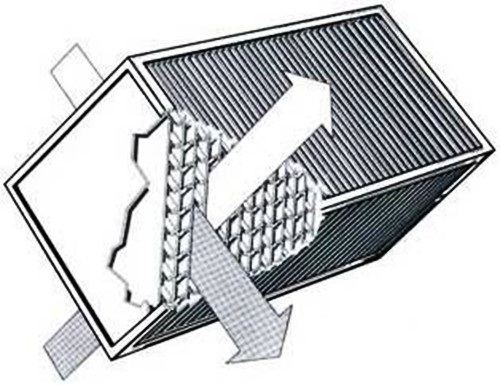
It sounds a bit confusing and difficult, but in fact the recuperator is a special box in which several radiators, filters and ribbons are installed. It is installed on the "output" of the exhaust air, as a result of which heat is used again and reduces the cost of heating by 50%. In the summer, the recuperator closes so that the houses are cool. The cost of the purchase of the recuperator is rather low, but if desired, it can be made with his own hands (a little later).
Types of motivation
Another important point in which you should know to build good ventilation is the views of the air masses. Speaking easier, so begins to move the air to the exhaust pipes.
Distinguish two types of motivation:
- Natural - ventilation works at the expense of the pressure difference in the house and on the street. The best solution will be put by the trim duct from the north side, because it is usually the most windy. To enhance the influx of air, you can also use a deflector that will increase the indicator by 2-3 times. Air removal is better to equip at the most distant end of the house where the receipt of fresh air will begin and distribute it in all other premises. A significant disadvantage of this system is that cold air from the street is not warming up, and it is required to additionally install the recuperator.
- Mechanical - the principle of operation is almost the same as with a natural motivation, except that the cooler or fan is worth at the inlet of the air ducts. His task is to prepare fresh air and insert it inside the room. At the same time, the flow rate increases, which allows you to install the disinfecting ultraviolet lamp inside the air duct and the recuperator with filters. The speed of removal of exhaust air also increases, so it is completely changed several times more often than with natural motion.

Ventilation with your own hands
Conduct installation of the supply and exhaust ventilation can be even without professional skills. The main thing is to be able to handle the tool and correctly calculate the power of the equipment. Depending on the calculations, the diameter of the air pipe and the performance of the fans should be chosen.

After the work of all the calculations, it is necessary to make up the exhaust ventilation scheme - the air intake (or several) with the cooler is located on the north side of the house, and from the central channel there are taps into all rooms. This channel can be equipped with a recuperator and filtration system. Filters should be mounted behind the fans. The yield of the air duct, which serves fresh air outside should be placed closer to the floor, and the intake - the ceiling (warm air always strives to up).
Installation of ventilation
When calculating and the scheme is finished, and the equipment is purchased, you can start installing exhaust ventilation.

Progress:
- In the outer wall of the house, make the inlet and outlet for air ducts.
- Prepare nozzles for mounting wall lattices. Nozzles must be equipped with check valves to prevent small sera, moisture and insects into the air duct.
- Install the nozzles into the hole in the wall.
- Secure the ventilator in the selected location.
- Install the ventilation channels for the fence and supply of air and connect them to the vesting of metal clamps. Air ducts can be used different: flexible aluminum or plastic pipes, air ducts with a square or rectangular cross section.
- Make a wiring through the rooms of the supply and intake channels, screwing them to the walls or ceiling. If necessary, use connectors, tees, etc. The most convenient to spend the channels behind the suspended ceiling.
- Install the ventilation grids in the walls or ceiling, placing the exhaust and supply grille in different corners of the room.
Recuperator
On the installation of exhaust ventilation, you can save even more if you make the recuperator with your own hands. This is an extremely useful detail of forced ventilation, so it is better to immediately consider the need for its installation. Its effectiveness and financial benefits depends on the total amount of the annual maintenance of the system, the prices of energy and exemplary operational periods of the system.
The most common type of recuperators is plate. It can be made of square plates of thick foil, aluminum or copper sheets, thin steel corrugated, textolite or vapor-permeable membrane.

The thermal conductivity of the material from which the plates are made, does not affect the heat exchange processes in the recovery. The number of plates is determined by the number of cassettes collected - for one enough 4 m². To increase the efficiency of the device, the sheets will be required 2 times more with the same sizes of the cassette. You can also make one big cassette, but since it is difficult to remove condensate from it, and it requires a lot of free space, this method is almost not used.
Also for work you will need a corner for fixing racks and flanges. To shift the plates, use a polellar rack or technical cork.
To make the platform casing, you will need:
- sheet metal or plywood;
- plate MDF 2 cm thick;
- mineral wool, foam rubber or other filter material (minvat cheaper than all);
- silicone sealant;
- bar to make a frame;
- hardware.

Progress:
- Gently cut down the sheet material for plates on the squares with a side of 30 cm. To make them as smooth as possible and the same, it is better to fold several sheets into a stack and cut the power tools. For one cassette need 70 blanks.
- On the opposite sides of the squares, stick the gasket or cork or plugs, pre-cutting them with sections of 30 cm. Leave the last square.
- After drying the glue, glue the squares into the cassette, smearing the gasket glue. Apply sheets by unfolding each successive 90 °.
- The last plate without glue strips. Thus, you will have a cassette with a multi-directional channels.
- Fill in the gaps with sealant.
- On both sides of the cassette to make a mounting flange. Note that it should be in one of the corners of the square and the maximum stable vertically as to obtain a perfect rhombus.
- In the lower part of the cassette will drain the condensate, so it is necessary to make a drainage hole drainage tube.
- If you want to make more than one tape in a box, then they should be the same size, and their corners should fit tightly to each other without gaps.
- Insert cassette into a box, the length and the height of the inner walls of the cassette which correspond to the diagonals of the squares, the thickness of the duct must be equal to the thickness of the cassette. If more than one, increase the size of the housing accordingly.
- The walls of the box opposite the points on the tape where the fasteners are made under the flange connections, make openings.
- Install the recuperator to the guides from the corner, securing them on the walls of the box. Thus, you can remove the cassette for cleaning and repairing.

It is recommended to install elementary removable cassette filters for air purification coming from the street. To do this, it is necessary to attach a layer of mineral wool with a thickness of 3-4 cm to the inner surface of the wall of the box. Also, for forced ventilation, it is better to install coolers with adjustable rotation speed.
As you can see, make exhaust ventilation with your own hands is not so difficult if you figure it out in theory and purchase all the necessary materials. At the same time, you can save a significant amount at the installation and you will know exactly how the system works in your home, so you can repair and clean it completely independently.