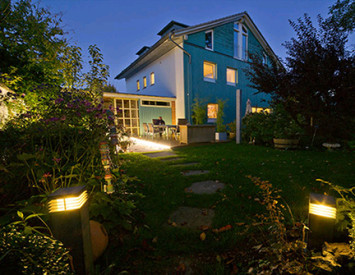
Installation of lamps on the summer site - the task is quite time-consuming, but real even for the electrician-novice. It is clear that the lighting should be not only inside the house, but also outside, otherwise it is impossible to move around the yard after the sunset. In this article we will discuss which lamps can be used for giving, which cables are needed for them and how to install lighting yourself.
Content
Ways lighting
Any lighting, internal or outdoor, performs decorative or functional tasks. That is why it is necessary to immediately determine whether the lamp will be installed for beauty or for a more practical purpose. Decorative lamps are installed in the garden or around the perimeter of the house. They illuminate small architectural forms, flower beds, alpine slides and reservoirs. "Useful" lamps are responsible for the safety of movement on the territory. They are mounted along the entire length of the garden tracks, near the entrance to the site, on the porch, etc.
Installation and connection of lamps in the country has a number of features associated with operational factors. Thus, the products installed outside must have good protection against temperature drops, high humidity, ultraviolet and other weather phenomena. The same advantages should have cables laid through air or in the ground.

To which special attention should be paid when choosing lamps for giving:
- degree of moisture protection;
- frost resistance;
- quality certificate;
- guarantee.
Useful advice: Practice shows that the best qualities demonstrate lamps running from low voltage.
The choice of a certain type of luminaires depends on the purely individual parameters: the desired effect, financial capabilities, the complexity of installation, etc.
Varieties of lamps
To illuminate all the necessary objects in the country, you need to carefully plan the placement of instruments. However, not only affects the efficiency of the system. For example, if you hang a small plafof with a watering lamp to 60 W, then such lighting will allow only the locking well to see the door to open the door. And if in the same place to put a lamppost with a LED lamp or a spotlight, then the lights are enough not only on the keyhole, but also halfway to the house.
Types of street lamps are a lot, but not all of them are suitable for use in the country. One of the most successful and attractive options are forged wall lamps. They simultaneously give a lot of light and decorate the facade.

LED lamps have recently gained unheard of popularity. They are perfectly suitable for use in the open air and generally have a lot of advantages over other devices. First, they consume amazingly little energy and at the same time can continuously work for a long time. Secondly, with its modest "appetite", the LEDs give several times more brightness than incandescent lamps. They are environmentally safe and stand relatively inexpensively, and the installation of LED lamps will not require professional skills.

Economic owners are suitable lamps on solar panels. These are usually small torches lanterns that insert into the ground along the tracks or at several gardens. During the day, the lamp is charged under the sunny rays, and after the sunset gives energy, illuminating the territory for several hours. The obvious advantage of the solar lamps is that for their installation it is not necessary to lay the cable - stuck in the ground and that's it. The disadvantage of such devices is the shorttenance of their work in the dark (3-4 h) - they give energy much faster than accumulating. For this reason, they are used more for decorative purposes.

Conventional incandescent lamps are also suitable for mounting on the street, but in this case you should take care of high-quality waterproofing of the ceiling and cable. This option is not the most economical, so more and more dacities prefer to him LEDs.
Types of lamps:
- Rotten lights - such lamps are installed along the tracks, near the arbors, reservoirs and benches. As a rule, it is made of steel and glass, for a decoration can be used forging. In the form of the formation, there are most often spherical, rectangular or have a non-standard decorative configuration.
- Suspended lights - installation is carried out on a wall or other vertical design by means of special hooks. Often, such lanterns are fixed to large trees, which makes it possible to achieve the original light effect and in harmoniously enter lighting into the natural landscape. Forms of plafones can be very different, but the most common products with a wrought base and glass inserts are most common.
- Street sconces - such lanterns are fixed on the walls of houses or fences. Usually they are made of plastic, metal alloys and glass, but there are also wooden models. With the help of street scaves, it is advantageous to emphasize the features of the exterior and combine the buildings at the cottage into a single architectural ensemble.
- Ground lights are classic lampposts of various shapes and sizes. Install them on Earth, pre-building the simplest foundation to protect against the effects of powered forces and better sustainability.
The choice is truly impressive, but at the same time moderation should be observed - too bright lighting will open the shortcomings of architecture or landscape, and the moderate and skillful arrangement of several lamps will turn even the most non-zeal country plot into the cozy abode.
Principles of lighting
So, we smoothly got to the topic of rational lighting, that is, the arts correctly place the lamps so that they hide the shortcomings and emphasize the advantages of the external decoration of the country area.

The basic principles of selection and installation of street lamps:
- Functionality - Even if you just want to decorate a plot with several light spots, try to arrange them so that they also benefit. If you just buy the lamps where it fell, it will be uneconomically and completely inexpedient. The first thing to highlight strategically important areas of the territory - the gate or gate, the porch, the path from the gate to the house and from the house to the toilet, if the amenities are on the street. If there are stairs in the country, pay special attention to them - stumble in the dark on the steps much easier than on a flat path. In other words, output all potentially dangerous and important sites.
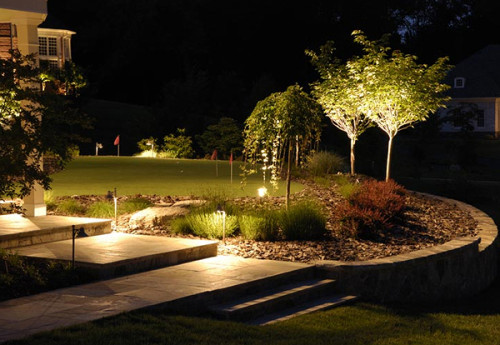
- Decorative - if you set out to cover all paths, pavilions and important segments of the territory, let it be beautiful. Even the most modest searchlight can be beaten so that it will emphasize, say, the modern style of High-tech exterior. As for purely decorative lighting, use it only where there really is something to see - lush flowering shrubs and flower beds, beautiful garden sculptures, tree trunks bizarre, carved garden furniture, etc.
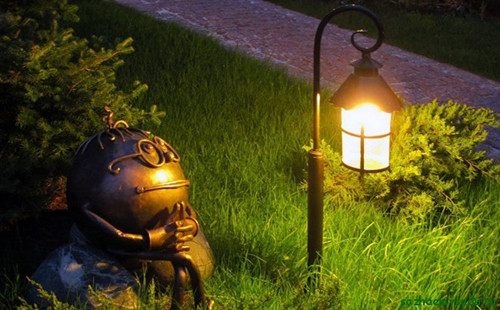


We should also talk about the choice of luminaires for garden paths. Getting around the area should be as secure as possible, so the lighting is necessary to choose the appropriate instruments. Imagine that along the narrow paths are massive street lights - it's not too beautiful, and uncomfortable. Fixtures should uniformly illuminate the entire route, that is, to walking along the path, you do not jump from one bright spot to another, and walked along the path, lit moderate ambient light. In this case, the lamp should not be directed to marching in the eye. If the path is short and relatively straight, would be enough to identify the contours of its small lamps, just rising above the ground or even placed on a par with it. If, however, in the way you expect a sharp turns and stairs, this place should be given special attention.

Illumination of plants and reservoirs
If you want to highlight plants on your site, then it is better to choose large specimens - perennial shrubs, massive trees. It's not just that a small object is "lost" in bright light. A massive trunk or magnificent foliage will reflect part of the world, creating interesting effects.

The light stream should go from the bottom up, while one object can be sent several lamps at once. If you want to highlight a tree by one lamp, try to place it as close as possible to the barrel. If the light sources are more than 2, position them at the same distance from each other throughout the perimeter of the tree so that the light streams converge at the top in about one place. Experts do not recommend placing lamps directly in the crown of wood or the foliage of the shrub, because then they will give local spots of light, and the composition will be unfinished.

As for the reservoirs, in this case the light sources are recommended to be installed around the perimeter or below the water level. If you install a lamp above the water, the light will be reflected from the surface without giving the desired effect. To make a beautiful and expressive reservoir illumination, use the perimeter backlight from the inside and the track leading to it. At the same time, the highlighting of the perimeter should be brighter than the lighting of the approaches to allow focusing on the reservoir itself and at the same time make access to it safe.

Features of mounting lamps in the country
So, we have already found out that any street lamps must be protected from moisture and other negative impacts. Cables for them should also have high-quality insulation, the degree of which depends on the method of wiring. You can spend the cable from the shield to the lamp by air or under the ground.

To put the cable underground is better in all respects - it will not spoil the appearance of the site, it is not necessary to install support for it, it does not stop the wind. Moreover, the cable laid so remains longer, since the earth protects it from any mechanical impact. The airing method of laying cables is used in cases where the lamps are located in the immediate vicinity of the house, for example, for suspended models, scaves or pillars at the porch. The advantage of the airway in its simplicity and minimum complexity compared to the underground, and the cost of such work will be much lower. The latter is explained not only to ensuring the protection of the cable under the ground (gasket in special pipes), but also the cost of the cable itself - for the underground method, the special maximum-ranged product is needed.

Below we in general terms, we consider how to set the lighting in the courtyard of the giving, when the internal wiring and working electric boards with grounding are already available. You will need a shovel, garden borrow, cement and sand to mix concrete, troping, sand and crushed stone to create a drainage pillow, boards or plywood for formwork.
Installation of lamps with your own hands on the country area:
- The first thing is to calculate the lighting, which implies the overall power of all installed lamps and the length of the cable. To simplify the work, draw a detailed outdoor wiring diagram, lines by specifying the cable laying path from each lamp to the shield. The gasket over the air can be denoted by the dotted line, under the ground - solid. The calculation of the total power consumption is necessary in order to understand whether your shield with a similar load will cope. So for large areas with an abundance of tracks rationally carry out the installation of LED lamps due to their economy. Depending on the power consumption, choose the cable cross section.
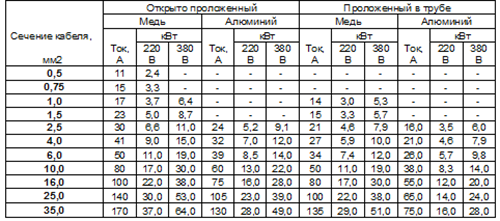
- Create a detailed layout diagram with an indication of the depth of the cable, the depth of the foundations under the support for lamp columns, etc. Under the ground, the cable should go at a depth of about 70 cm in 60 cm from the tracks, 50 cm from the pipeline and at least 30 cm from other underground cables. By air, the cable is made of 3 m above the garden paths and 6 m above the roadway. Do not forget to designate grounding places for all devices.
- Create supports for lamps. If these are wall products, drill in the wall of the hole under anchor. If you want to install a lamor pillar, it will take a miniature foundation for him. To do this, dig a hole in the ground using a garden drill below the soil freezing point (otherwise the spring lamp is twisted), pour sand with a crushed stone on the bottom of the sand, confuse, install a wooden formwork, and in the center stuck the plastic tube (cable is laid inside it). Both end of the pipe should be stuck so that the concrete does not get inside. Fill the formwork with concrete and immediately install the anchor to fix the column at an angle of 90 °.
- When concrete hardens, remove the formwork and process it with bitumen mastic for waterproofing from all sides. Install the lamor pillar and pave the cable to it. Experts recommend connecting wires with isolated terminals (shrink tube or other isolation). Do not forget to install switches in moisture-protected places. It is best to make a special box for them, for example, at the entrance to the site and duplicate on the porch or inside the house.
- Spend a test switching on by checking the zero resistance with a phase.

Installation of lamps in video format will help you in full attention to evaluate the specifics of the work:
Installing lighting in the country can be in a few hours, of course, if we are talking about hanging products or installation of point lamps. Working with lanterns will take more time, but the result is worth it. The main points that should be taken into account are the choice of products (lamps and cables) created specifically for use on the street, the correct calculation of the power and grounding of each element. In compliance with these three rules, the lighting on the plot will delight you for many years.