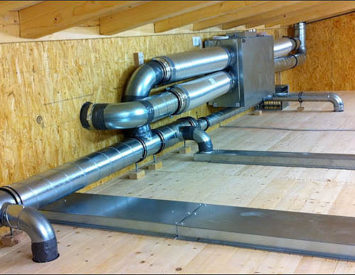
Ventilation is needed in each room, since it is thanks to the correctly adjusted air exchange, a comfortable microclimate is created in the house. However, unfortunately, not all household owners are under the power to install an expensive supply-exhaust system. Therefore, forced ventilation is most often equipped. But it should not be thought that its installation only comes down to installing and connecting the fan, because this air exchange system is based primarily on the correct calculations and on the competent placement of all elements. On how to make ventilation in the house with your own hands, let's tell further in the article.
Content
Characteristics and types of forced ventilation systems

Forced ventilation, this system is named because the air flow passes through the ventilation structure is not natural, but with the help of additional mechanisms and devices. In this case, the fan is used. It is placed in the air duct, thereby creating an increased air pressure, displacing the flow through the central channels. This is the optimal way to improve the quality of the air exchange, because the exhaust air is not delayed in the system for a long time, but it comes out forcibly. Fans are usually placed in kitchen air ducts or in bathroom. Thus, in the room where the forced ventilation is equipped with their own hands, fresh air is always present.

The system of forced ventilation is relevant for both private houses and apartments located in high-rise buildings. There are several species of forced air exchange:
- Potion
- Exhaust.
- Combined (sleeper).
Depending on how air is under the system, forced ventilation can be:
- with air duct;
- without air ducts.
If you decide to equip the forced ventilation of the house with your own hands, then the most effective option will be a combined (imputy-exhaust) air exchange. Here will be adjusted simultaneously and the influx of fresh air and the outflow of spent. Make such ventilation in a private house with your own hands is not so difficult.
Constructive elements of the ventilation system

With the arrangement of forced ventilation in an apartment or house, you should know from what structural elements it consists of:
- Lattices through which air is collected. They protect the design from entering the system of small rodents, dust, garbage. Usually they are fixed on top of the ventilation pipes.
- Filtering devices. They are designed to clean the air from garbage, as well as from large dust particles. Filtering devices are classified according to the degree of filtering. Depending on the functionality of the devices, their price is different.
- Regulatory valves. Send the flow of air into the air duct. Regulate the trajectory and force of the air supplied.
- Fans. With the help of them, the exhaust air is in a timely manner out of the system.
- Sound filters. Thanks to these devices, the operation of the ventilation pipe made by their own hands is silent.
- Calorifers. Adjust the temperature of the supplied air.
- Pipe-ducts. On them passes the spent air and comes fresh into the system.
- Automatic adjustment system. A block capable of adjusting the operation of the supply ventilation made by its own hands. Very often, such an automatic adjustment system is not installed in private homes, due to its high price. However, this unit significantly improves the efficiency of the entire system, automatically including and turning off the fans, calorifers.
Ventilation with your own hands: scheme

There are several ventilation device schemes, and depending on where it will be installed, its type is selected. So, there are:
- Combined systems. In such a system, forced ventilation is equipped together with natural. For example, air supply during ventilation arrangement in the garage can be carried out in a natural way, and the exhaust air output passes under the action of the fan.
- Cooling ventilation. It is not installed in all types of rooms and is quite expensive. With such a diagram of the device, air conditioner placed in the air duct, capable of cooling the incoming air. The cooling device is mounted directly on the ventilation riser.
- Heated ventilation. The device of this ventilation system is similar to the previous one. Only in this case is not installed conditioner, but a recuperator. With it, it is possible to save the cost of electricity. However, such equipment is quite expensive.
- Supply-exhaust system with recycling function. This air exchange system is difficult to mount itself, without attracting qualified professionals. However, if you have already taken out of such work, over time they will justify themselves, since this ventilation system is considered fairly effective. When using this design, the exhaust air passes through the filtering device and diluted with pure outdoor air. In this form, it falls through the pipe system directly into the room. Very often, according to such a scheme, the ventilation in the bath do it yourself.

With the arrangement of the forced air, it is important to calculate correctly and determine the value of the following parameters:
- Total ventilation system performance.
- The number of fans required for normal ventilation operation.
- The noise level that will produce the system when the air flow through it is passed.
- Dimensions of air ducts.
- Performance of additional equipment: heaters, heat exchangers, air-conditioning.
- The volume of air that would pass through the ventilation system at a period of time. This figure is called the "multiplicity". For example, if the value is 3, it means that the flow of air within one hour of three pass system.
- Proper distribution of airflows. It is important that the ventilation system was undeveloped, so that fresh air is evenly distributed throughout the room. In these calculations it is necessary to focus on the total area of \u200b\u200bthe house where the vents are installed. Indoor large area should make a record of air as high as possible.
- The locations of intake and exhaust valves of the air flow. From these calculations depends on the overall efficiency of the entire ventilation system. When calculating important to consider how many people will continue to live in the house, as well as the overall specificity of the room. For example, for the kitchen facilities, which will often prepare food, and will be smoking people, exhaust ducts should be positioned above and more than blowing.
Installation of mechanical ventilation system

Since the forced ventilation system works quite noisy, it should be located in areas that are far from the bedroom, hall, children's room. Ventilation can be mounted, eg in the kitchen, hallway, on the balcony or in the attic.

Procedure for work:
- Initially prepare the site for installation of ventilation ducts. To do this, reinstall the glazing a few centimeters below the window overlooking the balcony. Opening, which was formed between the old and new window opening, closing of the foam insert.
- Embedded in the polyurethane foam connecting pipe. If the point of connection with the hole remains, it should be sealed in any connecting material.
- At a distance from the polyurethane insert mount an air filter (tubular suction type EF or CCF).
- Mount heater. It can be located at any distance from the filter device and connect to it using a flexible hose. It is said that the body of the electric heater during operation is heated to high temperatures, therefore it should be insulated. In addition, it is periodically necessary to remove the cover during operation.
- Install the fan that will adjust and direct the air flow in the system. It should be located at some distance from the heater. Most often, this distance is 30 cm. It is best to take a semi-automatic fan. It is capable of turning off after a certain period of time (according to a given timer) and turn off when increasing the level of humidity in the room.
- In order to make the fan work not so noisy, you can install the device in the box and insulate the mounting foam. Previously in the box are done by the air duct and for further laying of electrical cables.
- Next, the air duct is mounted, which will pass the spent air. Usually enough pipe 70-80 cm long, but in some cases it may be necessary to install a longer duct. The total length of the ventilation system will be about one and two meters. If the length of the duct is greater, it will require galvanized pipes to install it.
- In the pipes through which fresh air will flow, grilles are installed. Their sizes average are 10 by 15 cm.
- In order to make the operation of the ventilation system more efficient, you can automate it. To do this, the thermal sensor and temperature controller is installed. Such devices are powered by the power grid. Wiring can be "hide" in specially done channels in the room walls.

As you can see, the personnel installation of the forced ventilation system is not such a difficult task that will be for each homeowner.