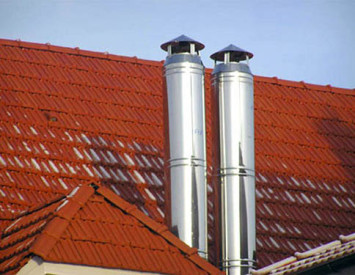
Stainless steel chimneys are best suited for installation with their own hands. With this work, the person will cope with this work, since everything that is required of it is to connect the finished components of the design of the designer. Of course, there are some nuances in this case, on which the efficiency and durability of pipes depends. From this article, you will learn everything about how to properly collect chimneys from stainless steel with your own hands.
Content
Features of construction
Stainless steel chimneys have the second shorter name - sandwich chimneys. As in the case of the sandwich panels, such a name is explained by the characteristics of the pipe design - they are created from several layers. The inner layer is made of stainless steel so that condensate arising in the process of operation of the furnace or boiler did not destroy the pipe ahead of time. Behind him is a heatel that does not allow the smoke to cool too quickly (if the hot smoke collides sharply with cold street air, condensate will arise). As thermal insulation, as a rule, use non-combustible basalt materials (mineral wool). The outer layer is made of stainless or galvanized steel (budget option), which gives the strength of the structure.

Such a device makes it possible to maximally successfully remove the furnace gases and soot, because the inner layer of stainless steel resistive tolerate extreme temperature differences, and its smooth surface does not delay the particles of soot. The latter will like it very much to those who decided to replace the brick chimney steel - it will have to clean it much less.
The advantages of stainless steel chimneys:
- The possibility of mounting at any time of the year.
- Elementary maintenance and care - since the inner contour does not contribute to the accumulation of soot, it is enough to clean the chimney once a year.
- In the event of a breakdown of a segment, there is no need to dismantle the entire design - you can disconnect and replace the faulty section.
- Due to the small weight of the chimney, it is not necessary to build an additional foundation under the oven, as in the case of brick products.
- There are variants of chimney pipes for all types of fuel: coal, firewood, gas, oil. By establishing one or another look, you should know that it will be most efficient to withdraw the smoke only in the case of the furnace furnace with a suitable raw material.
- For the manufacture of contours to a metal alloy, a titanium is often added to giving strength. There are heat-resistant pipes with a thickness of the walls to 1 mm that can withstand the heating to 600C.
- The durability of the design is determined by its quality. Good stainless steel pipes for chimney will serve 20-30 years.
Of course, some pipes for installation are not enough - a lot of fittings and fasteners will be required (brackets, revision, adapters, tees, knee, clamps, rosette, etc.). More details about the structure of stainless steel chimneys and installation is described in the video below:
The upper part of the chimney must be cone-shaped, as well as have a spark-like, a writer or at least thermal crib to protect the roof from fire, and that the precipitates do not get inside. The thermal insulation of sandwich chimneys allows you to withdraw them on the outer wall of the building, but if there is an opportunity, it is better to skip it inside the house to shorten the heat loss.
Types of metallic chimneys
Going into the construction store, you will see several varieties of chimney pipes. They differ not only worth the cost, but also a structure and purpose. The above-described products have two walls, between which the insulation is placed. Such pipes are suitable for installation on fireplaces, boilers, gas appliances and stoves.

There are also inexpensive single-bed pipes. There is no insulation in them, so there can be no speech about any insulating abilities. Such products are designed to repair any segment of a metal chimney, creating compounds in brick chimneys and enhanced design.

There is a third look - the most expensive. Coaxial pipes appeared on the market relatively recently and immediately demonstrated their effectiveness. They have an unusual structure - a smaller tube is placed in a larger diameter pipe. After one, it leaves smoke from the furnace, the fresh air penetrates through the other inside and maintains intensive burning. Coaxial chimneys allow you to make heating devices with more autonomous and used in cases where a constant oxygen supply is necessary for combustion of fuel.
Methods for connecting pipes
For the connection of stainless steel sandwich-chimneys, standard parts are used, however, the attachment methods may differ depending on the desired result.
There are two methods for docking elements of a sandwich chimney:
- For smoke - this method guarantees the protection of the inner premises of the house from the penetration of carbon monoxide. It is often used when installing heating equipment inside a bath or residential building. It is very important to isolate all the seams high quality, otherwise the condensate wet insulation.
- According to condensate - this technique allows you to create conditions in which condensate designed due to a sharp drop of temperature drops along the pipe down. With this method of assembly, the internal pipe of the upper segment is raised into the nizhny's socket, and as a result, the water flowing on top cannot harm the insulation. However, smoke can penetrate the house if there is at least one small gap.

In the first case, the chimney may suffer from condensate, in the second - there is a risk to choose carbon monoxide gases, so what to choose? If you build a chimney inside the house, it is better to give preference to the method "by smoke", if in the utility room - "on condensate". However, in both cases, you pay special attention to the sealing of all seams.
Installation of chimney
The dimensions of the chimney of stainless steel depend on the size of the building and the required thrust force. The standard length of one segment can be 50 cm or 100 cm. Installation starts from below near the stove and gradually move above, inserting one element to another. However, many experts recommend to act with accuracy on the contrary - to collect chimney from above-down, starting from the roof. This will allow in the event of a breakdown not to disassemble the entire structure, and easily remove the faulty part and replace it with a new one.

On each segment there is one narrowed end - it should go into a wide end of the next part. All the links should be fixed so that the condensate accumulate on the walls can smoothly flip down and can not linger in the seams.
Useful trick: To connect two pipes to high quality, pull out the inner contour of one of them by 15 cm, then insert into another pipe, after which it is built by external contours. Each joints mark the sealant and reinforce the steel clamp. The sealant should be a special - the usual simplicity will deal with high temperatures at the first furnace.
How to remove the chimney out
First of all, when removing the chimney on the outer wall of the building should take care of its sustainability. Sharp gusts of the wind, a strong degrees or a random blow can become a fatal closer, threatening to leave the house without heat. So that this does not happen, the chimney should be firmly consolidated. To do this, use various brackets that fix the chimney to the wall every 1.5-2 m.
If the design provides for the installation of a tee or a round, these parts should also be attached to the wall. They will hold the chimney strictly vertically, they will not allow its collapse and remove part of the load from the docking elements. At the same time, between the chimney and the wall, it is necessary to withstand a small distance - the retreat. To calculate the value of the descend, it is necessary to take into account the thickness of the heating equipment wall, the character of the furnace (open / closed), the degree of flammability of the walls of the walls. Let us give an example: let's say, the thickness of the wall wall with a closed firebox is 65 mm, and it is located near the wall unprotected from the fire. In this case, the safe distance will be equal to at least 50 cm. If the furnace has thicker walls, say, 120 mm and stands near the brick-free wall, the indent can be reduced to 20 cm.

If you need to set the chimney inside the box or between two walls, two window openings in size 150 cm² should be made on the outer wall. One window should be located on the lower floor, the other is closer to the roof.
Passing overlaps
If you keep the chimney inside the house, it is sooner or later we refer to the overlap between the floors. How to be in this case? To bring the pipe through overlap outside, you need to make a special box with a hole in the middle. Insert the pipe with a diameter of slightly larger the diameter of the chimney into this box. The thickness of the box must exceed the thickness of the floors by 7 cm on each side.

The main purpose of such a box is to protect the overlap from ignition. In the process of operation of the furnace, the chimney can crack up to 100 ° C and more, which creates a fire-hazardous situation, so it must be inhibited. The box should be carefully fixed in the overlap and tie with the pipe. The nozzle inside should be solid (without junctions, otherwise they will quickly disperse from temperature differences).
When you set the box to the overlap, the nozzle is necessary to isolate high quality. To do this, it is better to use special mineral wool mats with a foil coating, which reflects heat. Such mats are covered with refractory mastic and are not afraid of high temperatures. The hole in the roof will also not prevent these mats for reliability.
Remove the chimney on the roof
So, the installation of stainless steel chimney is already nearing completion, but there is still a very responsible moment in front - removal of the pipe on the roof. You can do this using a special link - the roof cutting. The cutting should be selected in accordance with the angle of inclination of the roofing of the roof.

How is the elimination of the chimney:
- Using the marker, make marking on the inner surface of the roof. The diameter of the future hole should be slightly larger than the diameter of the chimney tube (only a few millimeters).
- Cut through the end-to-end hole in the roof, alternately cutting and removing each layer of roofing pie. Do not even try to cut through everything in one fellible - the result will not please you.
- Inside the holes, place the steel pipe to isolate the roofing layers.
- From the inside to the roof, attach a steel sheet with a hole for the chimney in the middle.
- Output the pipe out and install the roof cut from above.
- On top of the cutting, mounte the required number of links.
- At the very end, attach an umbrella or a sparker to protect the pipe from precipitation, and the roof is from fire.

Important: where the pipe passes inside the roofing pie, there should be no joints!
Useful advice
Stainless steel chimneys are a new generation product and successfully replace massive brick structures. And at least the cost of them sometimes exceeds the price of the installation of even ceramic chimneys, the benefit becomes noticeable in several months of operation. So, steel chimneys less often need cleaning and break less, and if this happens, you can simply buy a new segment and quickly replace it without dismantling the entire riser.

And so that the use of chimney has become even longer and more convenient, we have prepared several useful advice:
- When the cleaning time has come, start working on top, pre-make sure that the chimney does not blocked (the bird could reject the nest in it, the leaves attacked, etc.).
- If the chimney has been driving something, do not try to pull the blockage, but simply push it to the nearest revision. Audit is special mounting elements that are installed in several places along the entire length of the chimney. They accumulate trash falling from above. Before cleaning, all revisions must be closed.
- To remove soot, get a special rash, the diameter of which should be slightly larger than the diameter of the chimney pipe. First, work as a hero, and when the soot grabs, clean the audit tanks.
- To clean the chimney as much as possible, try not to stir the furnace of wood coniferous rocks. It contains the resins that settled on the walls inside the pipes and form labor-based contaminants. The same will happen if they drown the stove with raw wood.
- It is not recommended to burn the household garbage in the "home" furnace - use for this old metal barrel on the street.
- For prevention from time to time, throw in the oven a little aspen firewood - quickly burning, they give a powerful high flame, burning soot inside the chimney.
Installation of stainless steel chimneys is not so complicated, if you correctly pick up the pipes and know how to contact them. Use the recommendations from this article and everything will succeed!