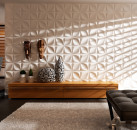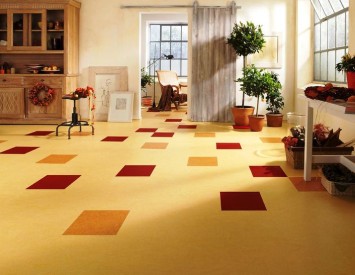
Linoleum is one of the most popular floor finishing materials. Its closest relative, marmoleum, has similar manufacturing technology and similar characteristics, but differs markedly on the component composition. In this article, you will find detailed information on such a cover as Marmoleum, learn about its advantages and disadvantages, as well as on installation methods.
Content
What is marmoleum
Some manufacturers are positioning marmoleum as an innovative material, meanwhile, it is not quite so. Marmoleum really appeared in the construction market not so long ago, but, in fact, it is a coating manufactured by old technology using the latest equipment, as well as completely eco-friendly raw materials. In appearance, the method of production and many technical and operational characteristics of marmoleum resembles a linoleum, only in its component composition there are no synthetic components. Such material is considered to be something among the linoleum and laminate, since marmoleum combines the best properties of these two flooring.
As it was labeled earlier, only natural raw materials are used in the manufacture of such material. The following components are present in the marmoleum:
- resins of coniferous breeds;
- wood flour;
- chalk;
- cork wood;
- linseed oil;
- painting substances of natural origin.
Natural pigments that are used in the production of marmoleum have a very wide color palette. Thanks to this, material manufacturers can offer potential buyers a very wide range of their goods. A variety of color gamma material allows you to enter such a floor covering in various interior styles. By the way, the production technology provides for the coloring of the marmoleum for all its thickness, because even more years later, when the material is somewhat angry, it will not lose its original shade.
The price of marmoleum is low can not be called, but its high quality and excellent performance justify the cost. In addition, the high cost of the coating may be due to the peculiarities of the process of its manufacture, which, must be said, takes a lot of time. Marmoleum production can be briefly described in the form of such steps:
- Initially, all the necessary components are stirred between themselves, and then leave the resulting mass on the ripening. Such a process lasts about 7 days, while the mixture should be maintained at a certain constant temperature.
- When the week passes, the mass for the production of marmoleum is painted in the desired color by making the necessary pigments. After that, the substance is pressed on special equipment.
- The resulting layer is divided into strips of a certain width and applied to the jute base.
- Then the future marmoleum is placed in the drying chamber, where he reaches for another 14 days.
- Almost ready marmoleum is covered with a protective polymer layer. This layer will prevent the rapid abrasion of the material and increase its durability. Optionally, you can buy absolutely natural marmoleum, on which there is no polymer film, but to care for such a coating will have to be regularly and thoroughly, rubbing it from time to time with special compositions.
The first company, which released Marmoleum to the construction market is the American company Forbo. Despite the fact that now on sale you can find goods of various manufacturers, marmoleum forbo is still considered to be a high-quality floor covering, which is able to serve not one dozen years. Such material meets all international quality standards, is considered environmentally friendly and durable.
Forbo's popular line of goods is Marmoleum Real. It is represented in the market in the form of panels or plates created from cork crumb and moisture resistant NDF. The upper protective layer of material has high wear resistance, as well as high-repellent properties. Such a coating is not damaged even from animal claws and thin female heels.

Pros and Cons Marmoleum
Marmoleum has many positive characteristics that I would like to consider in more detail:
- As mentioned above, all components that are part of the marmoleum have an exclusively natural origin. That is why the material is considered environmentally friendly, harmless to human health and the environment.
- Marmoleum refers to hypoallergenic coatings, besides, it is also characterized by bactericidal properties. Such a coating can be used in the children's room without fear for the health of the kid.
- Despite the fact that Marmoleum is more expensive than ordinary linoleum, he will still cost its owners cheaper than laminate.
- This material has excellent sound insulation properties, moreover, it additionally insulates the floor. In the room where Marmoleum is packaged, it will be quiet and cozy.
- Such a coating does not fade from the long-term action of ultraviolet, resistant to water, moisture and abrasion. Marmoleum is able to serve for many years without losing his color and beautiful appearance.
- It is easy to remove such a floor, the dirt is practically not absorbed into it and even if you are playing the floor of the oil paint, it will only be enough to wipe it with a rag.
- Marmoleum is not electrified, besides, it is absolutely fireproof.
- There is a lot of marmole coloring, so almost every consumer can choose the goods to their taste. At this time, marmoleum manufacturers produce products in 100 different main colors, and the number of shades reaches at least 2,000 options.
- This material can be used in any premises, including in the kitchen. Marmoleum is well tolerates temperature differences and humidity. When cleaning it, you can use a variety of cleaning products, because it does not enter into chemical reactions.
If you decide to buy Marmoleum, you should familiarize yourself with the disadvantages of this material:
- Such coating is characterized by some fragility than the features of its storage and installation are due. You can twist the marmoleum into a roll at no longer 1 times, while you need to turn it in such a way that the scaffold of the sheet was outside. When laying, marmoleum fragments can break through the edges, so the process should be carried out as careful.
- Over time, marmoleum can harden, which leads to risk of fracture risks on the floor covering.
- The material has a sufficiently large weight, as well as good plasticity. These qualities can be considered advantages if the coating is used to finish the floor. But for the cladding of the walls, the marmoleum will not suit, because it will be deformed over time under the action of gravity.
- Another minus is that it is very difficult to get a smooth edge in the process of cutting marmoleum. But even with this disadvantage, they learned how to cope, cutting off the sheets only near the walls and masking the edges of the plinths.

Classes of material and output
Marmoleum is available on sale in several forms, thanks to which the buyer can choose the most convenient option:
- Marmoleum in rolls is easy to install and allows you to store the floor with a coating in a short time. A standard roll of material has a width of 2 m, and its thickness is different and depends on the marmoleum class.
- The marmoleum in the form of tiles is sold in several sizes: 50x50 cm and 30x30 cm. In contrast to the roll material, some pattern can be put on the floor on the floor, which allows you to give the floor a unique view.
- The marmoleum panels have a size of 90x30 cm. They are easy to install thanks to a special lock system. In addition, such locks provide for installation of material using glue.
If we consider marmoleum from the point of view of wear resistance and quality, 3 main class of material can be distinguished:
- 21-23 Class is a general-purpose coating. Such marmoleum has a relatively thin top layer, the thickness of which does not exceed 2 mm. However, this particular class is most often used in the decoration of residential buildings and apartments. First, a similar marmoleum costs a bit cheaper than high-class materials, and secondly, the wear resistance of the coating is good enough to use it in residential rooms.
- Marmoleum 31-33 class is most often used in industrial premises, where there is no large stream of people, but where there are constant static loads on the floor. The thickness of the upper layer in such a material is 2.5 mm, such a coating with ease withstands high weight, but it is not too stable to variable loads.
- The material 41-43 of the class is considered the most durable and wear-resistant. Its top layer has a thickness of more than 3 mm. Such marmoleum can withstand variable loads, such as a large stream of people. Thanks to such qualities, the marmoleum of this class is used in public premises, where it is often crowded.
You should choose the appropriate type of material, first of all, based on considerations of its destination, and without relying on the price and wear resistance. For example, the most expensive marmoleum 41-43 class will serve for many years if you separate them the floor of the shopping center. But if you lay it in the production room, from static loads it is deformed faster than the cheaper marmoleum of class 31-33. For a residential building or apartment, a class of 21-23 is quite suitable, the strength of which will be enough for a long floor service, and buy the most expensive marmoleum in this case does not make sense at all.

Floor Paul Marmoleum
The longest service life of the Marmoleum will have in the event that it is to exploit it in favorable conditions. Such conditions mean that the ambient temperature should be at least + 18 ° C, and the air humidity should not exceed 60%. It is not recommended to retain the marmoleum in summer kitchens, on balconies, open verandahs, loggias, in arbors, etc. It is best to use such an outdoor coating in bedrooms, halls, halls, living rooms, children's rooms, offices. We will talk about the peculiarities of laying marmaoleum further.
Preparation of the working surface
Before purchasing flooring, do not forget to see the material for the presence of defects. After the marmoleum is purchased, it is necessary to leave it for several days in the room where it will be used. Store the coating is needed on a flat surface.
Before laying marmoleum, the walls of the room must be plastered, and all windows and doors are installed. It is desirable that the work surface is as strong as possible and fairly smooth. In the case when the floor is too curve, it must be aligned by performing a dry screed or using a bulk sex. In addition, before laying marmoleum, the base should be dry, with a humidity level of no more than 2%. It is possible to water the floor using a plastic film 0.2 mm thickness. Separate parts of the film should be laid on 20 cm in about 20 cm, and the edges of the material should be laid on the wall at least 5 cm. To create additional heat and sound insulation on the floor, it is desirable to cover it with a foamed polyethylene with a thickness of approximately 2 mm and a density of 30 kg / m³.

The process of laying marmoleum
The technology of installation of rolled marmoleum is very similar to the technology of working with ordinary linoleum. In the process of laying it is important to remember the fragility of the material and not bend it too much to avoid the formation of cracks.
To cover the floor marmoleum, first you need to stock such tools and materials to begin:
- pencil for making markup;
- hammer;
- roulette;
- hacking or electric jigsaw;
- wooden bars;
- cligs with a thickness of about 1-1.5 cm.
If you use marmoleum in stoves, you should decide in advance with the location of the picture. It is advisable to immediately depict schematically how the elements of the material on the surface will be located. In such a drawing, the thresholds should be denoted, various protrusions of the walls, niches, the location of pipes, etc.
Mounting process of marmoleum can be described in stages:
- First you need to decide on the number of necessary material. Calculate how many solid tiles or panels can accommodate the width of the room. Then calculate the number of rows along the length of the room. Do not forget that around the perimeter of the floor you will need to make a small gap equal to 15-30 mm. This clearance will subsequently be covered by plinths and becomes invisible, but in the case of temperature changes or plastic deformations, marmoleum will have a stock for expansion. In the absence of such a stock, the flooring can be taken. You can put the necessary clearance with pre-prepared wedges.
- The first marmole panel must be stacked the crest to the wall. All other elements are connected to each other until the row end. Customized panels are convenient with a hammer. So as not to damage the material, first you need to attach a wooden bar, and then tapping a hammer on the bar, adjusting the position of the part.
- The beginning of the second row is performed from cropping the panel or tile of the previous row. This fragment is inserted by a spike in the groove of the part of the first row, while the lock is not snapped to the end, and the fragment is installed under the tilt. In order to observe the slope, the bars are used again. In this way, all parts are connected to ends with each other until the row is completed. As soon as the panels of the series run will be laid, wooden bars are removed and snapped elements of the first and second rows.
- Similarly, finish the rest of the floor surface.
- If, in the process of operation, the gap between the wall and finishing material was less than 1 cm, the marmic position should be corrected.
- If, when laying the last row, the plane marmoleum does not fit in it entirely, you can cut off the jigsaw more too much.
- In those places where the pipes are laid on the floor, between them and the coating also need to leave small gaps. When the floor is ready, these places can be masked with special linings.
- When installing plinths, they are fixed only on the wall surface, but not on the marmic. Such a coating should have some mobility.
- In the event that the details of the marmoleum during the installation process were slightly damaged, the defective places can be sealed using a compound of a suitable shade.
Marmoleum, photo: