Among all types of floor coverings, linoleum is of great popularity. It is durable, wearless, hygienic, environmental and relatively inexpensive. Modern manufacturers offer us the widest choice of shades and textures of such a coating, including options that imitate parquet, laminate and other materials. In this article we will talk about the types and features of the linoleum, as well as how to properly sash it to the floor.
Content
Features and types of linoleum
Such an outdoor coating is good because you can always choose the option optimally the corresponding interior. It is worth noting that modern production technologies allow creating a very high-quality and externally attractive material. For example, linoleum with imitation of laminate often at first glance virtually no difference from the real laminated board. But it is worth it is noticeably cheaper, it is easier, and there is no difficulty care.
The advantages of linoleum can be attributed not only reasonable price and ease of washing, but also abrasion resistance, water resistance, environmental friendliness, to changes in temperature and UV stability. This coating is not afraid of mold and mildew, it will not start pests.
Lay linoleum, you can almost any base, most importantly, that it had been carefully prepared. The surface to which the material laying should be smooth, clean and dry. When it comes to wood, then you have to get rid of all of the projections and cracks and seal the gap between the boards. If this is not done, the elastic web material following the shape of defects on the surface.
Before you lay linoleum on the wooden floor itself, you should decide what kind of material is worth buying. To do this, you must familiarize yourself with the varieties of flooring:
- PVC linoleum is manufactured from polymeric materials. It can be a single layer or multilayer. A multilayer material except for the front side has a foamed, heat-insulating fabric or substrate. Coating Foam consists of 4 layers. Among its advantages can distinguish good acoustic and thermal insulation properties, high strength, long service life. By cons should include the lack of flexibility. Such a material used in high humidity level smokers and people with a high permeability. Linoleum on the basis of tissue-ply. According to its heat-insulating and anti-noise properties, it is inferior to the previous version, but it has good elasticity and durability. The coating on the insulating substrate includes a felt layer or the substrate of a foamed synthetic material. The easiest and cheapest type - linoleum without backing. It is characterized by a uniform structure, can be identified among the advantages of elasticity, water resistance, durability.
- Alkyd coating made from alkyd resins with the addition of mineral fillers. Typically, such a linoleum has a substrate made of natural or synthetic material. A distinctive feature of alkyd coating is a low elasticity, because of which it may crack or break.
- Rubber linoleum is made up entirely of rubber. The upper decorative layer has a beautiful color, or pattern. The substrate acts as a mixture of bitumen and crushed waste rubber. An advantage is flexibility, water resistance, abrasion resistance. Most often this material is used in manufacturing and processing facilities.
- Colloxyl linoleum is made from nitrocellulose. It is enough elastic, not a fuel, has a beautiful glossy surface.
All types of linoleum are available on sale a wide range of shades and drawings. A protective film is applied on top of the decorative layer on the linoleum, the thickness of the material depends on the thickness of which. The more wear-resistant coating, the wider the scope of its use.

Laying linoleum on the wooden floor do it yourself
Wood assessment
Installation of linoleum on the wooden floor always begins with an assessment of the condition of the working surface. It is from this that the need for preparatory work depends. To begin with the wooden floor, you need to vigorously walk or even run. A reliable base will not creak or be fed under your feet.
The second stage you need to estimate the state of the boards, which is determined by their color. Healthy wood has a uniform natural shade without darkening. If there are still dark spots on the surface, try to pierce them with a seboard or a screwdriver. In the fired wood, the metal will be easily, and the healthy will be solid and strong.
On the wooden floor there should be no plates of mold or fungus, and the nails, which are nailed to the boards, should not be rust. It is especially important to check the base for the presence of rot before sitting the linoleum on the wooden floor of the balcony.
It is worth assessing the floor and for the presence of pest insects. If bugs started in the wood, you will find the grooves eased on them. Finding false or acredited boards, they should be replaced with new elements, and in the case of bugs, the floor will also require bioprotective treatment.
When assessing the state of the floor, lift a pair of boards and look at their inner side, and also pay attention to the lags. Like the boards themselves, they should not be moldy or eaten.
Wooden floor also should not be fed under his feet. If this happens, then lags do not withstand the load and need to be strengthened. The coating can creak and in the case when the boards rub each other. Such a problem will help solve the talc falling asleep in the gap.
With the help level, you need to check the horizontal surface. By fulfilling all the recommendations, you will get a beautiful and careful coating.

Necessary materials and adaptations
To cover the wooden floor with linoleum you need to prepare materials and tools:
- toothed spatula;
- knife;
- roller;
- glue either bilateral scotch;
- a line of at least 2 m long;
- nails;
- cold welding, if you connect the joints of sheets in this way;
- wood putty;
- veneers, wooden bars, screws or other tools for alignment of the floor surface;
- scraping machine.

Floor preparation for work
linoleum flooring technology provides for the preparation of the working base. If the surface is flat and does not creak, then such work will take a minimum amount of time. You will need to remove the old floor covering residues protruding nails into the wood hats drown.
All minor defects easiest to trim scraping machine or a simple plane. Once you remove the top layer of wood together with minor irregularities, putty seal the cracks and crevices, as well as the places where the nails are hammered. For this job you will need putty for wood. If you do not produce the alignment of sex, the defects may be visible on the surface of linoleum, it will ruin the aesthetics of it.
If differences of the working height of the base is quite noticeable, it is a simple scraping machine can not cope with them. Before you lay linoleum on uneven ground, it is necessary to align. We describe two most common ways:
- The first method involves the use of self-leveling mixtures thereof. This mixture was poured onto the floor with a continuous layer and is distributed over the surface. It covers all of a gap and protrusions creating a horizontal surface. It should be noted that the wooden floor like the alignment is not considered to be optimal, but if you decide to use this method, you purchase a special blend of wood.
- More plank claimed method of aligning involves the use of a base sheet material such as plywood, chipboard, hardboard, furniture panels, etc. To begin such sheets trail on the floor, after covering their inner side and parquet planks with glue or with a mixture of gypsum and PVA. After hardening the adhesive sheet fixed with nails or clips. If the sub-floor elevation are significant, then the first on his stack logs in the form of bars, fitting them under the horizontal level. Then these logs and stack the sheets. The joints between the fragments of obscure filler, and after drying, the entire surface is impregnated with linseed oil.
The final stage of the preparatory work - is the cleaning of the base of the debris and dust. Linoleum laid only on a clean and dry floor.

Preparation and packing material
Before beding the linoleum on the wooden floor, you need to calculate the required amount of material. The calculation is made by pre-measuring the area of \u200b\u200bthe room and adding to the figures obtained by 10-15 cm. If a repeating pattern is applied to the material, then you need to purchase 1 row of linoleum more from each side. It is worth taking into account the temperature shrinkage, for example, for PVC it \u200b\u200bis equal to 2%.
If you want to lay a linoleum on the wooden floor with your own hands, expect caution during the transportation of the material. It can not be very popular to avoid the formation of the chances. When you bring sheets to the place, spread them in the room and roll out from the center to the walls. Leave in this form for 2 days. If there are waves and bubbles on the surface, press them with something heavy.
Fractures and bends strongly spoil the appearance of the coating, if such defects are significant and hid them in the repair process will not work, it is better to change the entire roll. It is possible to work with linoleum at a temperature of at least 16 ° C and the level of humidity from 40% to 60%.
It is best to spread the one-picture material in the direction of daylight to hide the joints between the sheets. Seams must be placed on the middle of the boards.
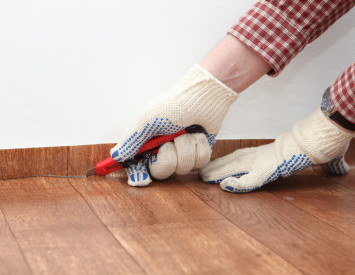
At the edges of the room, the extra linoleum is cutting off so that the gaps of 0.5-3 cm remained near the walls. They will allow the material to expand under the action of heat, but they will not be noticeable, as they will close the plinths. Where tubes come out of the floor, there are protrusions or something like that, the coating will have to be cut according to the appropriate form. To do this, it is putting marked with a pencil or a pen, then they make cutters with a knife and cut out.
In small rooms, no more than 12 m² linoleum can not be glued to the floor at all. Its stele throughout the perimeter and fix with the help of plinths and threshold.
In rooms with a larger area, the material is fixed to the surface with the help of glue or bilateral tape. Scotch can be pasted both throughout the inner surface of the material and around the perimeter of the sheets. Locking with glue is considered the most reliable, although the work itself will require more time and strength. In large rooms with an area of \u200b\u200b20 m², only such a method of laying is acceptable.
Shooting the linoleum on the wooden floor, the roller or roller passes along it. It will take 7-10 days to dry out the adhesive, during which it is better not to move around the room. Fragments of the material are glued together, then two layers of material are cut into a joint and apply cold welding on the seam.