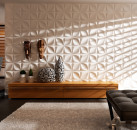
Modern designers use a fairly wide arsenal methods for decorating the room. With all the abundance of high-tech materials, preference, nevertheless, will be selected for old and proven techniques, one of which is stucco from plaster. It allows not only to decorate the room, but creates the spirit of aristocracy and luxury.
Content
Historical excursion
The issue of decorating the dwelling arose immediately after a person moved from the cave at home. Initially, various items and drawings were used for these purposes, but with the advent of social status, the richest representatives of the community began to invent various delights. One of the first achievements of the designer industry was the modeling.

It was used not only to decorate the rich mansions, but also in the temples and other cult facilities. In the Middle Ages, the modeling turned into a real art, which artists of the Renaissance era brought to the ideal.
Since then, this element of the interior is considered an attribute of luxury and emphasizes the social position of the owner of the house. It is worth noting that an alabaster, cement or clay was used as the starting material, but with the advent of the gypsum they lost the relevance, since the material is much more practical.
Advantages and disadvantages of plaster stucco
Gypsum is the material of mineral origin, therefore, in its pure form, it is safe for a person, does not highlight toxic vapors and is environmentally friendly. Besides:
- has low cost
- allows you to create products of any form,
- easy takes a different color,
- rather durable.

However, the gypsum has its drawbacks:
- crushes without special processing,
- not resistant to mechanical damage
- loses shape when in contact with water.
In practice, all these minuses are easily eliminated. Gypsum products have a special metal crate to which the main array is applied, then it is covered with a shallow mesh fixing the pattern. After frozen, the part is treated with special waterproofing primers, eliminating the crop, and the metal frame increases the strength.

Naturally, it increases the cost of production and as a result, the price of the product itself. Before buying, you need to clarify these nuances from the seller, since not all manufacturers comply with technological requirements, while deliberately dried up.
Gypsum products
Gypsum stucco is represented by the following varieties:
- moldings (decorative element that closes the angle between the ceiling and the wall),
- eaves (fastened above the windows and hide the usual cable for the curtains and the porter),
- sockets (various patterns or drawings around the central chandelier),
- columns (decorative imitation of real columns),
- capitals (top of the column),
- arches (semicircular monolithic columns, decorated with pattern or drawings),
- fireplaces (in view there are ready-made portals for fireplace openings),
- mirrors (patterns or drawings around the ordinary mirror that create the original frame)
- bas reliefs (sculptural compositions used to decorate walls),
- figures (individual figures of people or animals).

The stucco from the gypsum, the photo of which is presented in the article, more clearly demonstrates how certain products look in the interior.
Plaster stucco in the interior
Given the rich variety of gypsum products, apply them almost everywhere. In order to consider the possible options as in detail, we classify all products into three groups:
- stucco for ceiling,
- stucco for walls
- art Deco.
Ceiling stucco is represented by moldings and sockets. Install them in all rooms, except for the bathroom, as even with good waterproofing, the increased humidity softens the material and will affect its appearance.

Moldings differ in width and shape. The greater the room, the wider there should be molding, the same formula is valid and relative to rooms with high ceilings (more than 3.2 m). Sometimes plaster moldings make no patterns, there is no point in buying such a product, since the entire value of the stucco is in stock pattern. His choice is a purely taste. It should only be considered that the vertical lines visually increase the ceiling, and horizontal make it below.
Another nuance is associated with images of animals (for example, a lion head). This option is relevant for the kitchen, hall or guest. In the bedroom or children's drawing will cause a certain discomfort.
The size of the sockets depends on the ceiling area and the length of the chandelier. There are no specific standards, but in practice, experts recommend choosing a power outlet, the radius of which is equal to or more than the radius of the lighting device.
The layer of plaster on the walls is represented by columns, capitals and bas-reliefs. Columns are relevant in combination with frescoes or mosaic. This is a sufficiently specific attribute and in order to harmoniously enter it into the interior, it is necessary to carefully consider the work plan for the entire room.

The most common way is to create a terrace. A beautiful landscape is drawn on one of the walls, then columns and capitals are installed. As a result, it turns out the feeling that one of the walls is transparent and leads directly to the street.
Advice: Given the specifics and history of columns, the landscape should be a Greek or Italian motive.
Bas reliefs are much more functional. With their help decorate the lower third or half of the wall. They are either battle scenes, or images of wildlife, or intricate patterns.
Another execution option is a separate picture. Such a bas-relief is located in the center of the wall and serves as the main element of the whole composition. Therefore, the interior items should emphasize the uniqueness of the stucco and attach attention to it (the bas-relief is not only carried out by large, but also actually spectacular, the rest of the design is as much as possible and concise).
The latest trends suggest that the gallery version of the decoration of premises is particularly popular. It is relevant for corridors and halls. It is possible to use bas-reliefs in this case, by the exception that the size will be significantly less (15x10 cm, 20x20 cm, 10x10 cm).
Art Deco
The popularity of gypsum led to the fact that the material is successfully used not only to create standard stucco, but also for the production of other decorative elements. Initially, the technology was used only for fireplace portals. It is worth noting that the gypsum although it does not burn, nevertheless, poorly tolerates high temperatures, so it is used to arrange decorative fireplaces.
Then the stucco started will apply to create a framework. The stucco decorate the mirrors or cloth of paintings. In nature, plaster happens:
- gray
- white
- yellowish
- with a pink tint.
But, modern technologies allow you to get the framework of any colors, which makes the product really original and unique. The more mirror, the wider there should be a frame.

Another interesting use of stucco is the design of doorways. At the same time, it is not necessary to make a classic arch. Gypsum is great for creating an open-decorated opening, which looks no less effectively than the most expensive and beautiful door. A purely from a practical point of view of the door from the corridor into common rooms is not a mandatory interior item. Exception:
- bedroom,
- children's
- cabinet.
Gypsum figures successfully replace marble statues. They take any shape and size. Used, both in the form of individual elements and entire compositions. The only thing, they only look in rooms with a ceiling height of at least 3 meters and an area of \u200b\u200bmore than 50 square meters. m.
For a more detailed acquaintance with this way of decorating, like a plaster stucco, watch the video.