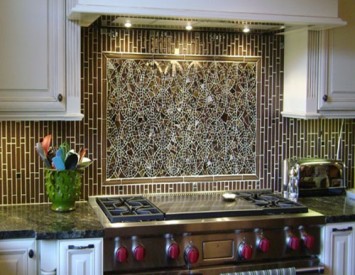
An important meaning in the kitchen interior today plays a kitchen apron, both with practical and from aesthetic point of view, thereby causing a number of difficulties with the choice of finishing materials that would satisfy all the necessary requirements. At the same time, most people stop their choice after all on the traditional ceramic tiles, because it will be able to lay out a small area of \u200b\u200bthe kitchen wall with a tile, even without having practical skills in a similar matter.
Content
Purpose of kitchen apron
Recently, kitchen aprons began to pay more attention, in many respects due to the emergence of a variety of assortment of finishing materials on the market.

If earlier for the design of the apron, only the tile of a pretty scanty color scheme and design was used, then its main task in the working area was the protection of the wall from random mechanical exposure, ingress of fatty and other splashes, etc.

Currently, the choice of suitable apron of materials is so huge that it easily allows you to protect the wall and the same time create unique masterpieces, contributing to the aesthetic attractiveness and creativity of not only the working area, but also the entire kitchen interior.

Therefore, the kitchen apron material should be durable, moisture and fire resistant, and also have excellent practical and decorative characteristics.
Types of finishing material, their characteristics
For the design of the kitchen apron today, various materials are used with different properties, sizes and external designs.

MDF panels
In recent years, the MDF panels produced by pressing small wooden sawdust, the front surface of which is laminated by heat-resistant coating is widely widespread.

Advantages of MDF panels:
- wide sample spectrum;
- simplicity of installation, as well as dismantling work;
- the minimum number of docking seams that prevent the accumulation of dust and fat droplets;
- the possibility of wet cleaning without the use of aggressive means;
- low cost.

Disadvantages:
- relative resistance in front of mechanical exposure;
- low moisture resistance;
- little service life, about 2 years.

Despite the durability of MDF panels to high temperatures, to use them to design apron if there is no gas stove, they are still not worth it, because they are made from wood waste, so with any violation of the integrity of the coating near open fire can easily light up.
Glass tile
A fairly new fashion trend is a apron made of glass tiles. The material for its manufacture is Kalenoe glass or triplex. In this case, the surface of the tile can be glossy, matte or corrugated. A wide model range is represented by tiles of various sizes with a monochrome background either by inclusion or strip of other shades. However, the most attractive is the tile with a pattern, which is applied by sandblasting or photo printing using special equipment, allowing to achieve 3D effect.

Pluses of glass tiles:
- high decorative qualities;
- resistance to high temperatures and high humidity;
- resistance to aggressive chemicals;
- easy to remove any contamination from the surface.

Minuses:
- low resistance to mechanical damage;
- the probability of clouding glass over time;
- labor complexity due to a distinct manifestation of traces from steam, splashes;
- complexity of installation work;
- the duration of operation does not exceed 5 years;
- high price.

Along with the glass tile, the glass panels have recently produced with the same properties as a tile, but substantially facilitating the installation process and care.
Mirror tile
The glitter of the mirror reflection gives the room a luxurious and original appearance, so the material is in high demand, despite the significant disadvantages. Cutting mirroring on the necessary elements allows you to get tiles of a wide variety of shapes and sizes. The color palette is represented by gold, chromium, silver and other metallic shades. In this case, the surface of the tile can be embossed, smooth or with a pattern. However, tile with facet or holographic image has a special originality.

The advantages of the mirror tile:
- visual increase in space;
- combination with any materials;
- resistance to the effects of ultraviolet rays, as well as high temperatures;
- moisture resistance to carry out wet cleaning using neutral detergents.

Disadvantages:
- fragility of material;
- over time, dark spots appear on the edges;
- painstopping of the departure, which consists in constant removal of traces of fogging, splashes, spots;
- small operational period of 2-3 years;
- the cost of the mirror tile is lower than glass, but above ceramic.

However, the mirror panels manufactured to order greatly simplify labor-intensive care.
Metal tile
For the interior performed in the style of high-tech, the metal apron of stainless steel will have to be very good. At the same time, in other style solutions, the metal will look too cold and industrially, so the choice in favor of such a material must be assessed in advance.

Advantages:
- high strength quality;
- excellent wear resistance;
- fire safety;
- resistance to moisture, ultraviolet rays;
- duration of operation;
- acceptable cost.

Disadvantages:
- scottle color palette, represented by metal shades;
- harness in the care caused by constant deliverance from traces of fat, water, which are clearly visible on the reflective surface;
- a low operational period due to the use of aggressive detergents leading to metal darkening.

Ceramic tile
The most practical and durable of all types of material is a ceramic tile produced from various grades of clay with the addition of binding components by pressing with a subsequent single (monocotture) or double (bicotura) firing. At the same time, monocotture has a smaller porosity, in contrast to the bicoture, and hence greater moisture resistance and durability. The surface of the same ceramic tile is smooth, embossed, as well as glossy or matte.

Advantages:
- large selection of sizes, shades, design;
- high strength due to firing at high temperatures;
- excellent resistance to mechanical, as well as chemical impact;
- high performance indicators, wear resistance;
- environmentally friendly material that does not release harmful compounds in the heating process;
- lack of temporary deformation;
- does not change the initial shade under the influence of ultraviolet rays;
- ease of care;
- acceptable cost;
- durability.

Disadvantages:
- fragility of material;
- the need to preliminary surface preparation to improve adhesion;
- the complexity and duration of laying.

Thus, the most durable and aesthetic kitchen tiles on the apron, which is presented above, includes glass and ceramic tiles. In addition, glass and ceramics are remarkably combined with any other materials, giving the room a harmoniously completed view. However, the price will be significantly higher for glass aprons than ceramic.
Determination of the size of the kitchen apron
The costs associated with the acquisition of finishing material directly depend on the size of the kitchen apron.

Lower border Apron
The boundary of the lower edge of the apron is determined by different criteria based on the following conditions:

- if the furniture is purchased and placed in its place, the border of the apron is the level of the tabletop;

- if the acquisition of furniture is at the planning stage, the height of the gas or induction plate is taken behind the lower boundary of the apron. However, if the washing machine will be placed under the table top, then the height of the machine is taken behind the lower limit, since it is always somewhat higher than the plates.

Since the perfectly smooth floor is a rare phenomenon, then when the furniture is arranged, the countertop can be below the apron, forming non-welltic gaps. You can avoid this problem in the process of installing apron, having reduced the obtained value of the lower bound by 2-3 cm.
Upper limit Apron
The distance between the mounted cabinets and the working surface should be at least 45-50 cm, otherwise it is quite difficult to use the tabletop for the purpose to fully, since the upper cabinets will block the overview of the working surface. At the same time, the width of the apron of larger size is necessary, taking into account the following factors:

- the height of the ceilings in the kitchen. Between the mounted cabinets and the ceiling should be free space at 30-40 cm for free mounting / dismantling of the upper cabinets;

- type of plate. Since the minimum distance from the electrical or induction plate to the exhaust should be 60 cm, and from gas - at least 75 cm, then in the area of \u200b\u200bhood area, the width of the kitchen apron will increase slightly.

- type of exhaust. When using a pendant design of a flat-type exhaust, mounted on the bottom of the mounted cabinet or to the overhaul, the upper boundary of the apron will be the bottom edge of the hood. When choosing a fireplace type exhaust, the upper limit will be similar to the height of mounted cabinets without any additional distance.

When determining the width of the apron under extractor, it is necessary that the edges of the apron can be 2-3 cm not only under the hood, but also for sides from it hinged cabinets.

Thus, planning a kitchen apron, dimensions must be determined taking into account the various features of furniture, household appliances, the height of the room and personal preferences. At the same time, you should not forget that the apron must enter the upper and lower boundaries under the cabinets.
Installation of kitchen apron from ceramic tile
The technological process of installation of the tile is divided into several steps, the sequence and thoroughness of which guarantee a satisfactory result.

Required materials and tools
For the convenience and speed of work, it is necessary to prepare in advance:

- primer;
- brush for applying primer on the wall;
- tile glue;
- ceramic tile;
- grout for seams;
- toothed, rubber and conventional small spatula;
- suture crosses 2.5, or 3 mm;
- level;
- metal profile, the length of which is equal to the length of the kitchen apron;
- dowel for fastening to the profile wall;
- pencil;
- capacities for the preparation of glue and grouts;
- rubber cizyanka;
- tiles or Bulgarian;
- pliers;
- foam sponge;
- roying from natural fabric.
Tile laying wall preparation
The quality of the prepared foundation depends on the reliability of the tile clutch with the surface, so:

- We purify the surface allocated under the apron from plaster, paint, wallpaper, and it is desirable to a concrete or brick base.
- Covered the prepared base of the primer and let it be careful.
- We celebrate on the wall the lower border of the apron and stalk a pencil to a flat line.
- Immediately under the applied line, they fix the metal profile with the help of a dowel, which prevents the slaughtering of the tile during the gripping period of the solution, as well as ensuring the evenness of the laid out of the row.
- The horizontal of the attached profile is checking the level.

Laying tiles
To obtain smooth rows, laying the kitchen apron from the tile is made from the bottom up and from the edge to the corner, so:

- We drag the tile glue, according to the instructions available on the package, and let it stand for 5 minutes, after which we thoroughly mix, getting rid of everyone's lumps.
- Using a toothed spatula, we apply glue to the surface of the wall for 2-3 tiles. If the base has deep irregularities, then glue is also applied to the tile.
- We take the tile and uniform pressing movements fix it on the wall. At the same time, the tile itself should be based on one side to the fixed profile.
- The next tile is glue next to the first, not forgetting to insert suture crosses between the tiles, providing the smooth suture.
- After fixing 2-3 tiles, check the horizontal, as well as the vertical by applying the level. If necessary, protruding the corners of the tiles are correcting in the image.
- As the tile laying immediately clean the seams from the excess glue until it grabbed.
- After the end of laying the first row, go to the next, etc.
- 48 hours after the end of work, we remove the metal profile, suture crosses and remove the remaining glue from the seams.
Shutdown of seams
The final stage of laying tiles is reduced to the following work:

- Sprinkle seams from the spray from the sputum, getting rid of dust.
- Rinse the tile so that the adhesive particles are not mixed with the grout.
- We divorce the grout, as indicated on the package, and mix thoroughly.
- We take a rubber spatula and, holding it at an angle of 45 ° C, fill the seams as much as possible.
- Excess the grouts remove immediately as all the emptiness of the seam is filling.
- Filling 6-8 seams, spending a finger on the seam, giving it a certain relief. If cracks appear, then we pass by a wet sponge and repeat the procedure.
- At the end of the work, the surface of the tile is wiped with a damp cloth, and then rinsed with the addition of detergent to get rid of the appealing divorces.
Kitchen apron design options from tile
Currently, you can buy a tile for kitchen apron to buy absolutely in any specialized or construction store, and the diversity of the forms and sizes of this material is so great that it is difficult to stop at some one option. And maybe you do not need to stop on the tile of one size and shape, but is it worth experimenting, combining contrast or monophonic colors?

Pretty interesting looks of various sizes in combination with conventional and diagonal masonry.

In this kitchen apron (10x10 tile is becoming more and more popular), it looks not only elegant, but also at cost inferior to conventional tile sizes, as small-format cutting size is almost not needed.

In addition, gluing tile 10x10 diagonally more handy, greatly reducing the time of work.

The use of small-format tiles can also easily upload small panels, reviving a monochromatic design tiles.

Although a rectangular tiles it is possible to make the insertion or draw a border in the form of paintings.

So, make an apron in the kitchen can be made of different materials, combining color and shape of the finishing materials. The main thing that colors tiles blend harmoniously with other home furnishings.