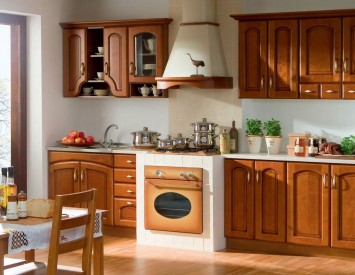
Kitchen headsets made of wood are striking with their variety of forms, attractive appearance and, of course, price. If you want to reduce the cost of living the kitchen room, you can try to make furniture without resorting to the help of specialists. How to make a kitchen made of wood massif on their own, let's tell later.
Content
Selection of wood breed

The kitchens made of natural wood today are very valued. So, about 40 wood breeds are known. All of them can be divided into two groups:
- Hardwood. It includes such rocks like maple, dogwood, rowan, beech, walnut, apple tree, ash. Acacia, oak, tees, samste and pistachio tree are most firmly considered. They are usually used to create bearing structures exposed to serious loads. For example, for the manufacture of a solid framework of furniture.
- Softwood. Examples are cherry, Iva, spruce, pine, poplar, juniper, ox, alder, cedar, fir and chestnut. Such rocks are used to make various decorative elements, facades and other parts of furniture, which are not exposed to large loads.
What objects of furniture can be made from various wood breeds:
- Let's start with pine. She, as already indicated, belongs to soft rocks. Usually it makes small cabinets, facades, shelves or various decorative parts from its array. Pine also sometimes build a frame for upholstered furniture.
- Beech also refers to soft rocks, but in strength it is almost the same as the oak. Its disadvantages should be counted the fact that it is able to absorb moisture from the air. Therefore, before using Brukes from beech, it is necessary to carefully treat special protective compositions. The furniture made from it should not be placed in places with high humidity.
- Very beautiful furniture is erected from birch. It makes chairs, dining tables, carved coffee tables. Birch products should not be used in places where humidity changes greatly. This material comes into disrepair faster.
- Oaks also often produce furniture. From its array, large and bulky products are erected. For example, it is often found from oak beds, bookcases and dressers.
Installation of kitchen headset
Creating a template

Kitchen furniture, if desired, can be done with the help of submitted means, special tools and materials. To prevent errors when cutting panels, you can buy or independently make a template required for markup and drilling holes. To do this, we will need two school rules with a length of 20 centimeters and transport.
Procedure for work:
- The rules are glued in the form of the letter T. The angle between them should be direct.
- Then, on the rack from the beginning of the intersection, several marks should be made and drilled holes. They must be made at a distance of 8 (for the end hole for confirmation and eurgowrup), 16 (under the thickness of the part), 32 (under the thickness of two parts), 60, 70, 90 and 110 millimeters. The latter is needed in order to place canopies and to retreat from the edge of the part.
- Holes are made with a diameter of 2 millimeters. This is enough enough to enter the sharpened pencil.
Despite the insignificant cost of such a simple template, it will not be worse than professional.
Tools for work
Kitchens under the tree with their own hands make easy. For this you will need:
- Schurpevorte
- Drill.
- Face mill.
- Hammer.
- Pencil.
- Awl.
- Previously made template for marking.
- Furniture loops.
Making boxes

Modern cabinets are necessarily equipped with roller guides for drawers. Therefore, it is important to learn them to install them. And for this, first of all, you should precisely carry out all the necessary calculations. Without it, it will not be possible to properly place the boxes in the closet, and as a result, even with a beautiful and strong framework, the furniture will be defective.
Usually, several sectional compartments are installed in the kitchen headsets from the tree, which should be the same, so that any box can get into place of the other. Considering this, you should remember the extreme position at the lower and top drawer (hubled). The facade of the top must overlap the bundle with the render, and the facade of the bottom usually closes the bottom.
When calculating, it should be borne in mind that 18 millimeters should be between the axial line and the bottom of the guide. Knowing the total thickness of the bottom and base, you can calculate a constant value (the distance from the edge of the facade to the lower drawer). This is done by subtracting from the size of the segment from the bottom end of the front side to the axis of the thickness of the stove used.
For example:
- The size of the facade plate is 16 millimeters.
- The screw thickness of the screw is 2 mm (add 2 mm for another so that it is tightly entering the hole, it turns out a 4 millimeter).
- The value of the segment between the axial line and the bottom guide is 18 millimeters.
- Fixation height of the guide: 18 + 4 \u003d 22 millimeters.
- The size of the segment from the bottom end of the front side to the axis of the guide: 22 + 16 \u003d 38 millimeters.
- Distance from the edge of the facade to the lower drawer: 38-16 \u003d 22 millimeters.
Then you need to calculate the height of the drawer side. Note that any of them should not be restricted into the binder.
If, when calculating the height of the facade, it turned out about 163 millimeters, then for the normal operation of the retractable mechanism, the sizes of 50-60 millimeters will be completely enough.
There is a distance equal to the roller diameter on the guide to the table between the drawer of the table and the binding jumper. To avoid the swelling of the chipboard, it is recommended to add another half of size. So, with the diameter of the rollers of 18 millimeters, the gap should be 18 + 9 \u003d 27 millimeters.
To determine for each box, the size of the compartment in height must be added to the length of the facade and the size of the gap. After that, it is necessary to calculate the distance from the top edge of the facade to the top of the drawer. To do this, we fold the size of the jumper and the gap provided for it.
It's time to calculate the height of the sides for the boxes. For this, the amount of the facade needs to subtract the amount of the values \u200b\u200bof the lower and upper intake. When calculating, consider the fiberboard thickness for the bottom of the drawer.
Mounting loops

- From the end of the door to the center of the landing socket, the distance can be from 65 to 130 millimeters. The amount of loops depends on the magnitude and weight of the door, but usually does not exceed five. From the angular part to the center of the landing jack, the distance is about 22 millimeters.
- With the help of sewing, you need to put a hole in the center of the socket for more convenient cutters. Depending on the type of loops, the depth of the groove can be from 12 to 13 millimeters. Only when drilling need to take into account the thickness of the panel, so as not to squeeze the front of the door. To facilitate work when drilling, it is best to use sharply sharpened milling mills.
- It is important that when drilling the angle of inclination of a drill with respect to the panel was direct. Door for convenient fixation, best put on the floor. At the same time, the loop should be freely bended by the edges of the door.
- Before fastening the loop to its place, you should check the holes for screws through the ears of the holes for the screws. This will help avoid shifting the screw to the side.
- Finally, the screws should be tightened. Installation of the loops is completed.
Making countertops for kitchen headset

You can make a kitchen countertop that will serve for many years. Before making it, it is necessary to determine the type of coating. Here we will look at the countertops with two types of coverage - "under marble" and with a facing of a cafeter.
Materials for kitchen
You will need:
- Material for frame. It is recommended to take a bar with a 40 or 50 profile by 50 millimeters. In this case, wood should be smooth, without visible defects. The higher the quality of the material, it will be easier to make the trim.
- For facing the surface of the table top for the kitchen, the tile will need a tile, glue for it and composition for grouting seams.
- To make the basis under the tabletop need:
- cement, crushed stone and sand;
- durable rods from metal (for reinforcing design);
- plasticizers and pigments (need for concrete);
- solid bars (for formwork);
- aluminum or plastic profile (for finishing the edges of the structure);
- liquid Nails.
Tools for work
It will take:
- Drill a small screwdriver or power.
- Bulgarian with a suitable cutting wheel.
- Master OK.
- Jigsaw.
- Grater for laying tiles.
- Spatula for concrete.
- The machine for cutting tiles.
- Building level.
- Roulette.
Frame and formwork

After buying all the necessary materials, you can begin to assemble the frame for countertops. Since the weight of the structure on the basis of the concrete slab is quite large, a special frame you will need to install it. He's going to the following:
- First, you must determine the height of countertops.
- Then you need to make the boards of the segments vertical frame rack.
- Ready to support fixed to the floor with metal parts. If some of them are adjacent to the walls, they are fastened with anchor bolts in pre-drilled holes.
- After installing the rack should be connected to each other by horizontal crosspieces. The result will be almost finished carcass frame, which will strengthen the diagonal braces.
- Then made of shuttering boards and worktops. Formwork should be collected so that it can be removed without damage to the concrete.
- Inside the formwork, in place of the washing location, to place the ring from a metal strip. If you need to install the hob on the perimeter of the formwork is necessary to put a wooden or metal bumpers.
- When the installation of the form is completed, it should be to lay a polyethylene film. This is necessary to protect the floor from the leak of the solution, because it happens quite liquid.
Installing headset
After completion of the work on the formwork to be stacked interconnected reinforcement bars. Then it is possible to start cultivation solution.
It is prepared as follows:
- Take one part cement, two parts sand and gravel.
- All parts of the mix.
- To improve the quality of the solution, it is recommended to add a plasticizer.
- The solution was diluted with water and mixed until a pasty consistency.
- If the worktop is made of imitation granite or marble, the solution is added to a special pigment, which can now be purchased at any store building materials.
When the solution is ready, it is poured into the mold to the desired level. After that the surface is leveled and covered with film. The mixture should be dry. This will require at least one week.
During this time, you need to ensure that the solution does not stop. To do this, periodically check the surface and if it is necessary, it is necessary to moisten it using a spray gun.
After complete hardening, the formwork is removed, and work on the worktop finishing are starting.
Finishing cladding
- With the help of a grater, the glue for the tile is applied to the surface and is uniformly distributed. To improve the sticking of tiles in the solution, it is recommended to make grooves.
- Then pre-prepared tile should be put on the glue layer and press. At the same time, it must be carefully aligned.
- It is also necessary to fir the width all the seams between the tiles. For this use plastic crosses.
- It will remain waiting for the complete drying of the glue and sweep the seams.
- At this stage, a profile should be placed on the ends. It is fixed with liquid nails or glue. To securely fix the profile should be fixed by clamps.
Making a dining table

Countertop for kitchen
- To make a tabletop for the kitchen table, you will need four edged boards with a size of 50 by 150 per 1000 mm. You can use oak or pine. If the width and thickness of the bars will be the same, it will remain independently cut them along the length. Just do it need it very carefully. Any cut must be performed exactly at right angles.
- In order for the boards to be more densely to each other, in front of their connection to one plane, the side ends of the Fugansky will be treated. As a result, the countertop should turn out to be beautiful and smooth. To thoroughly align the edge, when fugging should be made the same pressure on the power tool used.
- Elements are connected to each other with self-samples or nails. You can also use sewing and glue. The last option will make the furniture more rigid. Side ends of boards should be placed at a distance of 100-150 millimeters, but only in such a way that they coincide with adjacent bars.
- It is recommended to read one line on each side end in the center. Then the holes are made. This will require a drill with a thickness of 8 millimeters. In the finished holes should be scored by glue shuts. They still need to smear the boards. After that, they need to be shot down with each other so that they fit tightly to each other.
- Then it is necessary to wait until the compounds are dried. After that, the extra dried glue, which came out, is cleaned by sandpaper.
- Drown-up boards need to be collected to remove all the irregularities at the joints. Another sandpaper or rashpil should handle the edges of the structure.
Table legs

- The feet for the table is allowed to cut out of the board in any form. The first of them will be a sample, which is cut out the rest. With the help of a milling mill, patterns are applied.
- Each leg should be carefully polished. After which they can be collected. To do this, you need to cut jumpers with oblique angles so that the legs are located diagonally.
- After that, they are spoiled again. The legs can be placed in place on one glue without the use of furniture ducts, but the final rectangle will need to be fixed with clamps. For complete drying of the glue, the collected design must be withstanding at least one day.
- After everything is driving, you should attach a worktop. In the drawing and on the jumpers, the legs need to make markup, drill the nests and score the specks. After that, smear the connection places and finally connect the worktop with the design of the legs. Now the fixed parts need to be lubricated with glue.
The table can be read ready for painting. Such products are usually treated with a veneer, after which they are covered with colorless varnish. This will allocate natural wood texture. After drying the first layer, it is best to apply another one. The result is a high-quality table for a kitchen made of wood. The photo of the exemplary result is presented below.