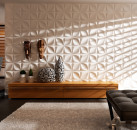
Earlier to update the interior, I had to buy the wallpaper of the color and shade that offered the manufacturer. Today you can purchase special canvases that can later be painted in any desirable color. The interior of any room will play with new bright colors. On how to choose and apply paint for painting wallpaper, we'll tell you further.
Content
Paint for painting

Under each type of wallpaper, a certain kind of paint is selected. It differs both in quality characteristics and in composition. As you know, there are several types of cloths under painting, among them:
- Fliseline.
- Gymelomes.
- Paper wallpaper.
For each of them, you should use your paint material. Usually manufacturers produce various types of paint for painting wallpaper, the colors and the composition of which are suitable for painting one or another type of canvases.

Consider the main types of material:
- Acrylic paint. The most common appearance. It is paint for painting fliesline wallpaper. It is not terrible moisture and ultraviolet radiation. Therefore, the wallpaper painted with such a mixture is practically not fade. It is usually applied to the outer surface of the cloth. After painting, all excess material should be removed. This type of paint can be applied directly on the wall before sticking wallpaper. After that, transparent wallpapers on the flieslinic basis are glued on the wall. After drying the material, thanks to the transparent structure, the color of the paint will be shifted through the canvas, so that the wallpaper will get a soft and even shade. If you wish to simplify cleaning in the room, you need to give preference to waterproof paints, thanks to which the wallpaper painted with such a mixture can be washed with a wet sponge.
- Painting with water-emulsion paint. Such mixtures have a rich palette of color shades. Suitable for painting fiber-based wallpapers. In this case, a soft pile roller is used to apply the material on the web. It is worth noting that this type of paint mixtures is washed off with water. This should be taken into account during the cleaning of the room.
- Painting Latex paint wallpaper. These mixes still got the name of water-dispersion. They are pretty environmentally friendly and safe. However, it is worth remembering that after opening the packaging, such a paint is pretty quickly thick, so it must be applied immediately on the canvas. Wallpapers painted with a mixture of this type are dry no earlier than in 2-3 days.
- Alkyd paints. Used for staining of glasses. A rather dense film is formed on the surface of the web, which protects the wallpaper from moisture exposure. Therefore, they can be in the future washing any detergents. However, it is worth saying some shortcomings of this type of mixtures. They do not let air, that is, "do not breathe", and still contain some toxic substances in its composition.
Tips for choosing a mixture

Above, we looked at what kind of paints are. Now let's talk more about some of the features of their choice:
- For flizelin-based wallpapers, it is better to use any waterproof paint. In the production of such wallpapers, high-quality cellulose is used, which is treated according to special techniques.
- Latex paints are recommended for vinyl-based cavetles. These wallpapers can be painted in both the inner and the outside.
- For paper wallpapers, absolutely any paints, both acrylic and water-emulsion be suitable. The mixture in this case, in order to avoid the appearance of divorces, is applied with a mild pile roller.
- Liquid wallpapers are not subject to staining. However, they can be given an additional saturated shade by mixing the components of the material itself with the paint of any type. You can still put the paint layer directly on the wall, where the decorative mixture of liquid wallpaper will be applied. In such cases, oil compositions or nitroemal are used.
Many are interested in the question - what kind of paint consumption when painting wallpaper? So, on average for coloring 1 square. The surface of the surface will require about 230 grams of the mixture. More precisely, the calculation can be done if we consider the recommendations on the consumption of paint specified on the packaging of the product.
Let us dwell on the color palette of the paints. So, the water-emulsion mixtures mainly have different shades of color, and the dispersion paints are most often produced in white. In order to get the desired color, you need to smoke them. Thus, you can get absolutely any shade, for example, "under gold", "under silver", "under the bronze" or other. Most often, the tinting is required when painting old wallpaper paint.

There are several ways to give the paint the desired shade:
- Homemade tinting. In this case, it follows in the building of building materials to buy a special coloring pigment. It is mixed with paint. As a result, paint is obtained. However, there are several nuances. So, the color of the mixture before applying and after its drying can differ significantly. In addition, if the paint is divorced into several portions, it will be difficult to get the same shade in each of them.
- Tinting using special software. In this case, you will need to take advantage of a special pulling machine. Thanks to this method, you can get the same column of paint in all banks.
The process of coloring wallpaper

For this we need the following tools:
- Soft pile roller.
- Capacity for paint breeding.
- Tassel 60-70 mm.
- Paper tape.
- You can apply a pulverizer.
Advice! It is important for painting wallpapers to choose correctly not only paint, but also a tool for applying it. So, it is recommended to use a roller with a long or medium pile. Long villi will be able to cry well any texture of wallpaper, even with an ornament. In no case do not purchase conventional foam-based rollers for staining. They greatly reduce the quality of surface staining. For staining of hard-to-reach places and corners, it is recommended to purchase brushes.

Procedure for conducting work:
- The first stage is the preparation of the surface. So, floors should be seen, cover windowsills, furniture, radiators with a film. Surface should be cleaned of dust.
- Plinths are covered with paper scotch. Under it does not flow paint when painting. When the mixture is dry, tape is removed.
- Recall that it is important to correctly pick up paint for painting of cavities, depending on what type of wallpaper is pasted on the wall. Next, the mixture should be made, as indicated on the package. Sometimes manufacturers recommend to add water to paint, but not more than 8-10%. In this case, the paint then mixes well with the help of a mixer so that it turned out good homogeneous color, without lumps and bunches.
- The surface of the surface takes into account all the recommendations from the manufacturer specified on the packaging of the product. It is important to remember that low-quality cheap mixtures should be applied in 2-3 layers. Thus, it turns out resistant and monophonic color. Before applying the second and third layer, you need to wait until the first will dry well. High-quality expensive mixes are allowed to apply in one layer.
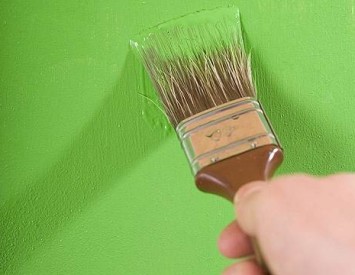
- Initially, the lower and upper parts of the walls are scored with a brush. Make sure that the paint smears are not overlayed on each other, since in this case we will not be able to get a homogeneous shade of the surface. In addition, it is important that the paint does not accumulate on the shocks of the wallpaper, otherwise the color will be much darker in these zones.
- Next, you should paint the surface with the roller. Moves should be performed in one direction. The brushes are then colored hard-to-reach places, such as zones around the socket or doorways.
- Then you need to change the roller or simply change it to the vors on a new one. The tool is wetted in water. It must be done in order to face a pile, which is not attached tight. Next, the roller is lowered into the container with paint and rolling well to them until it is completely soaked with a staining mixture.
- Next, stain in the wall on which wallpapers are pasted, the second layer. It is important to achieve uniform staining of the surface. Please note that the second layer of paint is applied only after the first will dry.
- Apply the coloring composition on the wall, wounded by wallpaper, can be vertical smooth stripes from the floor to the ceiling. It is important that these bands are strictly parallel. Each width can be 650-750 mm. It is necessary to cry around and accurate movements.
- Next, remove the surplus paint. The roller is filtering through the categorous stocking and rinse it. That's all, work on painting wallpaper can be considered complete.

Note when working for some points:
- In order to give the interior a special highlight, the painting of the wallpaper of pearl paint is used. Such a mixture can be painted both the wall and a separate zone.
- For structural wallpapers, a dispersion mixture is suitable. Coloring of these canvases occurs with a wide roller. The mixture is rolled over the wall surface. In order to emphasize the structure of the wallpaper, a structural roller with the middle length is used.
- To get an interesting shade of fliesline wallpaper, try to scroll them into two layers. And apply the second layer to paint another shade.
- As mentioned above, if you wish to get an unusual shade of wallpapers on a fliesline basis, then the paint must be applied to their inner side or on the wall. As a result, you can get a resistant, uniform shade.
Paint for painting under painting: photo