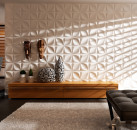
The installation of a drywall box is an excellent designer solution that is increasingly used to improve design. This element helps to hide the irregularities of the walls and the ceiling, due to the possibility of embedding the backlight, harmoniously and exquisitely fits into the general atmosphere of the room. Next, consider the question of how to make a box of plasterboard.
Content
- Advantages and device of a box of plasterboard
- Selection of drywall for the device device
- Recommendations for installation of a drywall box
- How to make a box of plasterboard on the ceiling
- Recommendations for the manufacture of a box in a bathroom of plasterboard
- Tips for making a box of plasterboard do it yourself
- Installing a box with a backlit from plasterboard
Advantages and device of a box of plasterboard
The drywall box is a design of an aluminum profile, covered with plasterboard. Such designs are installed on the ceiling or walls, to improve hiding water supply or ventilation communications. A variety of luminaires that perform additional lighting are often embedded in the drywall box. 
The box on the ceiling is similar to a multi-level ceiling. The only difference is that the design of the box does not concern the main ceiling. The box on the ceiling is installed either throughout the perimeter or in the form of geometric shapes. The device of the drywall box on the ceiling will cost cheaper than the installation of a multi-level ceiling.
Advantages of installing drywall box:
- hiding ceiling defects,
- the ability to hide wiring and communication pipes,
- the installation of lighting devices helps in the overall lighting device and gives the room sophistication,
- the ability to adjust lighting and zoning the room,
- a variety of figures and box forms will make the room unique.
Gypsum cardboard photo:

Selection of drywall for the device device
Plasterboard is used to finish the premises and consists of plaster and protective paper sheet. Paper helps plasterboard to be more elastic and protects gypsum from moisture and mechanical damage.
The type of drywall, used when installing the box, depends on the installation site.
Differences of plasterboard:
- Urk - standard plasterboard used for wall decoration, ceiling or for forming partitions, such a plasterboard is suitable for low and medium humidity rooms;
- DURK - plasterboard with a protective layer of moisture-proof impregnation and antiseptic, such a plasterboard is resistant to the formation of mold, fungus and to moisture effects, apply in the trim of the bathroom or room with high humidity;
- GKLO - the inside of such a drywall consists not only of plaster, but also from fiberglass and mineral mixtures, which make this material flame resistant.

Recommendations for installation of a drywall box
1. The drywall box is installed on the prepared surface. To do this, a number of preparatory work should be carried out, which include shockting and shtclosure of the surface.
2. Aluminum profile should be purchased only in specialized stores. Follow the quality of the profile.
3. Do not use a cheap profile, as the design will not withstand the load and deform during operation.
4. Before installing drywall, complete preparatory work related to electricity.
5. Sheets of plasterboard should be fixed on a pre-prepared framework.
How to make a box of plasterboard on the ceiling
1. Apply markup with a pencil and level. Straighten the ceiling and nearest wall design. When applied markup, consider the length of the aluminum profile and sheets of plasterboard.
2. Install the frame from the profile. In accordance with the lines of markup, cut and secure the design from the profile. For these purposes, use the perforator. For convenience of fastening, draw the contour of the box on the floor, and then move it to the ceiling. Secure the aluminum profile by self-draws and spacer dowels. Be sure to check the smooth installation of the profile design.
3. Installing suspensions. Cut the suspension with scissors for metal, according to the size of the box. Fix the suspensions on the designs from the guide profiles. Guides must be on the same level with the whole structure.
4. Install the electrical wiring for lamps. Make marking and secure the wires.

5. Secure the cross-type guides, previously cutting them. The minimum interval between the guides 1 m. Fixing the guides is carried out with the help of self-tapping and screwdriver.
6. Cut the necessary parts from drywall. First, fasten the plasterboard at the bottom of the structure, and then on all others. Make holes for lamps.
7. Secure the design with the help of screws.
After installing the plasterboard box, finishing works should be carried out. Surface roll is a very important process of finishing, which will determine the appearance of the box.
Tools for work:
- 5 cm spatula
- spatula 20 cm,
- perforated greater corner
- large and small mesh.
With the help of two spatulas, apply a putty layer on the surface of the box. A small spatula helps to put a putty, and large - distributes the mixture over the surface.
Gently press the spatula to the plasterboard surface and remove the excess of the spacion mixture. To form smooth angles, use the painting corner. The fixation of the corner is made by applying putty on the verge.
The initial process of the shtclotation is made by the starting putty, and the final - finish. Choose a putty from one manufacturer to avoid separating putty.
After drying, the putty should align the surface first large and then shallow mesh. So that the surface has become perfectly smoothly use special milk.
If necessary, color the box in the desired color and wind the lamps.

Recommendations for the manufacture of a box in a bathroom of plasterboard
The drywall box is installed in the bathroom in order to hide pipes or other communications.
For the manufacture of the box, you will need an aluminum profile and moisture-resistant plasterboard.
Consider the option of making a plasterboard box that hides the pipe passing in the corner part of the bathroom.
The installation of the box begins with the formation of a frame, which consists of three axes made from an aluminum profile.
This box resembles a construction in the form of a rectangular triangle with absolutely smooth sides.
1. First, make the markup and measure the parties of the box.
2. Two axes close to the wall should be fixed with dowels and self-tapping screws, and the central axis is attached to the side walls or to the other remaining axes.
3. After the frame is ready, it is necessary to check the flattering design using a level.
4. Measure the faces of the box and cut the harvesting from drywall.
5. Attach the parts using self-sinks to the frame.

6. This installation of the box is suitable for hiding both horizontal and vertical pipes.
Tip: If the pipes or other communications in the bathroom do not touch the wall, use the four-sided covering of plasterboard, which is made according to the same principle. Provide in the device of the hatch box, which will provide quick access to communications.
Tips for making a box of plasterboard do it yourself
- the installation of the box in the bathroom is made in such a way that this element is not a hindrance when accessing communications;
- self-tapping screws closer to the edge of the wall so that it is easier to install the tile;
- do not close the screws with tiles, leave a small gap that install the plinth, this method will help to easily disassemble the design;
- leave several centimeters at the bottom of the box not closed, in order to notice the water leak on time;
- to make the box more durable, install ceramic tiles that will not load the box design;
- to install the tile, use the glue for drywall.

Installing a box with a backlit from plasterboard
For work it is necessary:
- CD, UD profiles;
- dowels with screws;
- self-tapping screws with a brown marine;
- selflessness L 25;
- plasterboard;
- mesh for seams;
- primers;
- perforated corner;
- putty;
- waterimulsion paint.

Start work from installing aluminum UD profile. This profile will show the outline of the future design.
This stage allows you to correct the design. Set the following profiles by observing the distance of 0.4 or 0.6 m. The interval between profiles depends on the load on the box. For large sizes, reduce the interval, and with small - increase.
Install the wiring: Display the wires to the location of the lamps, check the installation of the electrical wires. Install the corrugated sleeve in which the wiring will be located.
Remove the measurements from the profile frame. Cut the plasterboard blanks and attach them to the box. The distance between the mounting places of about 14 cm.

After completing the packing of the box, hide the wiring to start finishing work.
When the box is putty, first set perforated corners with a stapler or putty. When weaklyan, use a grid that will not allow cracking.
After all the joints and seams are embellished, proceed to finishing the entire box.
After complete drying of the last layer of putty, stick the surface with a shallow mesh.
Sprouter the surface with the help of deep penetration soil.

After 24 hours, when the primer dries, proceed to staining the surface of the water-emulsion paint. Apply in two, three layers. With the help of brushes, paint the corners and hard-to-reach places, and use the roller to dye smooth surfaces.
When the paint finally dries, using a mounting knife or drill with a special nozzle cut holes for the lamps and install the lighting devices.