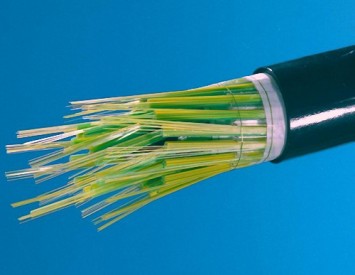
Progress Do not stop. Every day our life includes all new materials. A revolutionary discovery in terms of high-speed communications laying was the invention of an optical cable.
Content
What is the optical cable
The optical cable is a special kind of cable for communication networks. The main difference from the standard cable is a way to transfer energy. Transmission is carried out using a light flux, and no electric current at all. By and large, the optical cable is a thread, inside which the light is moving. The main component is optical fiber. It is the most modern and most reliable data transfer medium. Light on the fibers is transmitted to huge distances with almost loss and with a huge speed.

The main characteristics of the optical cable. Its advantages and disadvantages
The advantage of the optical cable in front of the cable is usually undoubtedly. Among the most obvious moments I would like to allocate:
- Incredibly high bandwidth. The optical cable is able to transfer a significant amount of information for a small period of time.
- Whole fiber does not radiate electromagnetic waves. Accordingly, it is not capable of exposed to electromagnetic radiation. As a result, the signal is protected from distortion.
- The cable is securely protected from unauthorized connection. An attempt to unauthorized connection causes a cable integrity violation and termination of data transmission. Hide it becomes impossible.
- A very minor signal attenuation indicator. Modern optical cable fiber with a wavelength of 1500 nm, it has attenuation indicator of about 0.3 dB / km. This makes it possible to position the adjacent repeaters and amplifiers at a distance of up to 100 km.
- The optical cable has less weight and volume than the usual one. For example, the diameter of the 900-paired telephone cable is 7.5 cm. It will successfully replace the optical cable with a diameter of about 1.5 cm. In this case, most of the cable will be all sorts of protective shells. The diameter of directly fiber optic will be 0.1 cm.

- When using an optical cable, there is no need for a membrane ground. This is due to the insulating properties of fiber.
- Ability to use in enterprises with high risk. It is associated with such a feature of fiber, as a lack of sparking. It is thanks to her an optical cable - fireproof material.
- Optical cable - very economical material. For the manufacture of fiber, quartz is used, the element is very inexpensive and common. As a result, the cost of the most optical cable does not differ from the cost of the cable of the usual.
- Durability. Nothing is eternal. Over time, all materials, including optical cable, lose their properties. Attenuation increases. However, these processes occur very slowly. The speed of loss of optical cable properties is significantly lower compared to other types of cables. The deadline for uninterrupted operation of the optical cable is at least 25 years.
Despite a large number of positive moments, the use of an optical cable has a number of shortcomings:
- High cost of communications with optical cable. True, this is due to the use of additional expensive equipment. The cost of the optical cable is not too different from the cost of the cable of the usual.
- Completeness of mounting networks with optical cable. Connectors must be installed literally with micron accuracy. The connection itself must be performed very accurately, smoothly. The presence of gaps is unacceptable. The surface of the joint must be smoothly polished. If the above requirements are not compared to the speed and quality of the transmitted signal.
- Connections are performed by welding or gluing. When gluing, a special gel is used, which has the same value of the refraction coefficient as fiberglass.
- In the process of working with an optical cable, special tools are used. Installation of optical networks is carried out exclusively highly qualified specialists.
- Optical cable damage is possible due to a sharp temperature difference. Fiberglass cracks. To solve this problem, optical cables are launched into production, during the manufacture of which radiation-resistant glass is used. Unfortunately, this leads to a significant increase in value.
As you can see, the disadvantages are not so significant. The popularity of optical networks is growing every day. At the same time, the value of the material is reduced and the number of specialists working with an optical cable is growing. With such a trend in the near future, these disadvantages will be outlined.
Types of optical cables
Distinguish two types of optical cables:
- Single mode optical cable. All light rays in the cables of this type are moving along the same path and at the same time suitable for the receiver. As a result, there are no distortions of the waveform. The single-mode cable is equipped with a fiber-optic diameter of 1300 nm. Only light waves are transmitted to the same length. The use of single-mode cables contributes to signal transmission to longer distances than using multimode cables. This feature is associated with very minor dispersion values \u200b\u200band signal losses. Using a single-mode cable, laser LEDs are used. The signal attenuation in a single-generated cable is very low, about 5 dB / km.
- Multimode optical cable. In this type of cable, the rays are not going on one way. Their trajectories are significantly scattered. The result is the signal distortion at the receiver. When transmitting a multimode cable signal, conventional LEDs are used. This leads to a significant reduction in the value of communication networks and an increase in the timing of the transceiver service. For a multimode cable, a light wavelength is about 850 nm with deviations of 30-50 nm. The attenuation of the signal in the cable can reach 20 dB / km. The length of the cable of this type is up to 5 km.
The main type of optical cable is currently multimode. This is due to its availability and low cost. In the future, leading positions must go to the single-mode cable. His excellent characteristics, low attenuation levels suggest that over time, the high cost of transceiver equipment will cease to be an obstacle to the spread of this high-quality material.
Optical cable design

The main components of the optical cable are:
- Optical fiber. Thin glass thread, called the core or residential. Covered with glass shell. The refractive index of the shell is slightly different from the same indicator of the vein towards the reduction. That is why the light beam directed into the core extends solely on it. Often, for the reduction of material, the vein is made from plastic, and not from glass. Such optical fibers are worse. Different single-mode and multimode optical fibers. The core of the single-mode fiber is very thin, its diameter is about 10 microns. It is due to the insignificant diameter through the core, only one single model of electromagnetic radiation is transmitted, which eliminates the presence of dispersion distortion. But the core of the multimode fiber is several times the thicketer, about 50 microns. This contributes to the spread of several emission modes. Each of the modes applies at a certain angle. The light pulse is susceptible to dispersion, which leads to the conversion of its shape from rectangular to the bell-like.
- Core.
To improve the strength of the optical cable, its optical modules, which are a polymer tube in which freely placed fiber is twisted around the cable core.

The role of core performs a central power element that protects the design from loads.
When producing optical cables, a twist is used by layers. The elements of the twist are concentrates along the central power element. The purpose of the twist is to achieve the presence of space, within which the load on compression, stretching and bending does not affect the transmission ability of the cable. Of course, the maximum value of these loads is limited to a specific framework.
Fillers are hung around the central power element. As fillers protrude:
- Modules without fiber.
- Copper cores
- Plastic rods.
All of the above elements are bonded with a ribbon or shell. Their population is called the core.
1. Covers for protection and reinforcement. Due to the absence of the need to shield an optical cable from an external electromagnetic obstacle, a metal braid is not applied. However, there is a need for mechanical cable protection. For this purpose, the following materials are used:
- kevlar thread;
- steel ribbon;
- steel wire.
2. Outer shell. Protects the cable from external influences, both mechanical and influence of harmful substances, moisture.
Varieties of cable designs
The following varieties of structures distinguish:
- Cable for outdoor gasket. Purpose - gasket in the ground either in the pipe.
The scope of application of one-flowered and cables with the presence of a lot of 10 light guides. But with more optical fiber, it is more expedient to use a multiseturized module or a burning module.
Modules are wrapped with layers along the central power element.
The power elements are coated with polyethylene by a layered shell made of polyethylene, elevated by aluminum.
The module is filled with a hydrophobic compound.

It is possible to impose on the shell of an additional layer of protective armor. In order to protect against pests, corrugated steel ribbons are ideal.
- Cable for internal gasket. Used inside buildings. For cables of this species, there is no need for grounding, as they do not contain metal. Convenient in use due to lightness and flexibility.

Distinguish cables:
1. Distributive. For individual wiring. Three types of design Based on the diameter of the module:
- with severe application conditions - 0.27 cm;
- under standard use conditions - 0.24 cm;
- under the facilitated application conditions - 0.20 cm.
Painted in vertical mines inside buildings or in the channels below the level of freezing, between adjacent buildings.
2. Connecting. Used as cable jumpers or during the termination of plug connectors.
3. Special cable. These are universal cables, used and outside, and inside. Features of the optical cable of this type:
- complete waterproof;
- lack of need for additional splicing at the entrance to the building;
- the presence of special fire requirements.
The varieties of special cables are underwater cable and an optical self-supporting cable, also called air.

Air cables are paved in the columns. It can be a lighting and communication posts, power lines, electrical transport networks. There are a lot of options for air cables. It all depends on the model. A characteristic feature of the air cable is high tensile strength. After all, the load on it is not limited to only its own weight. There is an increase in the load due to icing, wind.

Submarine cables are deployed deep under water. The central tube of the cable of this species is made of copper and filled with hydrophobic gel. But the armor performs 2-3 layers of galvanized wire made of steel. Between the layers and the outside there is a layer of polyethylene. As a result, the cable feels great at great depths and withstands considerable pressure.