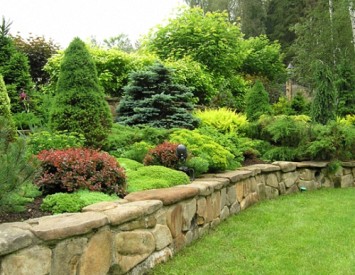
Wishing to get elementary construction skills, the easiest way to start with the development of the masonry of the boob stone on the example of a stone fence in the country or in a private house. Valuable experience and skills will be useful to arrange the foundation - the construction of decorative fences, cozpostroops and partitions in landscape design.
Content
What is the feature of masonry from natural stone
Masonry is the simplest fence or wall of natural or partially treated stone. A single-caliber stone, folded in several rows or levels, is fastened with cement mortar, special glue for facing stone or another binder building mixture. Suitable cobble slices and large stone blocks of the desired size and shape are sometimes laid out in 2-3 rows and without fastening.

The laying has several varieties:
- from bricks of different types;
- from stone sides;
- mixed type of masonry;
- masonry of wild stone - trees and neutasic.
Looking at a bunch of incorrect shape boot, the newcomer is not clear how beautiful laying of natural stone can get from this material. However, precisely from him, people built the first fortifications, fences, houses and temples in antiquity. Today it is the cheapest building material that can be collected on the ground. Natural stone goes to construction or arrangement:
- foundation of buildings;
- fences and fences;
- basements and cellars;
- economic buildings;
- auxiliary walls and partitions;
- hydraulic structures;
- wall-backups;
- communications (sewer and hydrotechnical);
- garden buildings and fences;
- basement for barbecue.
With any installation method, a stone fence or other neatly laid out stone fencing looks quite attractive.

To enjoy illustrative material and explanations, it is important to master several terms used by masonry:
- bed (broad base);
- spoons (sidewall);
- put (end);
- outdoor and inner versts;
- overseas;
- facade;
- horizontal and vertical seams;
- a spoonful (chain) and a twitch row (short side) - see the laying pattern.
Cooking a stone to laying
The stone collected or brought to the construction site is sorted in size and shape. It is preferable to make a stone masonry of the same mass, but a natural material is usually suitable up to 30 kg. A stone that is close to the parallelogram is deposited separately - the material on the corners. Larger blocks - on the lower rows and on the formation of dressings.

Dog stone varies in terms of strength. Under the "butt" means natural stone of arbitrary shape, suitable chipped pieces of breeds. A small boot is suitable for laying, in the range of 100 - 500 mm, or which can be transferred. A larger cobblestone crushed into pieces of up to 300 mm. For masonry suitable:
- granite;
- sandstone;
- limestone;
- tuff;
- dolomite;
- the sewer (crushes of different density, chipped and row).
Stones are selected with the calculation so that you can install rows. The combination of the shape and size of the material is equally important for laying the stone with their own hands - they must harmonize and create aesthetic pattern. The formation of masonry is made according to certain principles in order to obtain a strong base of the vertical plane, and not a chaotic journey. The correct laying of the butt stone is the upper edges horizontally or with a slope of the middle of the wall erected, which is important for the proper load distribution.
The layers of large stones and smaller sizes should be alternate, and emptiness is filled with smaller material so that there are no cracks in the masonry. Small stones are selected for filling emptiness, the rest is filled with "putty". This is the composition of clay and a small chipped stone, prepare it in advance for work.

Before masonry, the stone is cleared of shallow crumbs and wet for better clutch. When a suitable stone does not fit in the right position, small triangular pebbles are placed under it as a backup, so they should be at hand. Each layer starts from the corner stones to meet, the reinforcement of the rod is made between the rows. The last row is equal in particularly carefully and poured the binding mixture.
The best material for masonry is a dasane or brushing, suitable forms, which will give a relative smooth facial surface. A very large building material is splitting in different ways. Extra pointers are removed to get a suitable geometric shape. The laying of hollow stones is made similarly, but without additional refinement.
For buffet clings you will need a tool:
- hammer;
- sledgehammer;
- master OK;
- metal tamping and wooden.

Several ways to crush stone for laying
ATTENTION: Performing work on the rod of the stone, be sure to protect the hands with work gloves, face with glasses, use a household respirator, dense rob, high boots, you can wear a welding mask. There should be no number of random spectators. Just in case, keep the first-aid kit at hand, because the material is very strong, you will have to make an effort. Watch the tool not swore!
- Booth is broken with chisel and sledgehammer. In the ground hollow out a small recess for the stone - to avoid the rickest. A sharp and strong movement is applied to a sledgehammer in the center. If there is no result - the blows are repeated at the same point. A strong block can be turned over and repeat attempts. Sharp fragments, after splitting the stone, you should climb the hammer.
- Booth is broken by a hammer. If there is no suitable tool, it will suit the usual heavy hammer on the short handle. The chisel is selected with a carbide tip that can withstand the load. The entire action scheme is the same as described above, but the chisel can also be moved around the circumference until the formation of the first crack. It usually grabs 5-10 sudden beats, but it all depends on the density of the stone.
- A large cobblestone split is the most difficult, but the process is similar to the previous one - the stone in the recess is splitted with a chisel. Blows are applied with a hammer to the first signs of split.
- You can try to work with power tools, but it is important to calculate the possible load and choose a reliable nozzle. After breaking by the wedges in different places use a grinder with a diamond disk.
Tip: When using a sledgehammer, it is more important not the impact force, but the accuracy and proper holding of the tool. It is necessary to keep closer to the end of the handle, and it will give the blow more power than holding a heavy naval.
- The last way is to break a large cobblestone with dynamite, but here you need experience, equipment and removal from the settlement. These works trust professionals.

"Dry" and "wet" laying stone
Builders practice "wet" and "dry" masonry using a solution based on:
- construction glue;
- sand-cement mixture;
- clay kneading.
The dashest stone is better to lay out 2-3 levels without any solution with a thorough fit of each block, respectively, the form of a neighboring material.

Garden-park hedges with dry stone laying look very natural, especially if the earth is covered with the back side for the similarity of the natural terraces. The stone gradually turns the pigstream and the picturesque landscape, resembling the ruins of an ancient fortress or a castle.
In the "dry" masonry only a large stone of arbitrary shape, approximate to cubic. It is more important not only to fit each stone to each other, but also the calibration of the building material so that the wall formed in width and height. If the stone hedge is done under the back of the earth from the back side, it is important to align only the facial surface - with the help of a plumb. In the same way, you can make a low masonry of ceramic stone.
The largest stones are stacked at the lower level, but the ratio is necessarily observed as with wet masonry. Such work with something resembles a patch connection of fragments, and no more dry masonry is different. Empties or seams between boot or stone blocks can be filled with the rammed soil, if it is a low masonry in the form of a garden curb or fence for flower beds. The lower row of stones sometimes partially roll into the ground, like the foundation.
For the construction of a height of more than half a meter, only wet masonry is used, based on one of the varieties of the binder solution. If the natural stone is used for low hedges in agricultural mixed-type agricultural buildings, for example, as a base of saman masonry, it is also possible to fasten the clay mixture with the addition of dry cement. This guarantees masonry durability and stability.
IMPORTANT: Sea sand into the solution for laying stone is not recommended. Preference gives well-sieved river sand - it has the best characteristics for clutch and stirring, does not highlight the salt.

Methods of laying
From the method of laying the long, short and end sides of the construction or finishing material depends on the general type of masonry, and the strength of the structure. The main task is to shift vertical seams to avoid cracks in the masonry:
- boot concrete;
- large and small block;
- lightweight;
- decorative, etc.
However, with any way of work, stone masonry must meet the basic requirements:
- stability;
- durability;
- reliability;
- monolith;
- aesthetics;
- resistance to mechanical stress.
The simplest laying of artificial stone and bricks - blocks on each other are exhibited by wide edges (beds). The brick is laying out with spoonful and toned rows, depending on which side it lies on the front side of the wall. This is important for row dressing strength.
Traditionally, the laying of spoonful rows is drawn by dressing - where there was a vertical seam of the previous row, the gray brick, block or stone is placed there above. Often other types of ranks are also used:
1. English bandage, where the brick of the twitch row alternates with spoonful rows - a photo.

2. American bandage, where the tile row is moving 4-7 spoon rows so that the seams are mixed.
3. Flemish gag, where the alternation of the tychk and spoonful type of brick laying is underway through the row.
However, the natural stone usually has unequal dimensions and arbitrary shape, so observing such brickwork types of dressings are not so simple. Experienced bricklayers skillfully combine the principles of different types of styling, picking up a boot with a chip (short side) and a long (spoon). In the slaughterhouse (butt masonry), it is still important to observe the inquiry and alternation of vertical seams so that the chain dressage is like. The angles are laying out so that the long side of the stone alternately left in one wall, then into another wall.
The easiest way to observe Rows and alternating vertical joints when laying the cut stone, for example of limestone or sandstone. This natural material with a large content of calcium caused by underwater compacts connate shells, it is environmentally friendly, has a low thermal conductivity. His cut blocks, like brick, coquina so convenient to install. A rubble masonry in a lower tensile strength, since the irregularly shaped stones touch each other at several points, instead of flat. Here much depends on the quality and skill of the solution adheres stacker.
Masonry is different complexity, which are assumed to be:
- shaped protrusions and volumetric convexity;
- conducting bands (multiple projecting horizontal rows);
- rifles (smaller thickness the facade brickwork);
- overlaps (masonry fragment extending from the common wall near);
- ledges (front fragment of the wall goes in the opposite direction);
- indent (masonry temporarily cut off, vertical or "ubezhnye");
- niches (half the thickness of the masonry or more).
Thus achieving a special decorative effect, and not just a solid stone wall. Often, the indent with a gradual decrease of the round-shaped mount forged metal grid - turns out very effective hedge manor.
Technology rubble
Rubble and placed "under Gulf" and "under the shoulder blade."
1. The first series of often little dropwise and stack dry-compacting gravel, then all this is filled with a liquid solution until all voids are filled. Further ranks fasten thick solution to fill the voids, keeping the dressing. Be sure to make the intermediate horizontal seam. Each stone dozhzhen fit the adjacent blocks, and the vertical seam stone necessarily overlap upper row. If a sufficiently large voids in the joints and between the rows can be filled with stones, props or just filling. Load-bearing walls and pillars spread only in a manner respecting the Rows, dressing and rasschebenku.
2. Sometimes doing masonry with vibrocompaction adding strength - without mortar spread 1st row, scoring the gravel vacuum. Next, the solution was poured and set to seal masonry building vibrator until all the solution will not enter the clutch. Next comes the usual masonry "under the shoulder blade," and everything is compressed again. This is possible where dense soils do not allow drawdown, and the base wall trenched, the formwork can be used.
3. The masonry "Under the Bay" is suitable for a natural stone with a torn surface without sorting, starting with bookmarks in a trench, like the foundation. This is done without a formwork to obtain smooth sheer walls. Under a tightly laid stone, the slope is made and flooded with a liquid solution, which with excessive covers the stones on top and then lays a new layer of stones.
4. "Cyclope" masonry looks more decorative, thanks to a plump stone, which in the wall gives a kind of drawing. The masonry is drawn up with convex seams within 5 cm with extender - Photo.

Tip: With any type of masonry, the verticality of it check the level, especially in the corners. It is desirable to reinforce the wall between the rows. The horizontal of the masonry check the lace tensioned between the stakes, and if the semicircular laying is needed, it is placed on the radial markup from one point.