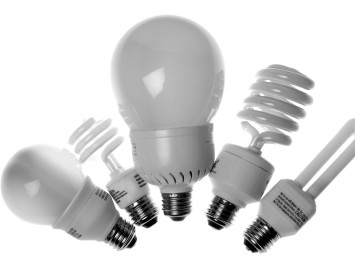
Today, the market has a substantial lamp of various types and cost. Each of them has its technological and consumer characteristics, advantages and disadvantages. Luminescent lamps are considered the most popular today. Consider this topic more.
Content
Varieties of lamps
Distinguish the following types of lamps:
- Instruments incandescent
- Halogen.
- LED.
- Luminescent.
Consider some more details each of them.
Instruments incandescent

For a long time, these lamps did not have decent competitors. Today, of course, the situation is different. As for the shape of products, it may be different. The same applies to power, which, depending on the type of instrument, ranges from 15 to 270 watts.
Incandescent bulbs, which are manufactured today are crypton or bispiral. The first is used inert gas Krypton. The minimum power of these products is 400, and the maximum 100 watt. Unlike ordinary lamps, they have a large light statement.
Considerable light output and in bispiral lamps that give streams of light due to the incansion of a complex arcuten tungsten thread.
Incandescent lamps regardless of their species can have a different surface. It happens transparent, matte or mirror.
Halogen lamps

They give beautiful saturated shades, so that they are often used when interior design in an ethno-style. Products can have a different form. These lamps are used not only for overall lighting, but also for highlighting individual sections.
There are several types of such lamps:
- Wall.
- Suspended.
- Point.
- Built-in.
- Swivels.
- Fixed.
LED lamp

The advantages of these lamps include:
- Low power consumption.
- Relatively low cost.
- High light output.
- Large service life.
There are options for products that are not required for the electrical wiring. They function on batteries or solar batteries. These lamps can operate at temperatures from -30 to +50 degrees.
Fluorescent lamps

These products have recently become increasingly popular. They give soft and scattered light. The power of fluorescent lamps can be from 8 to 80 watts. They function due to the effects of ultraviolet radiation gas discharge per luminophore. Such products require less electricity to work, which make it possible to save. The instrument models that are suitable for usual E14 and E27 cartridges are widely used to illuminate private and apartment buildings. Thanks to the availability and popularity of lamps, luminescent buy today will not be difficult.
If you compare the incandescent device and the fluorescent lamp of the same power, then the last light flux will be 7-8 times more. In addition, such products can serve much longer. From the disadvantages it should be noted that such devices are sensitive to temperature drops, and sometimes can flicker.
Types of luminescent lamps

There are only seven types of luminescent lamps:
- Natural light with improved color reproduction (LET).
- Daylight with improved color reproduction 1 (LDC).
- Cold natural light (LCB).
- Cold white (LCB).
- Warm white (LTB).
- Daylight (LD).
- White (LB).
Each of them differs from a luminophore used.
In form they can be:
- straight
- in the form of a ring.
Straight lamps are gas-discharge. Pressure in such devices is very low. They consist of a glass tube (columns) and two sockets with contacts. In addition, there is a pair of cathodes made of tungsten thread or steel tube. The cavity of the lamp is filled with mercury couples and inert gas. Light output The product directly affects the length of the tube. Such lamps are installed in public transport and residential buildings.
Instruments in the form of a rings can be used in almost any rooms. Due to the small dimensions of the tube, this lamp is conveniently used in flat shape luminaires. Quality and durability are the main characteristics of fluorescent lamps. The price of such lighting devices is usually acceptable. Most often, they are used to illuminate the premises of a large area.
Characteristics of luminescent lamps

Of these lamps, it is necessary to note the following:
- The temperature of the flask is not so hot as the incandescent lamps.
- Resistant to small voltage drops.
- Long service life, which is much more than that of incandescent devices.
- Large color range. Allows you to use practically in any rooms.
- These lamps provide the same flow of light, but at the same time spend almost four times less electricity than incandescent instruments.
The main disadvantages are the following facts:
- Bad operation at a fluorescent lamp temperature 0 and below.
- When high temperatures achieve, the flow of light is reduced.
- The flask contains approximately 40-60 millimeters of mercury. Therefore, constant location with such devices can harm health.
- There are energy-saving fluorescent devices. The principle of their work is similar to conventional fluorescent lamps. Only they have a much smaller area of \u200b\u200bthe flask.
Compared to incandescent lamps, they have several advantages:
- Require 80% less electricity with the same amount of light.
- It is possible to choose the color of the glow.
- Cash savings due to a longer service life occurs.
- Long service life. Its accurate value depends on the type of lamp.
Scheme and work order
First of all, you need to say that it is more correct to call it not a lamp, but an electrical appliance that consists of the following components:
- Lamp.
- Starter.
- Throttle.

In order to form a discharge, only 220 volts voltage is not enough. The fact is that there is a gas in the flask inside the flask, which is not an electrical conductor. For the occurrence of the charge, it is necessary that the ionization of this gas occurred. For this purpose, the starter is intended. It is he who in a couple of seconds heats the electrodes in different parts of the lamp. When the electrode is heated, part of the electrons from the surface flies from it. Then due to the presence of electrical fields, electrons move in the direction opposite to the electrode. At the same time, they periodically fall into gas atoms.
As a result, the gas is ionized, which leads to an increase in the number of free charges inside the lamp. At this point in the flask there appears a electric pressure. As a result, the collision of electrons with mercury atoms causes ultraviolet glow, which is not visible to our eye. It then, with the help of a phosphorus applied to the inner surface (a mixture of phosphorus with other particles) is converted to visible light. After the appearance of an electrical discharge, the electrotable is created, as a rule, to independently maintain the required level of ionization. Therefore, the heating of the electrodes is no longer required for this.
Connection diagram using Empre
Luminescent lamp diagram:

The electromagnetic streaming device or EMPRA is often called a throttle. This scheme was actively used to connect fluorescent devices in Soviet times. It is important that the power of this scheme corresponds to the total power connected to the lamps.
The principle of operation is as follows. When the power is turned on, the starter occurs in the starter. At the same time, bimetallic electrodes are shorted. As a result, the current is formed in the starter circuit and the electrodes, which is limited only by the internal resistance of the choke. Due to which three times the voltage in the working lamp increases. The electrodes are almost instantly warmed up. At the same time, the cooled of the bimetallic contacts of the starter and the chain opens. With the help of self-induction, the throttle launches a special high-voltage pulse. As a result, there is a discharge in the gas environment, which leads to the ignition of the lamp. Next, the voltages are not enough to re-closing the starter electrodes. Therefore, while the lamp is on, the starter with open contacts will be inactive in operation.

Connection diagram using EPRA
The electronic port-regulating device or EPRA submits to the device a voltage other than the network frequency, namely the high-frequency current by a value of 25-125 kHz. This avoids blinking lamps, which may be unpleasant to human eye. Here is a car generator scheme, which includes the output cascade on the transistors and the transformer. Connection schemes are usually applied to the front side of the block.
EPR has several significant advantages. So, they increase the life of fluorescent devices. This is achieved thanks to the special launch mode. In the process of work there is no unpleasant noise and glare. If you compare this scheme with the previous one, it saves up to 20% of electricity. In addition, there is no starter in it, namely, it often fails. Today there are special models that allow you to adjust the brightness of the glow and having the possibility of dimming.