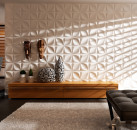
Ceramzite concrete blocks are rightfully considered to be boblocks. They consist of clay, cement, sand and gravel. They are used in the construction of buildings and structures, frames and garages. According to characteristics and pricing policies, they represent close competition for bricks.
Content
Characteristics of ceramzite concrete blocks
Modern society constantly builds new buildings and facilities under their needs. For the search for the optimal option of building materials, years are spent. For them, a high plank is assessed: reliability and durability, availability and easy use.

So, for the brick, the alternative analogue comes ceramzite-concrete blocks. They are widely used in Europe. In countries such as Austria, Germany, Denmark.
The material is made of environmentally friendly raw materials. The main elements of the ceramzite concrete is the burned clay, water and concrete. When kneading the latter, sand and / or crushed stone are added. As a result, hard and durable material is obtained. But which is characterized by a large level of thermal conductivity. So, it is not able to keep heat inside the room. Therefore, an additional facing material is used and insulated ceramzite-concrete blocks are obtained.
Ceramzite is produced in special spinning furnaces. It is distinguished by the ability to quickly absorb moisture. What is relevant for the construction of greenhouses, for the cultivation of crops. And the hardness of the structure is achieved by the method of semi-dry press and following the steaming. Each grain of the substance is covered with a crust and acquires the type of frozen foam.
Thus, the average density of the final block varies from 450 to 1750 kg / m³.
Ceramzit concrete blocks are used for the following purposes:
- erection of outdoor and inland walls of buildings,
- station of the foundation
- organization of ventilation mines
- construction of interroom partitions,
- filling the frame in monolithic construction.

The properties of these blocks are governed by GOST 6133-99 "Concrete wall stones. Technical conditions. "
The standard indicates that the surface of the material is the corrugated, the crotes, polished and smooth.
And by appointment, the stones are divided into ordinary and facial. The first requires processing with additional facing material. The second is made with one or two faces that perform a decorative function.
Ceramzit concrete blocks are usually produced in the form of a rectangular parallelepiped. But in coordination with the customer, it is possible to perform other options.
Regardless of the size of the ceramzite-concrete block, its weight does not exceed 31 kg.
Sizes of clay-concrete blocks
According to GOST 6133-99, blocks of certain sizes are manufactured for construction. Wall ceramic concrete blocks are produced, focusing on the following parameters:
- height 13.8 cm,
- width from 1.4 to 2.9 cm,
- length from 0.9 to 2.9 cm.
And for the construction of partitions, clamzit concrete blocks are used with the following dimensions:
- height 18.8 cm,
- width 9 cm,
- length from 1.9 to 5.9 cm.
Corners of blocks make straight or spin.

Calculation of clay-concrete blocks is carried out at the stage of compiling a construction project.
The material itself is solid and hollow. The latter type is formed with vertical through or not through-cavities which are uniformly distributed over the area unit. Full-bodied lightweight aggregate blocks are characterized by a dense structure. They are no voids and holes. Typically, they are used for laying the foundation.
Manufacturer makes no material marking, where notation:
- By - stone,
- C - for the scope of the masonry walls,
- II - the use of internal partitions,
- A and F - the front or the ordinary type of block
- PS - hollowness of the material.
By strength grade of heavy concrete divided descending hardness of the marker 300 to 50. A lightweight analogue - from 100 to 25.
It also indicates the level of frost, where F200 - the maximum rate and F15 - minimum.
Before you buy expanded clay blocks, it is necessary to check compliance with a symbol on them norms and the actual parameters of the material.

Advantages claydite-concrete material
Any construction element has its pros and cons. Based on them, you must choose the best option for a given type of work.
Experts determined number of advantages lightweight aggregate blocks. Here are the main ones:
- The air permeability of the material through the granules.
- Environmentally friendly building material.
- Insulation saves up to 70% of the heat indoors compared with concrete counterpart.
- Moisture resistance, unlike cementitious material.
- The minimum number of masonry mortar for the construction of walls.
- Saving on workers' hourly pay. Since laying this material occurs in 4 - 5 times faster than with bricks.
- Houses made of expanded clay are durable. They do not corrode, rot and do not burn in the fire.
- The material has high level of noise isolation compared with concrete counterparts.
- Claydite differs chemically resistant to alkalis and sulfates.
- The relatively low price lightweight aggregate concrete blocks with their large volume: one unit replaces 5 - 7 bricks.
- Unlike foam-aerated concrete, expanded clay lightweight keeps well dowels without special fasteners.
- Ease of production is available for self-fulfillment.
- Masonry lends itself to easy lining and trim other materials.
- The strength of up to 1800 kg / m³ and frost to -40 ° C.
- Because of its strength, in the process the material is not deformed and does not crack.

High demands are exhibited to the technology of manufacturing ceramzite-concrete blocks. Since the bearing walls are erected. Therefore, they are characterized by quality and reliability.
It is considered to be a good building material. It comes to 7% of structures in post-Soviet countries and up to 40% abroad.
In general, domestic masters leave approving reviews about ceramzite-concrete blocks. Making the emphasis on what will be required for another 10 - 15 so that they secure their position in construction business.
The advantages of ceramic concrete blocks make it possible to reduce the price and save construction time. At the same time, having received reliable and durable buildings.
Disadvantages of ceramzite concrete blocks
With the positive sides, relative disadvantages are characteristic of the ceramzite concrete:
- Increased porosity, compared with solid monolithic concrete. Because of which the physico-mechanical characteristics of the material are reduced. Including density. Therefore, when booking the foundation and construction of high-rise buildings, it is preferable to use pure concrete.
- The need for external thermal insulation to preserve comfort in a cold time.
- Unfair for the manufacture of blocks. Sometimes manufacturers use poor quality raw materials and cannot withstand the requirements of the GOST. And in the open access there is no complete technology of self-making.
- Despite the relatively small weight of the material, the building from the ceramzite concrete requires a solid foundation. So, it will not be possible to save on the supporting structure.

Ceramzit concrete blocks do it yourself
To save money, the craftsmen make ceramzitobatonic blocks independently. Also on this can be well earned. The process is not complicated, but requires compliance with proportions and instructions.
For independent preparation, the following material will be required:
- sand 35 kg,
- wooden boards for formwork,
- ceramizite with fractions 5 - 7 mm Weight 70.85 kg,
- cement 12 kg,
- water 11.7 liters,
- metal plate for laying material,
- the capacity is 150 liters and the tool for mixing the mixture.
Please note that the ratio of raw materials for the manufacture of 12-13 hollow blocks is given. Make appropriate calculations for the number of final material you need.
First, make the shape under the blocks of wood or metal thickness 4 - 5 mm. For the formation of internal cavities, a 3 mm material is sufficient.
Check the mixture of a ceramzite concrete to a state of plasticine. This can be done independently in the container with the help of a shovel. For large production, it is better to rent a machine for clay-concrete blocks represented in the photo.

Fill the shape of the mixture.
To dry out blocks are placed on the metal base. During the week, moisture and direct sunlight should not fall on them. In the heat they need to be wrapped with water and coat on top of polyethylene.
In fact, the material dries in 48 hours. But the masters claim that only after 3-4 weeks the ceramzitobeton acquires maximum strength.
How to put Ceramzit concrete blocks
The process of masonry of ceramzite-concrete blocks is largely similar to the masonry of the brick. But it is distinguished by a number of features. For example, the need for sutures.
For laying, the following tools and material will be required:
- measuring tape
- capacity and tool for kneading glue, for example: bucket and shovel,
- level to align blocks,
- recess
- wooden rails,
- ceramzite concrete blocks,
- rubberoid
- beach rope
- rubber or wooden hammer for laying,
- water,
- glue,
- saw for a thread in building material.

- The foundation is leveling up with a level of level and cement mixture. After not the rubberoid is stealing in two layers. It will perform the function of waterproofing. The surface is secondally aligned with a level or level.
- Start the laying is necessary from the corners of the structure. They contain level rails with a beep-tied to them, which will serve as a guide for the following rows of blocks.
- Blocks are treated with water, after which the adhesive solution is applied. Such a layer in 2 cm of substance. This is done so that the porous material is minimally absorbed a masonry solution.
- The next ceramzite-concrete block is placed at a distance of 4 - 5 cm from the end of the previous one. After pressing down and towards the joint, the blocks are aligned. Press the strength of their fasteners is carried out by climbing the surface with a hammer.
- Each 4 - 5 rows attached the reinforcement grid to impart a greater strength design.
- If necessary, reduce the size of the material uses a special saw.
Experts recommend parallel to erect the inner and outer walls.

After laying each row, the level is checked by its parallelism relative to the Earth.
Recommendations in the design of stone structures from blocks
- When erecting low buildings, you need to use coenproof ceramzite-concrete blocks. For the external walls, their frost resistance should not be lower than F50. During the construction of an additional inner series there is no such requirement.
- For blocking blocks use thin layer masonry solutions. In this case, the thickness of the seams is maintained in the amount of 1 - 2.5 mm.
- It is also possible to use heavy adhesive mixtures. The thickness of the seams between the ceramzite-concrete blocks in this case reaches 1 - 1.2 cm.
- Wall widths of 30 cm, it is necessary to design in one row of stone. With a larger size, one or two blocks.
- Performing a two-level masonry is a plash and tonge type of dressing. The size of the first type should be at least 1/5 of the wall thickness.
- The adjoining of the walls to each other needs to be made with rigid or sliding connections. For example, with metal guides and profiles.
- To ensure the required level of silence indoors, use a special soundproofing material.
- Depending on the magnitude of the load on the design, equip it with conventional or rigid reinforcement.
- Design and construction of the construction is better to provide a specialist. And for high-quality and timely execution to control the process.
- Make sure that the technical documentation is compiled correctly, taking into account the norms of safe construction.
- When designing and building stone structures, refer to video reviews on laying ceramzite-concrete blocks.