Chimney is one of the most important parts of the room heating system, in which boilers operating on solid, liquid and gaseous fuel are used as a heat source of heat. True, it is worth noting that some models of modern boilers, especially gas, are equipped with a special turbine, which forcibly removes fuel combustion products from the room. Turbined models do not need chimney. Boilers on a natural line to work without a chimney can not. The correct design of the chimney, exactly selected sizes and materials for its manufacture, as well as the full compliance with the installation technology is the security deposit of people living in this room. Unfortunately, quite often we hear about cases when the unsatisfactory state of chimneys becomes the cause of the death of whole families. Curmarket gas does not smell, and the saturation of the atmosphere in the house can not be noticed in time, especially if the breakage happens at night. We will tell about the features of the design and installation of chimneys further.
Content
Types of installations for private houses

Chimneys are made from various materials. Consider some characteristics of these designs. The oldest chimney is brick mine. Such structures have their advantages and disadvantages. Among the latter, the bulkness and complexity of installation can be highlighted. Also, the nonmonolite design of the chimney contributes to settling on its walls of layers of soot and dust, which is often the cause of weak thrust. Now modern houses are most often equipped with national galvanized steel structures, ceramics or asbestos. The latter did not get distribution due to the harmful effect on the human body, and steel structures have a sufficient number of shortcomings.
Ceramic chimneys are considered one of the most high-tech and wear-resistant structures. They have excellent performance:
- Anticorrosive resistance. In this regard, they significantly exceed chimneys from galvanized iron.
- Resistant to temperature drops.
- Accumulating properties. Due to the fact that the ceramics from which the chimneys are manufactured, it can be kept warm inside its structure for a long time, condensate is not formed in them.
- Low roughness of the inner walls, which eliminates the sedimentation of dust and soot on them. This aspect reduces the cost of exploitation of the chimney.
- Mechanical strength. Such chimneys are not defeated.
- Simple chimney installation.
- Durability. Ceramic chimneys with proper installation serve several decades, as the warranty period for such systems, which is more than 30 years.
True, it is worth noting that this type of chimney has a number of shortcomings:
- The main one is their big weight, which requires when it is installed, the construction of a separate foundation.
- Also, the construction of a ceramic chimney is possible only by strictly vertical axis, various angles and transitions are not possible. This often becomes an obstacle to the installation of the system in already operated rooms without repair.
- Another negative side is the relatively high price of ceramic chimneys, which is sometimes an obstacle to homeowners. However, it is worth noting that all of the above advantages will pay them a high price, so the decision to buy a ceramic chimney will be correct.
Ceramic chimney device

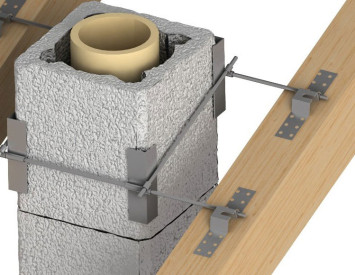
Standard ceramic block, if viewed in the context consists of three main parts:
- Set of vertical pipe. It consists of several special ceramic sections that are connected to each other.
- Carrying casing or mine. The outer sheath of the chimney. Designed to support the entire design. As a rule, it is performed from special foam concrete blocks.
- Heat insulation. The thermal insulation layer is stacked between the pipe and the carrier cover, which allows you to level the temperature difference so that condensate is not formed inside the casing. The heat-insulating material uses basalt wool, which is a fireproof material.
In height, ceramic chimney can be divided into three parts:
- Base.
- The trunny part.
- Podle.
The headband is called a part of the ceramic chimney that goes onto the roof. It establishes a protective element, mainly a cone, in order to protect the inner chimney from atmospheric precipitation and wind gusts that can reduce cravings in the pipe. A similar design is available in many installations, for example, in the EFFE2 ceramic chimney.
The most saturated part of the ceramic modular chimney is the base. It is there that the condensate collection is located, the audit window, through which works on the cleaning and prevention of the system, the ventilation window, which serves as an air inflow into the chimney, as well as a tee to connect the output of the heating device.
Ceramic chimneys: dimensions

These characteristics of the design include:
- The diameter of the ceramic pipe for the chimney.
- Height of the chimney.
- Headpipe height.
Important recommendations:
- The chimney dimer is indicated in the specification to the heating device and must be strictly observed, as it can affect the safety of people in the room.
- In terms of the height of ceramic systems, they make requirements other than brick or metal chimneys. The height of the pipe from the grate chamber grille to the edge of the headband should be at least 5 meters.
- Special attention should be paid to the height of the head. For the pitched roof, this parameter affects the distance from the chimney axis to the top of the skate. At the value of this parameter to 1.5 m, the height of the headband over the vertex of the skate should be at least 0.5 m.
- If the distance from the vertical axis of the skate to the axis of the chimney is more than 1.5 m, but less than 3 m, the height of the headband should be at least the height of the skate.
- If the mid-scene distance is more than 3 m, then the angle between the line spent between the tops of the skate and chimney, and the horizontal straight line conducted through the peak of the chimney should be not more than 10⁰.
- With a flat roof design, the height of the chimney head tree must be at least 1.2 m.
In case of violation of data values, the chimney can be insufficient for normal fuel combustion.
Also, you should not do the chimney too high, because you can achieve the opposite effect. With a high height of the pipe in it, aerodynamic resistance can be created, which will become a barrier to the output of gases.
Features and technology of installation of ceramic chimneys

The procedure for performing installation work:
- First of all, as we said, it is necessary to equip the foundation. It is necessary in order to withstand the weight of all the elements of the chimney. If the floor in the house or apartment is concrete, then in the foundation there is no need.
- After it is ready, a layer of waterproofing is stacked on it. As the latter, the rubberoid or the scuraly is perfect.
- A ceramic concrete block is lined with a waterproofing, inside which a ceramic glass is placed to collect condensate. The glass is fastened with a solution. The composition is prepare standard from concrete and sand in the ratio of 1: 3.
- As a rule, suppliers of such systems supply the Schiedel ceramic chimney set, which includes all the elements. This designer is selected by the manufacturer specialists depending on the configuration of the heating device and the room in which it will be installed. Everything that remains is to collect it correctly.
- For connecting blocks, fittings are used. Through holes are located in the corners of the elements. When installing them on each other, the reinforcement is inserted inside the hole so that passed through 2 blocks. Then the holes are poured with concrete. When laying elements between them a solution is applied.
- So, we have already laid the first block with a glass for condensate inside. We are laying out a metal grid that prevents the garbage condensate collection.
- Next, take the next block and scold one side in it. We will install the ventilation lattice inside. We put the block with a cut side under 90⁰ from the future input of the heating device. In the same way, we place a ceramic tee.
- Between the ceramic element and block install basalt wool. Next, the pipe segment is mounted with the next block. Ceramic elements are combined with each other with a special sealant, which prevents gas leakage through the connection location.
- The next step is to install a tee under the boiler. Be careful that when installing the removal from the boiler, exactly coincided with the chimney hole. Otherwise, gas leaks are likely when using the device. Thus, the chimney is built to the headband. The top also provides for the presence of an audit hole.
- The headpoint can be separated with decorative brick or stone. In some cases, cladding is produced by siding, which reduces the cost of work. In the mouth of the chimney, a protective cap is installed.

Installing a ceramic chimney into an existing mine is made somewhat differently. It is done from top to bottom. All items are connected on the roof and with the help of special fixtures are lowered down. Each part of the pipe is installed in the passage. The fact is that modern systems are equipped with blocks of standard sizes under the diameter of the ceramic pipe. If the mine is more, then the spider will keep the pipe in the middle.
Caring for chimneys

As we have already spoken, such designs do not require special care. However, experts recommend at least twice a year to check the chimney on the tightness and quality of thrust. Also at least once every two years, or earlier, if necessary, cleaning the inner surface of the ceramic pipe from dust and soot.