A few decades ago about such a landscape design element, like a garden path, no one thought. The site near the private house or giving was perceived as a vegetable garden, each square centimeter of which should be busy any culture. The track in the garden occupied only a small area between the beds and garden trees. In most cases, it was just a drowning tape of the Earth, which went people. Sometimes a secondary brick was used as a coverage of such a track, in some cases it was diminished with old boards, especially rich people were simply filled with concrete, and some even used the old conveyor belt.
Content
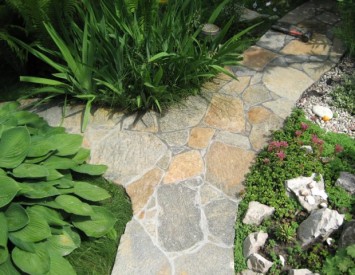
However, the times came others. Now in most private houses, the plot is used not for gardening, but for rest. The new generation prefers to make a landscaped design on a useful area, in order to relax from the urban bustle from the labor everyday. In this case, the appearance of the garden path plays a huge role. Successfully selected design and materials will help this design element to emphasize the beauty of the landscape of the site, and on the contrary, unsuccessfully designed and poorly mounted track can smear all the efforts of the designer. Especially attractive watching tracks laid out by stones. It is desirable that work on the construction of tracks is part of the complex refinement of the site, because in such an important case, each element cannot be separately, everything has its meaning in the overall picture. About how the laying of stone on the tracks is carried out - further in the article.
Choosing a stone for tracks

Naturally, it is better to invite professional builders to arrange the garden tracks from the stone, but if there is free time, a small experience of general construction works, as well as a minimal set of tool, even a lover can cope with her.
Particular attention is required to pay the choice of stone:
- First, it should have a homogeneous structure, without cracks and chips.
- Secondly, one of the sides of the stone should have an absolutely smooth surface. It is she who will act as a coverage of the track. Such characteristics have a marine stone for tracks.
Recently, high popularity among landscape designers received tracks from artificial stone. Such material is much cheaper than natural, but it has a more suitable geometry for laying. Modern technology casting and processing of concrete allow an artificial stone to have an appearance no worse, and sometimes, and better than their natural fellow.
The advantage of natural stone for the tracks is that it does not have in its composition of chemical additives, and therefore does not enter into chemical reactions that can lead to its destruction. In any case, the choice of material for the track depends on the preferences and capabilities of the host.
Stone track device with their own hands

Procedure for work:
- Laying track begins with a markup. To do this it is determined the location, width and configuration. Winding paths look quite attractive, though their styling is much more complicated than direct. Used for marking pegs and cord rope that is stretched between them. This will allow the entire length of the track to keep it the same width. When markup is necessary to take into account the width of the curb.
- When work is finished by the markup, proceed to remove the top layer of soil. Digging a trench depth of not less than 30 cm, as for the construction of the track must be laid several layers of different materials.
- The first layer on the trench bottom is necessary to lay the geotextile. This material will reduce the likelihood of emergence of the weeds in the gaps between the stones and allow normal drainage to excessive moisture does not accumulate between the stones that the onset of cold weather can cause cracks.
- Next, a layer of gravel slept. This material is required as a buffer, to distribute the load over the entire surface and allow some portions of the tracks fall to the ground. Gravel layer should not be less than 15 cm. After dumping it thoroughly tamped and leveled.
- Then backfilled with several layers of sand. Typically, 2-3 layers of uniform thickness is enough. After dumping of each of its moistened with water and tamped. This helps to gain the necessary density of the sand, to withstand the pressure of the stone.
- The next step is the installation of track laying stone. It is positioned so that the slots were as evenly as possible.
- After the end of the track laying surface is sprinkled with sand and disperse it to fill the seams. Next, the track is wetted with water to the sand in the joints better entrenched.
Casting artificial stone for tracks

This method has become quite popular in recent times. It allows you to effortlessly make beautiful garden paths, which appear to be not less effective than the tracks of wild stone.
The method consists in casting artificial stone in a special formwork. It is a stencil various shapes such as rectangular, or asymmetric. Work with this form of stone for the track is quite simple.
Preparation stone casting solution. Used cement-sand mixture with addition of dropouts. The ratio of components as follows:
- Cement - Part 1.
- River sand - 3 parts.
- Screenings - 3 parts.
The procedure for casting a stone:
- To give a decorative species, certain dyes are added to the solution. A reinforcing additive is also often used - fibrovolok, thanks to which the material will be more durable.
- One is usually done by 20 kg of cement. Initially, cement is poured into the pear. Then - 50-350 grams of 1%-iron-oxidine pigment. Depending on its quantity, the tile will have a different shade.
- The post falls asleep sand. After that, a plasticizer is added to the solution. It serves to give a solution of more plastic properties.
- The latter is added axis and water. At the exit, a mixture of consistency of thick sour cream should be obtained, in this case it will be strong and do not contain air bubbles.
Order order:
- First you need to select the direction and location of the future track. Then we set the stakes and stretch the threads that determine its borders.
- Next digit trench. For work on the casting track under the stencil, there will be a ditch depth of 10-12 cm. After that, we install the border.
- Then we thoroughly tamper the soil and we swell the trench sand into several layers. It is necessary to try to align the pillow by level. Each layer of sand is carefully wetted with water.
- After preparing a sandy pillow, a form is installed on it, which is leveling in terms of level.
- A concrete solution is poured into the established form. So that it is evenly distributed over the shape cells, it is smeared with a wide spatula. The entire solution is removed from the surface of the plastic form. When filling the cells, it is necessary to ensure that there are no air inside them. For this, the concrete is sealing a small spatula.
- After removing the extra solution, the form leaves about 1 hour, after which they remove and rearranged to another place where the procedure is repeated.
- The form must be removed carefully and evenly so as not to damage the uncomfortable concrete. Before starting work, the form must be lubricated. To do this, the machine testing or even vegetable oil is perfect.

Alternative to stone tracks
Concrete path
The monolithic path, although it is not such a beautiful view, as when using stone, but the costs of its installation and operation are much less.
For casting such a track, you will need:
- Cement brand 400.
- Sand (you can use screenings).
- Lighthouses.
The initial stage of production of work is not different from the installation of a path of artificial or natural stone with small differences. The torn trench is dumbling only with rubble, which is subsequently thoroughly tamped. Before this, a border is installed on the edges of the trench. Then mounted lighthouses for which the screed will be aligned.
The next step is mixed with a solution. To do this, sand, cement and water is added to the concrete mixer. The ratio of cement and sand should be approximately 1: 3. The finished concrete is pouring to the surface and with the help of the rule they roll around the level of beacons. The track can be safely used in 3-4 days depending on weather conditions.
For this operation it is better to choose a non-fit day. The fact is that if the moisture will quickly evaporate from concrete, he will lose part of its strength.
Wooden tracks
Recently, tracks laid out of wooden cuts have been greatly popular. Especially beautiful they will go root in the gardens. Such a track has a number of shortcomings, the main of which lies in the peculiarities of the tree. Without proper processing, this material will not be able to serve for a long time. That is why the procedure for applying an anti-corrosion composition is mandatory.
For the workpiece of the material it is necessary to take the trunk of the tree and cut it into circles with a thickness of up to 50 mm using chainsaws. Prior to this, it is desirable to clean the surface of the barrel from the knots and branches. After cuts are ready, you need to process them. This uses an antiseptic and olif. Processing must be carried out 2-3 times. After that, a pillow is preparing for laying wooden sections. To do this, it is necessary to dig a trench to a depth of 20 cm. Then it is pumped by gravel or rubble. After sinking each layer, the material must be carefully tumped and aligned.
The next step is to lay a wooden tile. The gaps between its individual parts do not matter. Here it is necessary to focus on the size of the step of those people who will walk along this path. After laying pieces of wood, the gaps between them are plugged with small pebbles. Unlike the stone, the skeleton of the wooden surface is better not to take. First, it does not look so impressive as pebbles, and secondly, the sand can cause damage to the ends of the wooden tile.
Stone tracks: Photo of ideas for registration