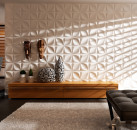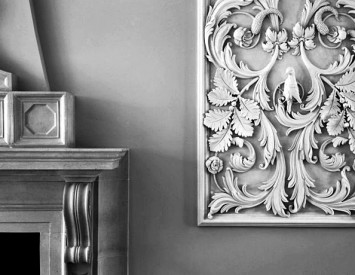
Lepunina has always been a sign of wealth and luxury. So today, the stucco elements of the decor confidently conquer popularity among mansion owners and apartments who want to arrange a semblance of Versailles in their home.
Content
In this selection it will be about installing plaster stucco. But for a start, a bit of general information about stucco as such.
The stucco is usually done from raw materials, which can change its state of liquid into solid, without exposing cracking.
What makes stucco
- clay;
- gypsum;
- cement;
- fiberglass;
- metal;
- glassPosit.
The last three material is not standard basic components to create stucco, but the parts of them are not much different than the classic visual.
Characteristic features of stucco different epochs of art development
- Baroque era - golden, pink or turquoise background + white stucco (lion head, floral ornaments, etc.).

- Classical Period - flat raised frames and panels for ceiling (garlands head monsters Amurchik, flame Gimeneja, sphinx).

- Modernist Period - plants and animals are intertwined in intricate patterns, seascape theme, flowing lines of the reliefs.

What good moldings from plaster?
- Environmental Safety.
- Fire resistance.
- White color.
- Availability.
functions stucco
- Aesthetic. Molded products, in this case, plays a purely decorative role, ie, simply decorate the interior. It may be a column in front of the building, fancy outlet trimmings, various panels, which assembly is usually carried out near the stairs to the second floor or in empty compartments. In some of today's mansions, built up "antique", even elements most staircase decorated with stucco details, installation of which is possible, and with his own hands. Moreover, the installation instructions in the area of \u200b\u200bstairs stucco identical to the technology of its installation on the walls and ceiling structures. Standard her steps described below.


- Practical. Some stucco details "hide" the various functional, but not very aesthetically pleasing things (wiring openings for different purposes, defects, etc.). In general, the role of the original boards of various purpose perform cornices and moldings. Although this is their purpose does not cancel the aesthetic component.

The mount stucco?
Previously widely used a mixture of glue and plaster moldings to interface with the wall surface. But the need to knead the mixture in certain proportions. It is troublesome and time consuming. There are a great alternative to "old-fashioned" method.
Today, the most practical glue - liquid nails. This material created from polymers and rubber, capable of withstanding heavy loads. A variety of different variations of this glue setting time (10-30 min.) And the polymerization duration (up to 1 day), the content of additives. Therefore, you should carefully read the instructions before purchasing.
types of stucco

- Foamed and columns. The diameter of these decorative details:. 14-35 cm They consist of three components. This is the base (bottom), the trunk and the capital (the upper part).
- Pilasters. Those half-columns, but not bulky.
- Eaves. Elements, which is the destination of cultivation line interface ceiling and wall constructions.
- Moldings. A similar ledge element for concealed lighting equipment and other communication elements.
- Outlets. Play the role of ceiling scenery to create edging lamps and chandeliers.
- Decorative wall stucco, for rebuilding, doors and recesses in the form of niches (various medallions and garlands).
- Overhead stucco parts for doors and walls.
Examples of plaster stucco can be seen in the photo below:


Montage stucco
What needs to be prepared?
- dry gypsum;
- water;
- dishes for the kneading gypsum;
- pVC form;
- putty knife;
- sandpaper;
- pVA-based putty;
- liquid Nails;
- paint or other finishing material.

Stroke work
- Thoroughly break dry gypsum, removing lumps.
- Divide water to a creamy state.
- Digitly stir up to homogeneity.
- Fill out a mass form.
- Failure a spatula.
- Leave for 10-15 minutes with a natural temperature for setting (hasty frosting using heating items may cause cracks).
- After full frost, remove the stucco item from the form.
- Leave for 2-3 days to dry.
- Severy using sandpaper.
- Stick the item to the desired location, using liquid nails (according to the instructions).
- Do so with all the parts of the stucco pattern.
- Take the joints with a PVA-based putty.
- Let dry.
- Strangle again.
- Apply the coloring substance for stucco parts.
Famography and other types of stucco finishes

Methods of blaming
- Classical. In this case, stucco make the same color as all the basic elements of the interior.
- Modern. It all depends on the flight of fantasy. Contrast solutions, gradient painting and even multicolored options - everything is permissible.
Other ways to finish stucco
- Patina or wax covering. In addition to making the stucco of the original textural surface, this coating also plays a protection role, protecting the gypsum crowd from destructive external influences and mechanical destruction.
- Imitation of various textures through the use of special dyes and auxiliary substances applied with a sponge or cloth (for the absence of a special sprayer). Externally, such a stucco will be like an artificial stone.
Main types of paints used to finish stucco
- Mosaic dyes. Inside such paints there are capsons of different shades, bursting during application, creating a marble effect. The size of the capsule determines the final drawing. To apply it is better to take a sprayer.
- Fluorescent dyes. With their help, an interesting effect of the glow is achieved in the dark. With the light of the stucco, it does not differ from the classic.
- Pearl dyes. The coating of such paints give the stucco the effect of "chameleon", it looks differently from different points and at different viewing angles. Such a dye can be applied as a pistol sprayer, and a roller, a sponge or tassel.
Creative effects that get by applying the latest braking techniques
- Artificial formation. To obtain a similar effect on the gypsum surface, the paint is applied with circular strokes on a lime base, applying a long pile brush. Paint, increasing in the collar of the volumetric pattern, seems darker than on the protruding parts. For a larger effect, paint on outstanding elements can be wiped with a rag. Waiting for complete drying, "aged" stucco is opened with wax.
- "Watercolor" effect. This visual illusion is achieved by applying the base layer from the paint of one shade of the paint layer of another color, blurred before the frozen so that both dyes of different tones are visible on the stucco. The texture of the drawing depends on the use of a variety of tools (a piece of foam rubber, roller in a suede case, brush, a piece of fabric, crumpled cellophane).
- The effect of "artificial leather". Stucco paint and give a little dry (not to the end). Then the embossed pattern is covered with crumpled polyethylene or suede, not twisting and give dry. Then the covering layer is removed, and the drawing "under the skin" is ready!
- The imitation of wood texture will help to achieve a special roller.
- The imitation of the marble texture is achieved by applying small stains of small spots of contrasting paint and quickly connecting them with the help of a goose pen.
Installation of stucco is not so complicated in the implementation, subject to the use of modern techniques and raw materials. However, this process is time consuming and requires some skill and patience. However, not the holy pots are pushing ...