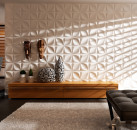
Porcelain stoneware is a finishing material for the floor and walls, which appeared relatively recently. Country Prattel Ceramic Granite - Italy. And that is why it is still the most best trademarks of the ceramographic. From ordinary ceramic tiles, porcelain stoneware distinguishes the water absorption coefficient, which is not more than 0.5%, as well as an appearance approximately a natural stone.
Content
Advantages of ceramographic
In the manufacture of ceramic granite, selective natural material is used - clay, quartz, field spat. It is also painted only by natural natural oxides. In general, the process of manufacturing a porcelain is comparable with the stages of the formation of natural stone. But only the formation of porcelain is happening much faster and controlled. The material is exposed to high pressure and temperatures that give it all its wonderful properties.

Porcelain stoneware is a serious competition of natural stone. Its technical characteristics are at a much higher level, and externally it looks natural, but it is much more attractive than that of the plates from natural stones. Unlike ceramic tiles, the pattern of porcelain notes does not have clear lines, it creates an impression of a random, chosen chaotic pattern. But, if you compare with a natural stone, the differences between each tile from each other in porcelain stoneware are not so pronounced. Another major advantage over natural stone is the complete absence of a radiation background.
The most important technical quality of porcelain stoneware, which makes it the main competitor of ceramic tiles - high density and lack of micropores. Ceramic tiles and natural stones have a large number of pores that increase their water intake coefficient, reduce frost resistance and mechanical wear. Porcelain stoneware in these characteristics has the best indicators, which makes it an indispensable finishing material in public areas.
Types of Ceramographic
The main indicators of the porcelain stoneware, according to which it is classified, except for purely technical indicators - the color of the pattern and the surface characteristics. The drawing distinguishes the following types:
- Salu-pepper - such a ceramic price is the price is the most liberal, as it is the most simple. It is characterized by a homogeneous color with small splashes of black and light tones, which are located on the tile evenly.

- Monocolor - a product of one color. In the manufacture is painted with pigments with cobalt salt, chromium, zirconium and other metals.

- The colors of natural stone is complex patterns that natural stones are repeated.

- Textural - no less complex patterns that repeat the color of various natural materials - leather, wood, and so on. Demonstrates such an unusual porcelain stoneware photo below.

- Porcelain stonewares with additional inclusions - in production, the porcelain stoneware is added by smalt, natural marble or sequent in small quantities.
According to surface characteristics, such types are distinguished:
- Matte - material that is not processed. Visually observes the absence of shine, but this material has high firmness performance and low moisture absorption indicators, which makes it suitable for use in the most severe conditions.
- Polished - visually observed a mirror brilliance of the material. It has aesthetic and attractive appearance, but it is not suitable for operation in harsh environments. In the process of polishing, the structure of micropores changes, which makes porcelain stoneware to moisture and mechanical effects.
- Grinding - visually has the same mirror glitter as polished material, but at it is even more demanding on operating conditions. When processing, coarse abrasive materials are used.
- Satinized or broken - visually observed a mirror glitter. The appearance is as attractive as the two previous varieties, but it is not demanded of the operating conditions. In the process of manufacturing on the tile, a layer of mineral salts is applied, and then it burns. This gives the material shine, but does not violate the pore structure.
- Relief - Material with a nonideal surface having irregularities and imitating chips of natural stone.
- Glazed - coated material from a special glaze. This technology has significantly expanded the design capabilities of ceramic granite. With the help of the glaze, he gives any colors and textures. The disadvantage - the coating tends to erasure, and therefore the glazed porcelain stoneware is not suitable for public areas.
These characteristics determine the aesthetic qualities of the porcelain stoneware, as for important technical characteristics, then it belongs to the abrasibility, which is also called the wear resistance of the material. According to this indicator, porcelain stoneware is divided into 5 classes:
- PEI I and II - the optimal material for the rooms in which the barefoot is moving or in shoes with a soft sole, that is, a bath, a toilet, a bedroom.
- PEI III - rooms that do not have a direct exit to the street visited relatively rarely.
- PEI IV - Public Rooms with Intensive Motion.
- PEI V - any intensity of motion and operating conditions.
Among the listed groups, the optimal choice for a conventional residential room is the third group, since this material has the best surface characteristics, strength and porosity levels. In addition to this division, each tile class, regardless of the type of its surface and color, has a mass of indicators and characteristics that should be considered when choosing. But the basis still serves this classification from which it should be repeated initially.
How to choose a ceramographic
To determine the optimal material, repel from the first and most important factor - the nature of the room for which it is intended. The loads that have to withstand the material are also rated, as well as the type of surface. For example, put on the floor a very smooth coating is incorrect and even dangerous, this is due to such reasons:
- With wetting, the floors become overly slippery and the likelihood of domestic injuries increases.
- With constant exposure to pollution, the material quickly loses its qualities. In the summer, dust and small stone particles contribute to this, in winter various springs from ice from the street.
- On polished material, any scratches are well noticeable, the appearance of which on the floor cannot be avoided.
- Over time, from permanent contact and friction, porcelain loss will lose shine and gloss.
However, the corrugated surface for the floor is also not the best option, as it creates obstacles to movement and it is bad to bring off her stains. The optimal option for premises with an average of visits is glazed porcelain stonewares with volumetric patterns or matte coating.

For corridors and hallways, the movement in which passes in street shoes, the tile of class IV and V is suitable, which has a high rate of resistance to erasure. Porcelain stoneware for the floor of the bathroom must be chosen based on the fact that in this room it will be constantly in contact with various chemicals. Shampoos, gels, cream, tools for washing and cleaning are left on the spots coating, which sometimes it turns out to be quite difficult to remove. Therefore, the tile in these rooms should have a structure with a small amount of pores, resistance to acids and bases. Public rooms have a high visiting indicator require the laying of expensive material IV and V class, with a high indicator of resistance to mechanical effects and low temperatures.
Deciding with the necessary technical characteristics, the next step is estimated by the color and dimensions of the presented line of porcelain stoneware. Colors and textures are selected based on their own preferences and room features. Designers are recommended under strict officially furnished furniture of porcelain stonewares to buy in monophonic colors of cold tones, and for soft and cozy home furniture to stop their choice on warm colors and textures.
The size of porcelain stoneware is standard and presented in different versions. Mainly on the market there is a tile width from 20 to 60 cm square shape. There are more products or less, but they are rarely used as a basis, more often they act as additional elements that make the emphasis on the entire composition and create a decorative effect. The size of the tile, like its color, is chosen, based on the features of the room. For small rooms, a large tile is not suitable, as visually it will make the space even less. The optimal size for small rooms does not exceed 30x30 cm. In the rooms of the large area there are no restrictions on the choice.
When choosing a size and purchase of tiles, it is also important to navigate the area of \u200b\u200bthe room. It is necessary to calculate the overall square of the room, and then divide it on the estimated square of one tile. Thus, the necessary piece amount of material is accurately calculated. Another plus of this method is the ability to change the solution and change the estimated size of one tile in a large or smaller side. The fact is that porcelain stoneware is quite difficult, therefore it is better to pick it up so that it is a little cutting parts. Also avoid cutting will help a smaller tile, which beautifully fit into the composition and facilitate the process of laying tiles.
Purchase of porcelain stoneware, practical advice
When all technical indicators, configuration and color are selected, the next step is going to shop. At this stage it is important to know how to choose a really high-quality and good product, without overpaying the extra money. This will help some practical advice on how the choice of material professionals make.
- First of all, it is necessary to determine the category of goods - the tile is either a porcelain stoneware. External differences are in the side cut, porcelain stoneware does not have differences between the pattern on the surface and on the cut. The usual tile is painted only on top, and therefore it has a different color on the cut.
- A simple means of determining the quality of goods - to carry out a felt-tip pen with an alcohol content or a conventional marker on a polished surface. If after a few minutes the track is easily erased, then this product is high quality, if not, then low.

- Some experts advise you to wet the tile and trace whether it will absorb moisture. However, this method is applicable only to ceramic tiles, as the moisture stoneware does not absorb completely. Testing the goods so still it is worth ensuring that the proposed products are actually a porcelain.
- During the purchase, ask the seller about the weight of 1 m2 tiles. The optimal weight ratio to the tile of 8-8.5 cm thick is 18.5-19 kg. All relations are indicated in the catalog, which is always available from sellers. If, after the question of such a catalog, it was not proposed to be familiar, then it is necessary to doubt as the proposed product and leave the store. Since the wrong ratio indicates violations of the technological process in the manufacture of porcelain stoneware.
- The density and quality of porcelain stoneware is checked from its reverse side. It has small square depressions that should not be too deep. The optimal depth is 1.5-2 cm. If this indicator is higher, then this product is also not worth buying.
- Mandatory on each product should be the name of the company, and not just the country manufacturer. Proven brands that produce high-quality goods will not hide their name.
- The price of porcelain stoneware is mainly from its coloring and thickness. The most affordable price is ceramics from the "Salt and Pepper" group, as mentioned above. Therefore, it is not necessary to be afraid to buy such products, considering it not high quality. Here, the whole thing is only in the complexity of the technological process, which gives the tile of those or other decorative characteristics.
Manufacturers of ceramographic
The market for finishing materials offers many trademarks of porcelain stoneware. There are not very well-known names among them who offer high-quality goods, but there are also those who have already managed to get a high rating of consumer reviews. Among them are allocated such names:
- Fiorano, country manufacturer China.
- Estima, country manufacturer Russia.
- Kerama Marazzi, Country of manufacture ITALY.
- Sal Sapiente, Country of China.
- Grsaaro, Country of manufacture Russia.
- Shakhtinskaya tile, country producer Russia.
- Ural granite, country manufacturer Russia.
- Imola Ceramica, Country of manufacture ITALY.
- Floor Gres Ctramiche, Country of manufacture ITALY.
- Grasaro, Country of manufacture Russia.

Each of these manufacturers offers the different cost of its products, but in terms of price and quality ratio, they are among the best brands. The most qualitative is the ceramics of Italian production, since this country is the progenitor of this material. But the Chinese and Russian production are not lagging behind Italian quality.