The home cinema has long ceased to be an element of luxury and today has become the necessary attribute of high-quality leisure. With the help of a multimedia projector, which provides projection on a large-sized screen signal from an external source, you can view any movies, entries, etc. and so that the image is as close as possible to the user's requirements, it is necessary to understand the selection of projection screens and their installation.
Content
Types of projection screens
Before buying a projector screen, the most significant parameters and features of the equipment should be taken into account. After all, most buyers know perfectly well, for which they need a projector, but not quite well oriented in the characteristics and technologies of such a system. So, first of all, you should choose the type of projection screen.
Types of projection multimedia screens:
- Stationary screen (tension or rolled).
- Mobile screen.

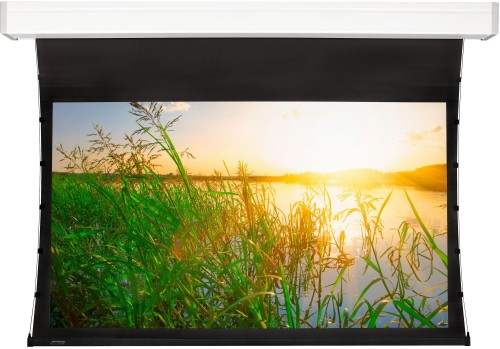
Wall-mounted screen for stationary projector - a durable and reliable design, which is quite easy to operate. This type of screen is presented in the market for rolled and tensioned species.
The rolled projection screen is characterized by simplicity in use and compactness, because it can be deployed immediately before starting to demonstrate video files and hide when the need for viewing disappears. Such a screen can be motorized or spring-loaded. The first option rises and lowered through a special electric motor. The second option must be deployed manually, and to add with the help of a spring mechanism.

The stretch screen is attached to a special metal or polycarbonate frame, therefore it will always be in the detailed state on the wall. Selecting this screen depends on the functionality and its purpose.
Mobile projection screens are characterized by compactness of the dimensions and differ in the type of fastening and design. The most popular today is the web on a tripod, which are distinguished by low weight and speed of change of their positions.

Screen selection by technical parameters
Before you start choosing a multimedia screen, you should distinguish between the design features and its technical features. Among the most important screen parameters, the size and format is highlighted.
Multimedia screen size
Manufacturers of projection techniques recommend paying special attention to the following characteristics:
- The distance from the canvas to the first row of the audience should be similar to the width of the screen itself or the value component of the double height of the canvas.
- The height of the web should be at least 1/6 of the distance of the distance range on which the last viewer will be located.
- Selection of the screen for the projector in size must be based on the following data: The height from the lower boundary of the floor to the floor should be at least 120 cm. This is a comfortable value for the viewer, which does not apply if the screen is fixed under the tilt or the hall has several tiers.

Multimedia screen format
This parameter is the ratio of the width of the illustrated image and its height. Many home-based projection devices are equipped with a screen in 9:16 format. While for the office option, the most suitable screen format is 3: 4. To increase the qualitative characteristics of the video image, it is necessary to ensure that the canvas format corresponds to the format of the image itself transmitted by the projector.

Select the screen by surface material
Manufacturers of projection screens offer structures with different surface coating to provide the highest possible video image. The selection of the screen by the surface material parameter depends on its purpose and the room in which the design is planned.
The main parameters of the surface material are the following:
- The gain ratio is the value that means the light reflection of the canvas. The higher the coefficient, the stronger the video brightness will be, which allows the audience to see it at the far distance.
- Contrast - an accuracy of the accuracy of displaying light and darkened fragments of the video.
- The viewing angle is a value that characterizes a part of the space, where it will be most comfortable to look at the screen to the audience.
A universal option for home-winding will be the screen with a white surface of a matte type. Thanks to the enhanced viewing corner and reliable color reproduction, the screen will send the quality characteristics of the video and will make a browsing comfortable. This screen is marked with Matte White.

To achieve the most bright image on the screen, you need to choose a beaded spraying cloth, which is marked by manufacturers as Glass Beaded. It has a mirror reflective surface. A beadic coating is a spraying in the form of a glass crumb, which helps to reflect the light flux. This allows you to install the screen close to the audience or even on the table in front of the audience. Such a screen finds the use of indoors with sufficiently bright external lighting.

To strengthen the contrast of the image on the canvas, you need to put the screen with the surface of the gray shade, which manufacturers call Hidef Gray or High Contrast. This projection screen clearly transmits saturated black shades, without dimming the bright gamma of the image.
Read more about the intricacies of the projection screen selection here:
Installation of the projection screen
To produce well-coorded screen installation for the projector, it is necessary to follow easy rules. These recommendations will help get a good result and avoid gross errors in the process.
Choosing a position of the web
To begin with, decide on the location of the projection screen. When choosing, it is important to take into account the data that is prescribed in the instructions for the device. And also you need to think over which space it is necessary to free up the screen and where possible points for connecting to the network are located.
- The screen plane should be located so that the projector's lens is perpendicular to the canvas.
- The ratio of screen dimensions should go according to the image format.
- The projection screen should be fixed so that the image is displayed throughout its surface.
- There should be any obstacles between the screen and visual sites.
- It is important to make sure that each viewer in front of the web was in the zone of optimal review.
- In the home theater, the distance from the projector to the screen should vary within the boundaries of 60 cm - 90 cm between the lower boundary of the screen and the floor. This will provide a permanent image in sight of a person. For business presentations, this distance indicator must be in the boundaries of 120 cm.
It should also be remembered that the quality of the illustrated video material depends on the illumination of the room itself. For this reason, it is necessary to ensure that there is no additional sources of light. To make the image as optimal for viewing, it is recommended to darken the room.

Installation of the screen on the ceiling or wall
The main recommendations for reliable and high-quality attachment of the projection screen are the following:
- To set the screen on the ceiling surface or vertical location, it is recommended to apply fastening components that are supplied with the device. These materials were tested for suitability and provide high-quality fixation of the canvas on brick or concrete surfaces.
- If the multimedia screen has a built-in electrical drive, it is necessary to provide a place for the switch. It must be set at a level of at least 1.5 m from the floor, as well as to ensure that the place is not affordable for children and pets.
- To install the screen for the projector on the suspended ceiling, it is necessary to use a special ceiling type fastening. It is supplied under the order as an additional component. Brackets look like a set of two independent components - the ceiling rod and directly fastening. Often, they are produced with the option of adjustment in the height of the structure, the rotation of the lower center horizontally, as well as the possibility of adjusting the angle of the screen tilt.

In this case, the installation of the screen to the ceiling is carried out quite simple and promptly:
- Remove several finishing plates for a while.
- Fix the socket to which the power wire will be supplied.
- Cut in any ceiling element hole for rod and cables.
- Display them out.
- Lock the finishing plate in place.
It is important to provide that nuance that the switch should not be located in the zone of turning the projection screen. All moving screen components need to be positioned in view to control the decay / folding / folding process.
Read more to learn about the work of the projection motorized screen here: