Among modern roofing asphalt shingles has a special place. With the optimal combination of processability, which has shingles, price corresponds quality. Its flexibility and plasticity allows to implement the boldest architectural ideas.
Content

The most unusual shape and configuration frame for the roof makes the master of the soft roof, as it is called shingles or Shinglas. Domed or bulbous roof configuration, do not constitute a problem for soft tiles. The standard parameters 100h33 cm, typically uses three or four units flexible shingles with a shaped profile on the edge. The shape of this tile is very diverse, sometimes in the form of hexagonal cells, oval, triangle, fish scales, and so forth.
The economic benefits of shingles
The roof, which was used shingles, feedback is positive in the majority of cases for resettlement. It is convenient to install, easy to cut out and she has a minimum of waste.

- Due to its flexibility and plasticity, the flexible tile when laying has very little waste, usually not more than 10%. Among the various roofing materials, on a flexible tile Price is one of the lowest. In complex architectural structures, it is often necessary to make a solid cerebral plane from OSB plates.
- The foundation, walls and rafter frame are designed with the weight of the roofing material. Considering the fact that 1 m2 weighs up to 8 kg, building materials will significantly save during the construction of the house. A small volume and weight should be cheapening loading and unloading and transportation.
- The warranty service life of flexible tiles from 10 to 50 years, in addition, in the course of operation, it does not need additional paint, is not subject to genuine, moss and mold. To replace the damaged section of the roof, it suffices to replace several separate tiles without dismantling the entire roof.
Benefits of the roof of flexible tile
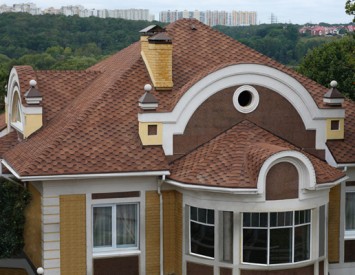
An external aesthetic type of soft roof, its plastic capabilities and technological use in the construction of multi-level complex roofs, can be viewed in the photo on the Internet.

- Due to the optimal combination of technological qualities and properties of the components of the components of the bituminous tiles, the roof has high strength, reliable waterproofing and resistance to mechanical damage. Given the advantages and economic benefits, a flexible tile to buy for a roof will be a true solution.
- The main function of the roof is waterproofing housing. It does not rust and is not susceptible to rot or corrosion. During the rain or other atmospheric precipitation, the flexible tile successfully devour the sound. Under the influence of solar heat, the bitumen tile is melted into a homogeneous waterproof mass and due to this does not pass and does not absorb moisture.
- In terms of its characteristics and in practice, the flexible tile can withstand sharp temperature differences. The range of its use from the polar regions to the tropics. It does not crack in the cold, it is not deformed and does not warm in the sun.
Building and technological properties of bituminous tiles
The main component of the flexible tile is glass cholester or pulp fabric impregnated with oxidized bitumen.

- The composition of the impregnation of the main binding layer includes polymer additives and SBS modifiers. Natural or artificial bitumens used for the production of flexible roof tiles are considered environmentally friendly materials. Natural bitumens include asphalt, Malta and Kerites, mined in quarries. Artificial are produced from oil refining waste, coal or shale. The technological properties of natural and artificial bitumens are almost equivalent.
- The front side of the flexible tile has a coating of colored mineral crumbs. This coating protects the roof from the atmospheric effect, increases the strength of the flexible tile and does not change the color under the influence of sunlight. For convenience in the work, a bitumen glue layer can be applied along the edge of the roofing soft tiles.
- The inner surface of the bituminous tiles is covered with a thin layer of quartz sand. Such a layer prevents the gluing sheets during the storage, transportation and installation of the roof. To create a monolithic waterproof reservoir of the roof, a bitumen adhesive layer protected by a film is applied along the edge of the tiled sheet. Before mounting the flexible tile, the film must be removed.
- Some manufacturers as a facial coating use copper tin. Such a flexible tile technology significantly affects its value and has a different structure. The roof of such a tile is though more expensive, but opens up great opportunities for design. On the cut, you can see the structure of such a tile: a layer of transparent glue, a copper sheet, two layers of a universal bitumen I have soaked two layers of glass coolers and a lightweight coating with a protective film. The flexible tile with a copper coating is produced in the form of scaly cells, in the form of hexagonal cells, ovals, rectangles, etc.
Operation of the roof of flexible tile
Warranty period of flexible bituminous tiles Manufacturers declare from 10 to 50 years. The actual service life of the roof from bituminous tiles is much more.

- With long-term operation of the building, it sometimes occurs its shrinkage or due to the destruction of wooden rafting structures. Due to its plasticity, the bituminous tile tolerates such deformations absolutely painlessly and provides the necessary waterproofing.
- Through the use of natural crumb to cover the faceplate, soft tiles does not fade in the sun. Bioaggers present in its structure prevent the growth of moss and lichens. In the case of mechanical damage, there is no need to dismantle the entire roof. It is enough to replace a small affected area.