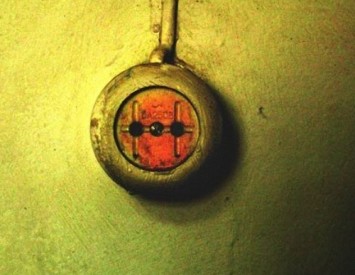
The outlets are not only internal, but also outdoor. Despite its shortcomings, the installation of this type of sockets is still relevant. This is due to several factors, which further talk, and at the same time we consider the installation technology from "A" to "I".
Content
Features of using outdoor outlets
The main distinguishing feature of the outer outlet is that all its elements are located in the housing. Consequently, it is screwed directly to the wall without installing the opposition. On the one hand, it simplifies work, on the other, has explicit cons:
- unsightly appearance,
- exposure to mechanical damage
- unprotected connection of the electrocable
- the risk of learning a shock in case of contact with
- accelerated wear of fasteners and bases.

It is these factors that caused the fact that in the houses it is customary to install internal sockets. However, in garages, sheds, utility rooms or greenhouses, often it is impossible to install a full-fledged inner socket. In addition, under the outer outlet, it is not even not necessary to do the stroke, it is enough to fasten the boar with cloves to the wall or hide it into a protective box
Another indisputable plus is the cost. On average, the outer socket will cost $ 1-3. Manufacturers do not stand still and constantly improve the appearance of the outer outlets. Therefore, it is appropriate to talk about their varieties.
Types of exterior sockets
It is customary to allocate the following groups:
- standard outdoor single outlets
- standard Outdoor Double Outlets,
- standard external sockets with protection,
- decorative outdoor outlets.
All of them are like grounding and without it. In fact, grounding is necessary only in two cases:
- if the outer socket is mounted in a metal garage,
- if the decorative outer outlet is mounted.

Let us consider in detail each of the types:
- Standard outdoor outlets are a plastic container in which the housing, contacts and plates of the plug crimping are mounted. Since the socket mechanism has a standard height of 5-7 cm and a width of 4-5 cm, the final dimensions of the outer outlet, taking into account the protective garde under the plug of the electrical appliance, range from 10 to 15 centimeters to height and about 10 cm in width. Usually have a parallelepiped form.
- Double external sockets differ from single only by the presence of multiple plug connectors.
- Sockets with protection are both single and double. The main distinguishing feature is the presence of a closer that prevents free access to the connector. Use them either in the garden plot so that insects do not flasher or to protect the health of small children.
- Decorative external sockets appeared relatively recently. Their main advantage is height, only 1.5-2 cm, which is similar to internal sockets. Due to the features of the device, such devices are suitable for mounting in residential areas. The variety of colors and shapes together with the simplicity of installation makes them serious competitors internal sockets. But this is only at first glance. Fastening using a double-sided adhesive base or even a bolt to the wall is not reliable. The glue and dowel is sufficiently resistant to permanent loads, but sharp efforts to supervise the fork from the outlet, loosened construction and lead to the fact that the socket falls off. Therefore, it is better not to experiment and install external sockets in the appropriate places.

The service life of the outlet depends largely on its quality. Therefore, when choosing it is better to pay attention to proven firms. Among them:
- SIMON, Spain,
- JUNG, Germany,
- Gira, Germany.
When choosing an outdoor outlet, it is necessary to consider the following characteristics:
- The degree of protection of the shell from penetrating inside the outlet of water and external solid elements. The degree of protection is displayed on the rosette itself with two digits. The first digit displays the degree of protection against the penetration of external items and is ranked from zero to six. Where six is \u200b\u200bthe maximum level of protection. The second digit displays the degree of protection against water, and is ranked from zero to nine. Where nine means complete waterproof under pressure.
- Nominal current and rated voltage.
- The material of the base of the exterior socket case. It is desirable to acquire white or beige outlets, which indicates the use of full-color plastic without dye.
Installation of outdoor sockets
Before switching to specific actions, you need to prepare a tool. To work, you will need:
- Electric outlet.
- The insulating material is a lining under a socket in the amount of outer outlets installed. As such a basis, an isolation material of the type of textolite is used. The economical option is a piece of plywood or a wooden board with a thickness of 10 mm.
- Dowel, selflessness or screws.
- Cross and flat screwdriver. In the case of installing an electrical outlet in concrete or brick walls, you will need another drill or perforator.
- Pencil and level.
- Indicator screwdriver for checking the voltage in the outlet.
- Knife or other mounting tool for stripping the ends of the wires.
- Insulating tape.

We carry out the installation of outdoor outlets:
- draw a diagram on which all the necessary sockets mark,
- stretch the cable from the meter to the first electricucer,
- clean the end of the cable, we clean the wires,
- we disassemble the outlet, for this you need to unscrew the bolt located in the middle between the holes under the plug,
- connect wires to contacts,
- fix the outlet on the wall, for this, either screw it on the dowels or glue with liquid nails, an insulating gasket is installed between the wall and the socket,
- measure the required number of cable until the next node with a reserve of 15-20 cm,
- cut a cable and clean it on both ends,
- connect the cable to the first and to the second node,
- we repeat the procedure until you connect all nodes.
By safety, the cable must be hidden in a special protective box. In practice, this requirement is not necessary, but for your own security, any protection should be provided. If there is no desire or the possibility of making a stroke, then you need to start the cable to the rigid corrugation before connecting electrical disperses. It'll be enough. Even in the case of a short circuit or overload, the corrugation cable localizes fire and prevents fire. If it was decided to install a protective box, you should choose products from non-combustible plastic.

Another problem occurs if the outlet mounting is made after sealing the counter. To remove the seal, you need to call the engineer and order a rather expensive and long-term procedure. The solution is quite simple - to assemble the extension with two forks. The first is included in any home network socket, the second is in the outer outlet.
Important: The underwater exterior socket must be single. It is a source of voltage throughout the power supply, therefore it carries the greatest load at the time of the electrical appliance. Consequently, you need to use the extension cable with a cross section of at least 4 mm, and the contacts are made as strong as possible. For this, stripped ends of the wire bend in half, thereby even more increasing the cross section. The outlet, also, you need to choose quality. For the rest of the wiring, a sequence of 2.5 mm is enough.
Socket with grounding outdoor
If the installation occurs in rural areas or in the country, there is no grounding inside the network. For the convenience of installing wiring in apartment buildings inside the switchboard, the grounding line is installed, the counter is connected to it, and through it, the rest of the post is connected. Additional grounding is established only in cases when the voltage in the network jumps greatly, and the apparatus used appliances are not equipped with fuses.
In the field, the owners of private houses and other separate buildings are forced to make grounding on their own. The term emerged due to the fact that the earth has resistance close to zero, accordingly, it is capable of instantly passing the current of any strength without heating. It is in this principle that grounding works.

Installation is performed as follows:
- an armature with a cross section of at least 0.5 cm is burst into a depth of 40-50 cm.
- armature must be recessed by 10 cm above the ground level,
- from the reinforcement to the first electrical node, the cable is measured and cut off with a reserve of at least 15 cm,
- the cable is stretched through a thick corrugation,
- the ends of the cable are cleaned,
- one end is attached to the reinforcement, crimped with a rubber clamp and closes with a tape,
- the second end is fixed in the outlet, for this it must be equipped with the appropriate connector,
- the connector is in the middle between the phase and zero,
- the remaining electrical disperses are connected between themselves a thinner single-core cable.
Important: Single cable is used for grounding. Its cross section does not matter much, most importantly, choose a metal with the least resistance. The smallest resistance from silver, but such a wire will have to be made to order, so high-quality copper is suitable.
In practice, most problems are connected not so much with incorrect connection of sockets, but with miscalculations regarding the load on the cable. In addition, some manufacturers save and use instead of copper or aluminum iron, and lead or various alloys. This reduces the cost of production, but significantly reduces the technical characteristics of the cable. Therefore, before starting work on self-installing sockets, carefully recalculate which cable should be used.
Useful tips on the installation of outdoor outlet
- Recommended location of the outer outlet 25-30 cm from the floor. It is also not recommended for the location of the electrical outlet near the electrical appliances.
- There are external sockets with terminals in which there are connectors under the wires. Similar electrical outlets are characterized by lower contact reliability. They are better not to acquire. The outdoor socket, the photo of which is presented below, will clearly demonstrate what we are talking about.

- When installing outdoor outlets, it is necessary that the wires of 4.5-9 cm long were removed from the wall.
- For security purposes, the installation of outdoor outlets must be carried out in rubberized gloves.
- If there is a small child in the house, you should take care of the protection of sockets using a special set of plugs.