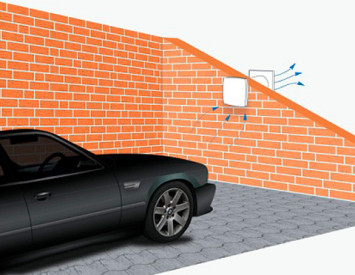
Each car owner wants his car to serve as long as possible and at the same time did not lose an attractive appearance. To do this, it is necessary to regularly make inspection, care for the car, but the main thing is to provide him with the proper conditions of "storage". If the car is idle on the street in the open sky, it will quickly start rust, the paint fade, scratches and chips will appear on the body. If you close it for seven locks in a hermetic room, the benefit will also be enough of this - in the stuffy space it is impossible for a long time and maintain equipment. To avoid similar troubles, you need to install the ventilation system. About how to make ventilation in the garage, we will talk in today's article.
Content
Ventilation system device
The primary task of any garage is to protect the car from the encroachment of intruders and atmospheric influences. However, it is not enough to just build a "box" and put a car in it, it is necessary to create inside the comfortable conditions: the level of humidity, temperature, etc. If there is no ventilation system in the garage, there will always be a fox air and high humidity. This will lead to the active development of corrosion in vulnerable places of the corps and will significantly reduce the life of the machine.

What functions perform ventilation in the garage:
- Water pairs displays or evaporate, inevitably resulting from the penetration of snow, dirt or rain droplets, when the car drives from the street.
- Displays evaporation and gases harmful to human health.
- He dries the body of the car after trips in bad weather.
- A timely removes condensate, which appears on the inner surfaces of the garage, thereby extending its life.
- He dries the observation pit and the basement in the garage, if any.
To make it possible, it is necessary to choose correctly and establish one of the types of ventilation systems: natural, forced or mixed. Consider the advantages and disadvantages of each of them.
Natural ventilation
Natural ventilation is the simplest and cheapest way to ensure the ventilation of the garage. This explains its popularity. The air enters inside due to the supply holes placed at the bottom of the gate. Fresh air flows penetrate them, pass through the floor at the bottom of the car, gradually heated and climb up, capturing condensate, toxic gases and evaporation with them. The garage ceiling is the other holes - exhaust. Through them, the exhaust air exits.


In order for the system to work smoothly and efficiently, it is necessary to properly choose the cross section of the supply and exhaust air duct. The exhaust pipe must be made of asbestos or tin and climb over the roof level at least 50 cm to create a craving required power. If the thrust is not, the exhaust air will not be released from the inside or will go very slowly. It is also recommended to organize the thermal insulation cover around the exhaust pipe so that in the cold season, the condensate does not frozen and not clog it.

Why is the air begins to move and flow in the right direction? Circulation is carried out due to the various density of spent and fresh air, as well as due to the arising thrust in the pipes. But if the exhaust air volumes are too large, and the natural system does not cope, it is necessary to establish a combined type system.
Mixed ventilation
Such a ventilation system in the garage combines the principle of work natural and forced. The air enters through the supply pipe, and is output by means of a fan operating from the network and installed in the exhaust hole under the ceiling. The fan sues the spent air masses and turns them faster from the room.
To make such a system as efficient as possible, you need to correctly select the power of the exhaust fan. It is desirable for the garage to be at least 100 W. The quality of the product also matches the value - it should be reliable and durable under the condition of continuous operation.

The main disadvantage of the combined ventilation system is to supercool the garage in winter. The cold air will quickly penetrate inside and also quickly goes out. The absence of a filter in the supply hole can also cause inconvenience.
Forced ventilation
Forced or fully mechanized ventilation in the garage is perhaps the optimal solution. In this case, the influx of air and its excretion is carried out by autonomous subsystems, which completely eliminates the shortcomings of the above methods.

The supply ventilation in the garage consists of an air duct with a filter, a fan and a canorior. When the fan sucks the air from the street, it is immediately cleaned, passing through the filter, and heats up in the calorie. Thus, the garage will be warm even the frosty winter. The garage exhaust ventilation subsystem is an axial fan that can be supplemented with a channel fan.
During the arrangement of the forced system, modular structures are used or monoblocks. The first implies the installation of autonomous blocks for influx and air separation, combined into a single system by means of sensors. The monoblock is a single box (block), in which the influx and the extractor will occur. The most effective are monoblocks with lamellar recuperators, which heat the incoming clean air, thereby reducing the cost of heating.

You should choose the garage ventilation scheme even during design, but even if the garage is already used, you can enter the system into the overall layout. Of course, it takes more strength, time and money, but you already know what can happen in the garage without ventilation. If there is a heating in the room, it is reasonable to use a forced system with a recuperator, and the usual natural scheme is suitable for the unheated.
Useful advice: All the ventilation holes regardless of the type of system, install protective grids or lattices, so that insects are not penetrated into the garage, the air duct did not hit the garbage.
FEATURES OF MONTAGE
Each of the ventilation systems has its own installation technology, requires one or other skills, is characterized by the cost and nature of the service. In this chapter, we will consider in detail the features of the ventilation device in the garage with their own hands.
Natural ventilation

Natural ventilation is the easiest way, but before you go to the store behind pipes and lattices, it is necessary to calculate to find out the cross section of these pipes. From the section of the air duct depends on how quickly it can pass fresh air and delete spent. And this, in turn, defines the square of the garage and the speed of its pollution. There are some requirements for the organization of natural ventilation, which says that each m² should have 1.5 cm air duct. That is, if you own a garage of 18 m², it means that for ventilation, it is necessary an air duct with a diameter of 18 * 1.5 \u003d 270 mm. But if you want to install two exhaust pipes in different corners of the garage, then this value should be divided into two and buy air ducts 135 mm in diameter.
How to make ventilation in the garage:
- Put the hole for the supply pipe as low as possible. Ideally, it should be located just 30-50 cm from the floor.
- Consider that the overall diameter of the supply air ducts should exceed the diameter of the exhaust air ducts by 2 times.
- It is better to make the supply holes from the northern side of the garage so that the wind in them blows as stronger as possible.
- To make a good exhaust air exhaust, place the duct hole at the highest point of the garage, that is, or on the roof, or under the ceiling.
- The higher the exhaust pipe will be, the better. From it to the supply hole should be at least 3 m. If the garage with a double roof, then the hood tube can be carried out through the attic to the skate.
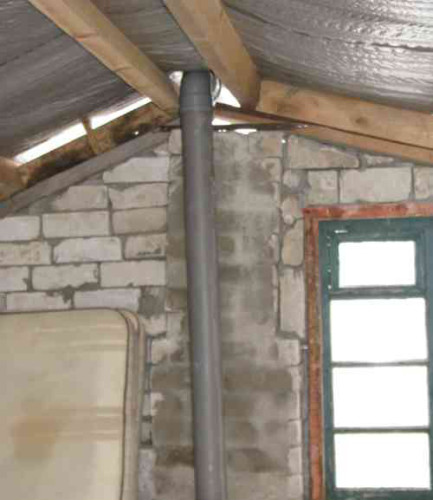
- The outlet hole of the exhaust pipe must be closed by a canopy or a visor so that precipitation, garbage or insects do not penetrate there.
- Make a draw so that the direction of the air duct coincides with the direction of the wind (the wind should not blame him in order not to break the craving). To do this, find out what direction the wind prevails in your region.
- Between the air duct and the wall will remain empty space - fill it with it with mounting foam and sealant.

As you can see, the natural ventilation of the garage with their own hands is very easy to arrange, so even the newcomers should not have difficulties in this matter. The cost of work is minimal, especially if you consider that the air ducts can be bonded from galvanized or sheet steel.
But before you decide to make such ventilation in my garage, the main drawback should be taken into account - the air will circulate only at temperatures on the street to + 12c. In the summer, the air exchange will be rather weak, so it may be necessary to install additional fans, but below.
Combined ventilation
The principle of arrangement of the combined ventilation system is almost the same as described above, only the exception that the fan is installed in the exhaust hole, which sues the exhaust air and pushes it out through the air duct. Another nuance - the supply and exhaust holes can be located at any points of the garage, only without opposite, otherwise there will be no air circulation.
For air ducts, plastic or metal pipes can be used, the diameter of which you can already calculate. The combined system ensures efficient garage ventilation all year round, regardless of the temperature on the street. The fans themselves consume not so much energy, so you will not feel a substantial difference in payment. The only thing to take into account is the active penetration of cold air in winter, since the supply hole is not equipped with any heating devices. Well, if you equip it, and even put the filter, then it will be a fully mechanized ventilation system. Of course, it is significantly better natural and combined, but it is worth an orderly.
How to make a simple and efficient combination ventilation in the garage, see the video below:
Ventilation pit and basement
It is not difficult to guess that if the air goes into the garage through the hole is low from the floor, and go out somewhere under the ceiling, then the observation pit and the cellar will be ignored. Working in a stuffy pit under the car is very uncomfortable, and if you do not ensure air circulation in the basement, a mushroom plantation will grow very quickly there.
To equip the ventilation of the observation pit, on the sides, located closest to the inlet hole, open it by 10-15 cm so as not to get injured, inadvertently coming there. If the tributaries are located on both sides of the pit, make the slots on both sides. Between the skulls of the lid of the pit in the place located directly opposite the exhaust hole, make a slot width of 5-10 cm.
If the supply hole will be 2 times wider than the exhaust, natural traction will appear in the pit, and the air masses will independently replace. At the same time, try to put the car so that it does not overlap the exhaust gap of the pit. There is a plot of the most aggressive environment, and if the spent air from the pit will blow into the car body, it will begin to rust and rot the first thing.

How to make ventilation in the garage with the basement? In this case, you will have to equip a separate ventilation system in the cellar with its underlining and exhaust air duct. The basement itself is always very raw, and there is a fairly powerful air circulation.
The following recommendations will help you make effective ventilation in the garage cellar:
- Supply hole output from the north.
- Exhaust ducts Install on the south side of the building.
- Passionate air duct in the basement to the floor, and cut into the ceiling.
- So that the products and things stored in the basement are not impaired in winter, place them as far as possible from the supply pipe (50 cm at least).
- Remember that the overall diameter of the supply pipes must exceed the total diameter of exhaust channels by 2 times.
Make ventilation in the garage is not so difficult, whether it is a natural system or forced. To strengthen air circulation, especially in the summer, make the windows in the garage - they will not only stick the fresh air, but also allow you to save on lighting.
Ventilation in the garage: photo