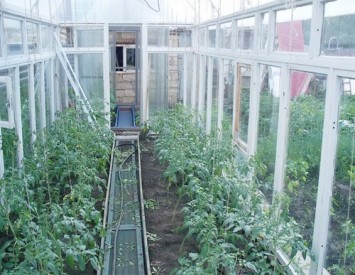
The widespread installation of plastic windows creates favorable prerequisites for creating homemade greenhouses from window frames. After all, I spend the minimum of materials and labor costs, you can enjoy the vegetables grown in our own greenhouse in the late spring. In addition, the Rama build a greenhouse with their own hands is quite simple, without possessing the skills of the construction business.
Content
The advantages and disadvantages of the greenhouse
Regarding greenhouses, built from various materials, a greenhouse from old window frames has a number of positive and negative sides.
Advantages:
- The low cost of the finished greenhouse, since the costs are associated with the acquisition of materials for the construction of the foundation, wall frame and roof.
- The presence of many ready-to-use submarines contributes to good ventilation, due to which a normal level of humidity prevails in the greenhouse.
- The glass does not purge, which is favorable on the good capacity of ultraviolet during the entire period of use and contributes to maintaining the optimal temperature.
- Easy installation design.
- Easy and availability of damaged glass replacement.
Disadvantages:
- In view of the fragility of the material of the material is high, the likelihood of violation of the integrity of glazing with careless circulation.
- The large weight of glazed frames requires a durable foundation and frame.

Preparatory work
Determination of the sizes of the future greenhouse
For the construction of symmetric greenhouses need:
- measuring the height, the width of all frames;
- to draw an approximate drawing of the placement and number of beds of the required width, not forgetting to leave a seat for the passages;
- based on the data obtained, proceed to the exact calculation of the dimensions of the future structure.
Features of choosing a place for greenhouse design
To keep the greenhouse for a long time, and the plants planted in it did not have a shortage of sunshine, one should thoroughly consider the location of the future building, given some features:
- The presence of a smooth surface. A small angle of inclination in combination with negative climatic conditions in the future will provoke the skew of the frame or the lord of the entire design.
- Comprehensive illumination throughout the day. Near the structure, it is undesirable to grow high trees, as they not only prevent full-fledged lighting of the greenhouse, but also can cause his damage to a strong hurricane.
- Stable durable ground in view of the heavyweight design.
Choosing foundation
An important aspect in the construction of the greenhouse is a competent approach to the selection of the foundation type, since it is intended to perform a number of the following functions:
- Extension of the useful life of the entire structure.
- Durable base for the installation of the greenhouse frame.
- Ensuring thermal insulation, especially if there is an additional heating device in the greenhouse.
- Protection of plants from the negative manifestation of the external environment.
Getting Started with the choice of foundation, it should be proceeded from the financial resources, the intended use of the greenhouse and the time for its manufacture.
1. Wooden foundation is constructed by plugging several layers of timber interconnected.
Pros:
- speed mounting;
- operational assembly of design and disassembly;
- excellent heat insulator;
- low cost;
- the possibility of moving to another place.
Minuses:
- lack of protection in the winter from the freezing of soil;
- dISTRIBUTY.
2. Block foundation represents styling in the trench of blocks with their subsequent fill with a concrete mixture.
Pros:
- reliability;
- durability;
- resistance to aggressive medium;
- easy installation.
Minuses:
- high price.
3. A columnar foundation is based on the installation of concrete, tubular columns under the greenhouse box.
Pros:
- simplicity of dismantling;
- saving construction material;
- durability.
Minuses:
- lack of full heat insulation;
- high price;
- labor complexity;
- the need for additional insulation when used as autumn greenhouses.
4. Ribbon - the construction of the foundation by filling the trench by cement mortar throughout the perimeter of the structure.
Pros:
- reliable protection of plants from weeds and other negative manifestations of the external environment;
- excellent thermal insulation;
- durability.
Minuses:
- labor complexity;
- difficulty dismantling design;
- high price.
Preparation of Ram
For high-quality assembly of a carcass greenhouse from window frames, a number of significant events must be held:
- Pull the glass to avoid damage in the preparation and installation process.
- Dismantle the window fittings (loops, locks, handles, latches, etc.).
- Remove the layer of old paint through sandpaper or firing with the subsequent scope of paint with a regular spatula.
- Process the frames with antiseptic solution, proliferate.
Technology manufacturing greenhouses
Foundation building
1. Bruce.
- dug a trench with a width and depth of about 20 cm;
- to replace the waterproofing material;
- share a timber, previously processed by an antiseptic, in the groove, taking into account the protrusion over the soil 30-40 cm;
- creare the timber, using construction brakes, reinforcement bars or by means of pre-prepared grooves.

2. Block.
- dig a groove along the perimeter of a structure, which makes up 30 cm of depth, 20 cm - width;
- fall asleep by 10 cm rubble or sand;
- pave waterproofing;
- top laying reinforcement, and then reinforced concrete blocks;
- to build a formwork, 30 cm towering over the level of land;
- internal walls of boards isolate through a film;
- mix concrete solution;
- pour the entire volume of the groove with the prepared solution;
- drown anchor bolts, leaving 5 cm to install the box;
- after the end of the folding process, dismantling the formwork.

3. Column.
- on the perimeter of the future facilities, dig a pummue with a depth of 30 cm in 60-70 cm increments;
- in the pit float 10 cm rubble, then 10 cm of sand and tamper;
- to build a formwork protruding over the surface by 10-20 cm for each pit and fasten the film from the inside;
- lay the reinforcement;
- pour with concrete solution;
- restore in a non-core concrete Anchor bolts for the subsequent fastening of the greenhouse carcass;
- dismantle formwork;
- the remaining empty space of the pits of the earth and tamper.

4. Ribbon.
- around the perimeter dig up a groove with a depth of 50 cm and a width of 20 cm;
- fall asleep at 15 cm layer of gravel, tamper;
- on top of gravel pour 10 cm sand and also tamper;
- install formwork with a protrusion over the soil up to 30 cm;
- the internal walls of the formwork cover with cellophane;
- pour with a concrete mix;
- drown the anchor bolts necessary for fastening the box to the foundation;
- leave to complete rejection, occupying 1-2 weeks;
- remove formwork.

Mounting carcass
For assembling the frame, the bars are perfect for a diameter of 4 cm. The skeleton of the frame is performed in the following order:
- Attach the cross-racks to the corners of the foundation through nails, anchor bolts, depending on the selected base.
- With the help of a bar or boards with a width of 4-5 cm to build a lower and upper strapping, connecting the transverse racks.
- On the perimeter of the design, an additional reference racks at a distance equal to the width of the frame.
- Fasten the frames by means of screws, nails on support and corner bars, as well as upper and lower strapping.

Montage of the roof
The skeleton for a single and a duct roof has significant differences: For a single roof:
- Secure on the upper strapping 2-3 longitudinal bar.
- Fix crossbars.
- Connect the frames with the resulting grid with self-draws or nails.

For a bartal roof:
- Above corner side stands to build triangles and combine the top of each other longitudinal bars.
- Make a transverse timber.
- Cut fasteners to the roof frame.

Finishing stage
- Insert glass into the frames are pulled out before installation.
- Detected between the strapping and frames of the gap to close the mounting foam.
- Install doors.

Thus, the use of old frames for the construction of the greenhouse will help not only save money, but also pleases the wonderful harvest. In addition, interesting options for greenhouses from window frames, which can be found in many magazines and to implement, will make a certain originality to the buildings already existing on the site.