During the repair activities related to laying outdoor materials, it is often necessary to keep various types of coatings. It may be, for example, various types of laminate, linoleum and much more. The problem is that the docking of materials should look attractive so that it does not look untreated, and even more so not practical.
Content
Often, special joints are used in places where you need to create a small separation. We are talking about zones or even rooms that need to use such techniques. For example, it can be different jobs, as well as rooms or whole industrial premises. If 2 different material is joined, you need not only to keep the attractive style of the room, but also ensure the absence of damage to their edges that appear during permanent operation.
In this material, we will consider the main parts associated with the methods of compounding flooring, creating the most successful decorative solution.

Joints of floor coatings. Indian zoning
The creation of individual zones in the interior is the practice in our days. From a technical point of view, there are often no difficulties, but to ensure an attractive appearance of space - the task is not simple.
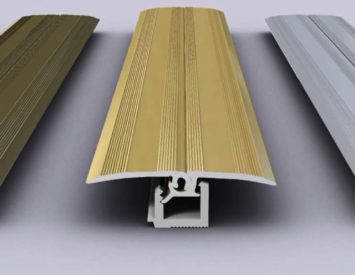
Most often, metal beads are used to create zones, which can be straight, flexible, as well as with different versions of forms and sizes.

Types of butt thresholds for flooring
- The most common thresholds (are produced on the basis of metal) are mounted after the arrangement of the floor covering on the basis of the seam created in advance. Most often, the width of the seam is 20 mm. Such thresholds are used in various cases associated with the use of certain types of coatings. For example, there can be some separation between the bathroom and the hallway, which will separate the laminate from the ceramic tile.
- The second type of thoring is used in cases where different types of surfaces are used to create some decorative stylistics of the room. First of all, the thresholds are fixed to the rough floor, after which the corresponding pattern or figure is created when laying coatings in various zones of the room. Two-storey profiles are most often used, which are based on plastic based, and based on metal, and even on the basis of wood. Such thresholds may be too expensive if the work area is too big. Often, dowels are used for installation, which have a head in the form of a castle.
Fastening options are also different. The simplest and common are cross-cutting fasteners with screws. In the new products it is customary to use a dowel-nail, which are installed on the offside of the metal profile. In some projects, the only faithful and reliable way of fastening the waves is the use of durable construction glue.
Types of flooring
- Laminate and linoleum. As we have already mentioned, the docking of these materials is the simplest thing that could be in this case. The thing is that these coatings are about the same thickness. This suggests that these materials are stacked at about the same level. For example, if we use PVC overlays, then the permissible deck of coatings can be up to 2 mm. Accordingly, in the case of laminate and linoleum, this requirement must be respected.
- Uniform coating. Obviously, if you need to create a dock between the same material, then no difficulties in this matter will certainly happen.
- Coatings of different thickness. It also happens that the difference between one material and the other is too big. It may even be a few millimeters. For this case, the bellows are used by the corresponding form, and possibly based on flexible materials.
- Carpet and any other coating. The question associated with the use of rarers for carpet and other coatings has long remained sharp. The problem is that the carpet is a soft material due to which ordinary threshold will progress, and later cracks from the solid coating will appear. Therefore, you need to use M-shaped thresholds with movable shelves. Also excellent solution will be the use of hidden thresholds.

Special requirements for threshing
- Most often in building stores and supermarkets, you can purchase thresholds with other materials. It may be, for example, plinth. Accordingly, we obtain materials about the same quality, and, most importantly, similar appearance. The joints focus on people's attention, so such combinations should be in the appropriate style.
- The quality of the thresholds should be high. In the premises where a huge number of people constantly moves, the threshings will be abrasion. Thus, it will be seen that the floor covering is in an acceptable state, while the profile will already be worn out. There are thresholds from wear-resistant materials, almost for any conditions, and this should be used.
- Color solutions associated with threshings should not be too high against the background of the floor coverings themselves. Again, if you take too wide profile, and it will have a brighter than materials on the floor, it will look short. It is best to take a thin inconspicuous threshold, which will look modestly, but at the same time clearly fencing different surfaces.
Characteristics of high-quality profile (thoring)
- Flow resistance. As we have already spoken, profiles can have different color colors, but after a while it can grow into a problem, since the top layer of the joint can peel. Also, the threshings are often used in the outdoors, so the sunlight and precipitate should not affect the quality of the coating.
- Waterproof. If the profile is used in the bathroom, or near it, you need to ensure that the material from the water action does not become unusable. It also needs to be understood that we are broader the dirt, various liquids, which can also affect the state of the neck. And, as we said, jokes are used not only in housing, but also beyond, therefore, the precipitation can make metal elements completely rust.
- The possibility of laying on the surface of different levels. We mentioned that there are special profiles that are intended for floors located at different levels. However, even on a homogeneous material there may be small differences, which the high-quality junction must compensate. The presence of gaps between outdoor material and profile means that in the future there are large problems.
- The possibility of cutting. During work related to the creation of floor joints, it is often necessary to cut the thresholds on the part. Accordingly, this material must have such properties so that the cutting occurs without the slightest problems. If plastic joints with this task are easily coping with, the metal elements are sometimes substantially deformed and come into disrepair.
- Hidden fastening elements. If the installation of the threshings occurs on the basis of dowels or other elements, all this should be hidden, since even though it will be visible, the floor should look like a single surface. However, there are classes that are fixed on top of the screws right above.

Joints of floor coatings. Installation process of floor coatings and thresholds
- If the bellows are installed in the process of creating floor coatings, it should be borne in mind that most often the fastening takes place to the main surface with the help of tapes using plastic plugs. In this case, you will need to make a marking on the basis of a screed. It is necessary to arm a pencil and note the border of the joint, as well as the places where the fasteners will be placed.
- It is worth remembering that such a thoring has a so-called wide shelf, and also presses flooring on top. If the joints are used when laying the tile, you need to keep in mind that during the entire process you need to ensure that the boards do not shift, therefore it is desirable to fasten them initially.
Mount the joints
- The width of the joint should be no more than 20 mm. The gap that was formed between the two surfaces should be perfectly smooth. Directly the shelves of the joints must make the cover of each floor surface by about 10 mm or more.
- The hidden fastening of the thoring begins with the creation of holes in the floor, after which a dowel is clogged, on which the design will be held.
- Two-storey joints have a somewhat specific design. We are talking about changing the form after adapting to specific types of surfaces. In such cases, the removal of some part of the profile after installation is occurring.

Flexible profile
- As we have already spoken, there are flexible profiles that are perfectly adapted to substantial differences between floor coverings. In practice, before installing the profile, it is necessary to bend it. Metal-based profiles can be mounted to a maximum of 60 degrees. Inserts from bitumen polymers can be deformed up to 70 degrees.
- The step of flexible profiles should be about 15-20 cm. There are special lining on profiles that are right before installation are placed in hot water, and already in the process you can get the right surface shape. In this process, it is important to remember that when installing the heated portion, it is quickly adapted to the current conditions, and in the future it is possible to change it only by repeated heating, but the appearance of this element can suffer significantly.
Included with the threshings, you can detect a small documentation, which indicates all parts associated with the installation of the thresholds. For beginners, the process may seem somewhat specific, but everything is much easier than it may seem at first glance. The most important thing is that damage the floor coverings in the wrong profile installation will not work in any way, however, extra money can be spent on the joints themselves if large volumes of these products are needed.