An important part of the repair in the kitchen is the ceiling finish. In this case, the question may arise: which materials are best suited for such a work, because the kitchen is a room where not only beauty is important, but also practicality. About how to make a ceiling in the kitchen, we will tell in this article.
Content
Features of the kitchen as room
The main requirement for living room, halls or sleeping rooms is a comfort, so when finishing such premises, the focus is on the decorativeness of materials. The kitchen can also be called a peculiar desktop, in which the practicality and wear resistance of the finish get up first place. However, like any room in the house, the kitchen should also be withstanding in a certain style, which should also be taken into account during the repair process. Before making the ceiling itself in the kitchen, you should consider the features of the kitchen as premises and deal with the basic requirements that facing materials must be configured:
- First of all, it is worth noting that air humidity in the kitchen is not only higher than in the rest of the rooms at home, but also changes. In the process of cooking in the environment, a fairly large amount of water is evaporated, which settles the condensate on the walls and the ceiling. That is why it is not recommended to use wood, fane or MDF - materials perfectly absorbing moisture as facing materials. From constant wetting and drying, such a cladding will come into disrepair in a very short time.
- Temperature drops are another feature of the kitchen room. Especially the temperature difference in different parts of the kitchen is noticeable in winter, for example, when the window is open to ventilating, and the food is prepared on several burners. Given this factor, the material for finishing the ceiling must be selected by one that can expand and narrow under the influence of heat and cold, while not losing its strength.
- In the process of cooking in the surrounding air, fat microparticles are falling, which are settled by sticky raid on all available surfaces. Hence another requirement that the facing material must correspond - simplicity of care. The easier it is easier to wash the surface - the better. We also note that in the process of cleaning will have to use detergents, so the surface should not enter into chemical reactions.
- Facing materials that are used in the kitchen finish should not absorb odors that are in abundance in this room.
- Non-hatching is another important requirement that any finishing materials must be configured. It is desirable that the facing is generally unable to light up or, in the extreme case, in the process of combustion did not highlight toxic components.
- Do not forget about the possibility of flooding, the cause of which can become both leaks on the roof and the neighbors on top. In such a case, the material that the ceiling is finished can spoil and demand replacement. To avoid this, it is better to give preference to water-repellent materials.
- Ecology is another important requirement for materials used in those places where people will constantly be.
- If the finish is planned to be carried out with your own hands, it is worth selecting such a type of facing with which you can cope on your own and not attract specialists.
- And, of course, we must not forget about the decorative qualities of materials, as well as on the compliance of the selected option to the overall design of the room.
In addition to all of the above requirements, when choosing a finish type, attention should be paid to such factors:
- the area of \u200b\u200bthe kitchen and the height of its ceiling;
- the style in which the room is completed;
- quality of room lighting, light direction, location window.

Simple and inexpensive Ways to finish the ceiling in the kitchen
Walking surface
Relatively simple performed, as well as one of the cheapest finishes options, the ceiling alignment is plaster and putty. With the help of such materials, you can create a flat surface of a strict concise view, but you can use decorative plastering formulations and make the ceiling relief.
Plaster As a finishing material has certain advantages:
- It is well tolerating the differences of humidity, which is a useful feature in the case of the kitchen. Temperature fluctuations also do not have a noticeable exposure to plaster.
- Such material is absolutely not lit and safe in case of fire.
- Plaster eco-friendly, does not distinguish with harmful substances into the environment.
- With the help of decorative surface plaster, you can give any texture, so the material makes it possible to fantasize and test yourself as a designer.
The negative qualities of the material include such properties:
- Plaster is able to absorb water and, in the case of a strong flooding, she simply goes away from the ceiling and disappear. But even if this does not happen, after the flood on the surface, the divorces will remain guaranteed.
- Such material also has the property to absorb odors, which is not very good for the kitchen.
- In addition to smells, the plastered surface absorbs dust and particles of fat, and it is almost impossible to wash it. But with these shortcomings, it is possible to deal with additional processing of the plastered ceiling. For example, the surface can be painted with water-repellent paint, which will facilitate the process of care of the ceiling and make it not so brand.

Painting ceiling
Simple way to finish the ceiling in the kitchen with their own hands, its staining is considered. For repairing in the kitchen, paint should be signed solid, non-toxic, as well as washing. Before the painting surface should be well prepared. Preparation consists in plastering the ceiling, close up of all the cracks and irregularities putty, stealing the smallest protrusions by sandpaper. It is worth remembering that the paint will not be able to hide the shortcomings of the surface, on the contrary, it will only emphasize the disadvantages, so that the ceiling alignment needs to be suitable with full responsibility. Of course, such a work will require considerable time spent, but financially painting the ceiling is considered one of the cheapest options.
We will understand more, which colors are most often used to finish kitchen ceilings:
- Polyvinila acetate paints have an aqueous solvent in their composition, which makes them environmentally friendly and safe for health. In addition, PVA paints are relatively inexpensive. By cons of the material include the fact that over time he changes the shade. For example, the white PVA-paint turns yellow in a few years, so the ceiling will require a new repair.
- Acrylic paints based on special acrylic resins are more expensive, but also more durable material. Such a coating does not pass water, does not fade, retains its strength characteristics for a long time. It is worth noting that the color palette of such paints is very wide, thanks to which the material is popular with consumers. Acrylic paint can be applied to the surface only if at least 30 days have passed after plastering.
- Latex paints have good hydrophobicity, they do not miss the water at all, so they can be disgusting. In the process of cleaning, it is also permissible to use detergents and cleaning products, because it is difficult to damage a similar surface. Latex paints after drying create a very durable and tight coating, two layers of such a material will be enough to disguise small cracks on the ceiling. Among the backs of such colors can be called their high cost, but the durability of such a coating should be taken into account. Latex paint service life is at least 15 years.
- Silicate paints are made on the basis of liquid glass, which makes them durable and absolutely waterproof. In some cases, such paints are used as a waterproofing layer.
- Silicone paints are the most popular material among modern buyers. These paints are produced based on silicone resins. They differ in durability, good water repellent properties, long service life, as well as high elasticity. The temperature fluctuations are not terrible, changes in the level of humidity in the room, the prolonged effect of sunlight. Silicone paints are great on any surface and after drying form a uniform, dense film. Perhaps the most significant disadvantage of the material can be considered its high price.

Suspended ceilings as a modern finish option
Types of suspended ceilings
A characteristic feature of suspended ceilings is that they allow you to hide the defects even the most uneven ceiling. As materials for creating suspended ceilings, wood, plastic, PVC film, plasterboard, metal, and the like can be used. The operational characteristics of the surface will be due to the properties of the material that was used in the finish.
All suspended ceilings can be divided into 2 large groups: modular and solid structures. Modular ceilings, in turn, are rack, cassette and lattice. The one-piece categories include stretch ceilings and designs from drywall.
The cam ceiling is a combination of long specks, often made of aluminum. A similar option is better suitable for the kitchen, because such a surface is obtained waterproof, refractory, resistant to pollution, environmentally friendly and easy to care. In addition, the metal surface has a mirror effect, which makes it possible to visually expand the space in a small kitchen area. A similar ceiling is quite difficult to assemble independently, so you will have to attract specialists.
The cassette ceiling is a design consisting of a frame and modules. Metal profiles are used to create a frame, and aluminum or mineral fiber cassettes are used as a finishing material. Rare option is considered mirror or glass cassettes. Behind the ceiling of this type, you can easily hide not only surface defects, but also various communications. If necessary, separate parts of the ceiling can easily be removed and installed in place. The minus of such a finish is that it grows some space, so in the premises of a small area and height use such structures is not recommended.
The grille ceiling consists of special cells, the rear of which is closed with a background substrate. The shape, size and depth of the cells in such a ceiling can be different, and the grilles themselves can be painted in any shade.
We will describe more about some types of suspended ceilings further.

Metal ceiling in the kitchen
For such a room, like a kitchen, a metal ceiling is considered a very successful solution, because this facing material has a lot of positive qualities:
- Aluminum and galvanized steel, which are most often used in such structures, absolutely not afraid of moisture. Such ceilings are not terrible sharp differences of air humidity, as well as direct contact with water.
- Temperature differences for metal ceilings also do not represent any problem. The material is capable of expanding and narrowing from the temperature change, while not losing its strength.
- Metal is a non-combustible material and is absolutely safe in case of fire. In addition, such ceilings are environmentally friendly and do not harm human health.
- Another plus of such structures is their practicality. Due to the lack of pores, the metal does not absorb smells, dust, dirt and fat. In the case of contamination, the surface can be easily cleaned using completely any cleaning agents.
- Metallic ceilings are not terrible flooding, they do not form divorces, and the material itself does not affect anything and does not lose its operational qualities from direct contact with water.

Plastic ceiling in the kitchen
The PVC panels are considered a popular material for finishing the kitchen ceiling, which is primarily due to their available cost and simplicity of installation. Those who do not expect to spend large amounts of money on the cladding of the ceiling, should look at this option. In addition to low cost, plastic ceilings have a number of other advantages:
- PVC panels are not subject to corrosion due to water and high humidity.
- Drops for plastic are also not a problem.
- Such a surface is easy to care. It does not absorb dust and particles of fat, and if necessary, it is easily messed away.
- The design weighs quite a little, and it can be assembled independently without resorting to the help of masters.
- PVC panels are not lit, but they can melt when exposed to fire. At the same time, in the event of a fire, such material is considered relatively safe, since it does not support combustion and does not allocate toxins into the environment.
- Flooding from above such ceilings are also not scary, the material will not deteriorate from direct contact with water.

Plasterboard ceilings in the kitchen
Plasterboard for many years is very popular as a finishing material. The reason for this lies in the multiple merits:
- Plasterboard is easy to work. It will easily cut and even bend, thanks to which the material can be given a variety of forms.
- The surface of plasterboard sheets is perfectly smooth. Such a ceiling requires minimal additional processing, which consists only in climbing the joints between individual fragments.
- Paint, decorative plaster and other finishing materials perfectly fall on plasterboard.
- Such material is considered safe for ecology and does not harm health.
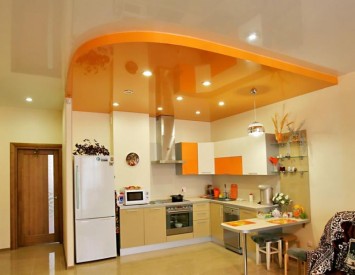
- From drywall, you can make a two-level ceiling in the kitchen, and you can come up with other, more interesting designs.
- Behind the sheets of drywall installed on the frame, you can hide communications and wiring.
- Pre-preparation of the surface before trimming by plasterboard is not needed. The most important thing in the work is to correctly install the framework of metal products.
If you wonder how to properly make a ceiling in the kitchen using drywall, take into account some recommendations:
- Plasterboard makes it possible to create multi-level structures and give the ceiling various forms. It is thanks to one or another forms in the room you can highlight certain zones.
- The circle is most often used to emphasize the center of the room, the square allows you to zonify the kitchen of narrow planning, and rectangular forms make it possible to hide the disadvantages of the room.
- If there is a low ceiling in the kitchen and a little space, multi-level structures are better to avoid.
- A single-level plasterboard ceiling looks restrained, concisely and elegant, and its installation does not take much time and effort.
- In the case of multi-level structures, you will have to attach more efforts, but also the design of the room will be unusual and original. Multi-levelness is best standing out with the help of contrasting colors and properly selected lighting.

Stretch ceiling in the kitchen
Stretch ceilings always look stylish and expensive. As a rule, they are performed from two materials: fabrics or PVC films. Consider in more detail the characteristics of each of these species:
- The tissue stretch ceiling has high strength, acute items are not scary to him, as it is not even special - the task is not from the lungs. Despite the strength, the fabric still can pass water. In addition, dismantling of such a ceiling, followed by tensioning the same tissue, is impossible, so in the case of flooding from above, the fabric will have to be removed, and then install the ceiling again. The fabric looks very attractive, has a rich assortment of textures, drawings and colors. Such a ceiling looks warm and cozy, but more suitable for the bedroom, rather than for the kitchen.
- The PVC film stretch ceiling is considered a more acceptable option for the kitchen, since the film does not absorb moisture and dust, repels the dirt. True, the strength of such a material is inferior to the tissue, so that with sharp objects should be careful. But if the neighbors flood you from above, the PVC can hold water. Subsequently, it can be accurately merged, and dry the film and install in place. By the way, the PVC film can withstand at least 60 liters of water for 1 m². Such material is not only not afraid of moisture, it is also not terrible temperature fluctuations. The stretch ceiling from the film is easy to care, it can be cleaned with the use of various detergents.
Ceiling in the kitchen, photo: