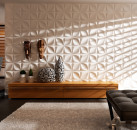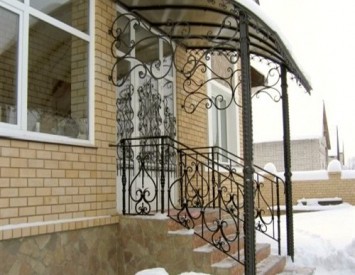
A canopy above the porch not only protects the entrance to the house from the unfavorable manifestations of nature, but is a rather significant part of the decor in the overall exterior, so before the construction of the visor needs to carefully approach the choice of shape, size, type of canopy, as well as material for its manufacture. Possessing minimal construction skills, make a canopy from polycarbonate very simple.
Content
Choosing polycarbonate
Recently, a remarkable alternative glass is polycarbonate, produced in sheets of various structures, size and thickness directly affecting the pluses and cons of the material. 
Polycarbonate advantages:
- excellent transparency rate;
- excellent protection against ultraviolet;
- high flexibility of material contributing to the manufacture of original structures;
- biological, chemical stability;
- excellent bearing capacity;
- good heat, noise insulation;
- low degree of flammability;
- a small propulsion opening wide structural capabilities;
- high impact resistance;
- safety of use, since when the polycarbonate is destroyed, the formation of sharp fragments;
- durability.
Disadvantages:
- exposure to temperature expansion requires the mandatory availability of compensatory gaps during installation;
- over time, the likelihood of damage to the surface of polycarbonate by abrasive particles is high.
Material with a mass of rare properties produced 2 types:
1. Monolithic polycarbonate - represents a solid sheet without any inclusions and voids formed by the melt of polymer granules before receiving a homogeneous mass. 
Monolithic polycarbonate, compared with cellular, has:
- higher supporting strength;
- better impact resistance;
- excellent transparency (about 90%);
- heat resistance.
However, the high cost and greater specific weight of the monolithic polycarbonate, rather than cellular, make it irrational use when building canopies, arbors and other designs in everyday life.
2. Cellular polycarbonate is characterized by the presence of two or more sheets, interconnected by internal jumpers playing the role of ribs.
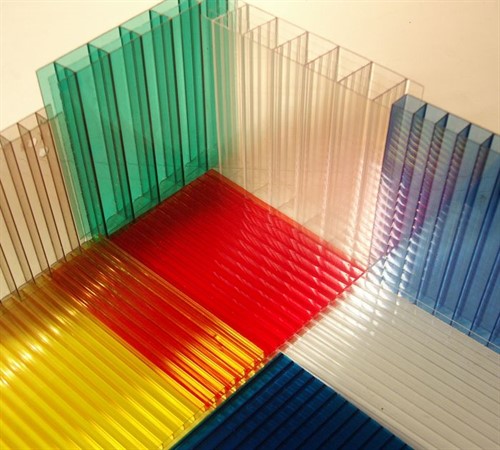
Cellular polycarbonate exceeds monolithic in the following criteria:
- thermal insulation;
- ease;
- price.
With regard to other operational characteristics, cellular polycarbonate is somewhat inferior to monolithic, therefore it is often used for the construction of greenhouses, canopies, various kinds of partitions. The strength characteristics of the cellular polycarbonate directly depend on its structure shown in the photo:
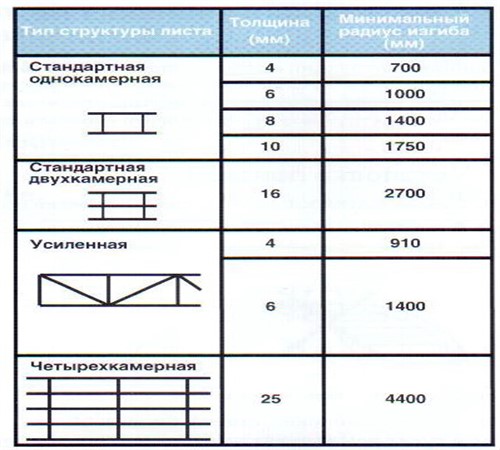
In this case, the sheets can be carried out with a reinforced design, several times the strength of polycarbonate.

Thus, the use of monolithic or cellular polycarbonate largely depends on the shape of the canopy, its size and method of fastening. When using a cellular polycarbonate, the optimal sheet is considered to be the thickness of 8-10 mm.
Types and shapes of canopies
Polycarbonate canopies have a variety of forms and dimensions corresponding to one or another frame, which differ in the method of fastening a visor depending on the type of frame, as well as the material for its manufacture. Based on the installation method, the canopies are divided into 2 types:
1. Supporting - canopies that are fastened to supporting supports. Apply to canopies made of heavy materials or large sizes.

2. Suspended - fasten directly to the wall of the structure, are used for relatively light sized canopies.

Since the canopy over the porch is a continuation of the design of the entire structure, the visor's form must match the shared style. From polycarbonate you can make a canopy of one of the following forms:
3. Single-sided - the most simple on the technique of manufacturing and the cheapest canopy, despite the use of monolithic polycarbonate.

4. Straight with the pylon - constructed from a monolithic material. From a single-table is distinguished by the absence of an angle of inclination of the canopy and the presence of a rectangular insert, designed, for example, for a store sign.

5. A double - a more complex design of a canopy, manufactured from monolithic or cellular polycarbonate, contributes to good protection of the porch from negative weather manifestations.

6. Arched canopy is constructed from cellular polycarbonate. Like a double canopy, perfectly protects the entrance part of the building, and the modern design will suit any architectural style.

7. Went canopy - attracts an unusual shape and provides a smooth gathering of snow from a roof.

8. Domestic, as well as concave canopy, is mounted from cellular polycarbonate. Ideal for a porch having a semicircular shape.

Thus, made from polycarbonate canopies, which are presented above, differ simplicity and, at the same time, the originality of the design used.
Frame for a shed
The frame, along with the shape of the canopy, is an integral part of the decor of the facial part of the building, so it is worth the choice of material not only from the point of view of value, but also a harmonious combination with other elements of the structure. The frame for a canopy to a house from polycarbonate is manufactured:
- From wood - it is distinguished by the simplicity of installation, availability and low cost of material. At the same time, the wooden frame has a very small operational period, being under constant impact of rain, snow, sun. Extend the service life of this material can be applied to the frame elements in 3-4 layers of olifa or antiseptic impregnation that prevents the decomposition of wood.

- From steel corners, less often - tubes - a sufficiently reliable design at low costs. However, the manufacture of steel frame is invariably connected with welding work. In addition, after the end of the frame assembly, it is necessary to clean the seams, to primitive the surface of the entire design and paint, in order to avoid the appearance of corrosion on the metal.

- From aluminum corners, tubes - the ease of giving any form profile or corner allows you to make a frame for a canopy of any complexity, forming a solid design. The only disadvantage of using aluminum is a considerable cost. However, such a design does not require additional processing, since aluminum is not subject to corrosion.

- Through metal forging - the high cost of the frame is justified by the unsurpassed uniqueness of the finished product.

The choice of a carcass largely depends on the size and shape of the canopy, so it is necessary to take this factor when making a final decision.
Stages of the construction of a canopy over a porch of polycarbonate
Determining the size of the future canopy
Since the canopy serves not only by decorative design of the building, but also by protection against bad weather conditions, the following conditions must be observed:
- canopy must exceed the wing width by 30-40 cm on both sides;
- it is advisable to provide a visor's conversation that exceeds 10-20 cm the length of the porch;
- the angle of inclination of the visor should be at least 20 ° C, in order to avoid the difficulty of snowing snow from a canopy in winter.
Permanent measurements are better to display as a sketch of the future design, after which you can start assembling the frame.
Mounting carcass
For a single, straight canopy:
- Protecting racks, supporting bars, beams and booms with respect to calculated sizes.
- Attach the racks to the porch by means of nails, either be concerned in pre-dug apartments close to the porch, a depth of 0.5-1 m.
- Fasten on vertical racks and wall transverse bars, beams, rafters.
For a bartal canopy:
- Calculate the size of the brackets represented by the triangular form, given the length, width, as well as the height of the canopy.
- Make brackets by connecting perpendicular beams with a tip, sticking to 45-60 ° C.
- Fasten the brackets on the wall through several screws with respect to the desired visor's width or by analogy of a skeleton for a single-handed canopy, to set up vertical racks whose top to connect with carriage beams.
- Making rafters by fixing the desired angle of the slope of the canopy with the help of riglels.
- Fix the rafters on the upper beams of the supports.
For arched canopy:
- Build 2 arcs, bent the tube or profile. To obtain a smooth arc, it is necessary from the center of the profile to the edges to make shallow cuts in a step of 4 cm. Flexing arc, it is better to keep both of its edges, providing uniformity of the radius.
- The resulting arcs connect the profile sections corresponding to the length of the porch.
- When mounting the frame to the wall, the connecting beam is welded to the back arc to which canopies are welded to make fasteners.
- When using support racks, the frame of the arc is mounted on vertical racks by welding, after which it is necessary to sand seams, cover with primer and paint.
Polycarbonate fastening
Laying polycarbonate sheets implies compliance with the following features:
- Polycarbonate fastening is performed by protective from UV rays, film up.
- To create temperature gaps, the holes for fasteners in the polycarbonate are drilled by a slightly larger diameter than the diameter of the self-pressing or thermoshair, with the step of step between the holes at 30-40 cm. When fastening the polycarbonate with a frame, there is a rubber gasket that impedes the moisture; , dirt inside the structure of the sheet.
- For the docking of the components of the elements, a special connecting element is used, which serves as the cover of the deformation seam. In this case, insert a sheet into the connector is necessary, taking into account the compensation gap.
- The attachment of the docking sheets is derived from the center to the sides or from the top down.
- The ends of the polycarbonate sheets are sampled with a special adhesive tape or closed with end linings, contributing to the condensate cavity from the cavity and preventing dust penetration.
- To obtain arched bends, the polycarbonate is pre-attached to the profile, since this way to give the necessary bend to the sheet will be much simpler. The bending of polycarbonate is performed only perpendicular to the length of the internal channels, in order to avoid the subsequent fault of the polycarbonate. At the same time, the minimum bending radius is 80 cm.
- After carrying out the full fixation of polycarbonate sheets, it is necessary to immediately remove the assembly film, because it will be quite difficult to remove it.
Based on the foregoing, to build from polycarbonate a canopy will not be difficult for even an unprepared person.