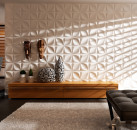
Filling the interconnect space Arches is one of the most popular receptions in the design of the room. The arches expand the space of the kitchen room and save space due to the absence of the need to install interroom doors. In addition to the design of the interior opening, this architectural element is often used to framing wall niches or fireplaces.
Content
Types of arches in the design of the premises

Different arches configurations in modern design large quantity. Thanks to such a variety, the arches fit perfectly into the interior of any direction, ranging from the classics and ending with minimalism and modern. Arches differ mostly only by the shape of the arch. The main structures that are used in the interior decoration of the room are as follows:
- Roman arch. Arch proper design. Differs in a high radial arch, the diameter of which is equal to the width of the arched opening. Such designs are perfectly combined with design solutions in the classic style, and are ideal for premises with high ceilings. Often, such arches are framed by plaster stucco or natural wood.
- Arch in modern style. Great for premises with a small area and a small ceiling height. They are characterized by more smooth lines of the arch, which are a truncated radius. Thanks to this, the room seems more elongated, visually expanded.
- Slavic arches. These are pretty simple models, which are almost a rectangular arch with slightly beveled corners. Evoid popular among beginner builders due to ease of installation.
- Oriental arches. Have an inherent Eastern architecture a pointed form of an arch. Will be an excellent addition to the interior in the North African style. This design is quite complicated, so novice builders are very rare to such forms.
- Thai arches. Received popularity relatively recently. A distinctive feature of Thai arches is an asymmetric form. Their arch has the form of semiradius, due to which one side of the opening is greater than height. Such forms can be an excellent solution for modern or minimalism.
- Trapezium. A simple form that resembles Slavic style, but with more massive beveled corners. In the frame of the natural tree perfectly suitable for the interior in English style.
- In the manufacture of repair work without a certain experience, it is better to give preference to simple models, such as square arches.
About how to make a square arch with your own hands for the kitchen - further in the article.
Why better use drywall for kitchen

The emergence of this material greatly facilitated the work of builders. Now, in order to build an interroom wall, you do not need to build it from bricks and slagoblock. It is enough just to make a frame from the profile to which the plasterboard sheets are attached. This material has a lot of advantages. Consider them in more detail:
- Ease of installation and processing. Plasterboard is a sheet material that consists of two layers of dense cardboard, between which layer of plaster is located. Thanks to such a structure, plasterboard is very well processed. To cut off a piece from the sheet, it is enough to make a knife with an incision from one side, break down a piece, and cut off the cardboard on the other. This feature makes it possible to cut from the material any, even the most complex figures. Installation of plasterboard structures is quite simple. For them, special steel profiles are sold, thanks to which you can easily build the design of any complexity.
- Minimum weight of structures. Himself plasterboard, as well as profiles for its installation, have low weight. Thanks to this wall, you can put anywhere without the need to build an additional foundation.
- Low cost and high installation cost. Unlike brick masonry, the cost of the construction of plasterboard structures is rather low. Its production does not differ in large difficulty. Plasterboard rebuilding is constructed independently in less than four hours. Unlike a brickhouse, which needs to be applied several layers of plaster, the drywall surface is flat. It is enough to apply a thin layer of finishing putty, which significantly reduces the repair process.
Arches from plasterboard square do it yourself

This option is the simplest, so even a beginner master will easily cope with it.
So, to close the interconnect opening with a thickness of 100 mm square arch.
- Sheet of wall drywall, the thickness of which is 12.5 mm.
- Profile of steel plasterboard UW. The profile width depends on the thickness of the wall opening. For the opening of a thickness of 100 mm using a wall drywall with a thickness of 12 mm, the profile width will be 100 - (12.5 + 12.5) \u003d 75 mm. In this case, the finished arch will be in the same level with the wall.
- Fast mounting dowel with a diameter of 6 mm.
- Self-tapping screw for fastening a metal profile, the so-called "seed".
- Saws for fastening plasterboard.
- Perforated corner.
- Spacure finish.
From the tools you will need:
- perforator or shock drill
- drill with winning tip,
- screwdriver with nozzle
- mixer for the preparation of putty.

Procedure for work:
- Before starting work, you need to measure the dimensions of the future arch. Its width will be equal to the width of the interconnect opening, and the height is depending on the desire of the landing room. Then the transverse segment is cut off, which will be attached to the ceiling. It is exhibited in such a way as to depart from the edge of the opening to a distance of 12.5 mm.
- In the profile, the holes are drilled with a diameter, which is equal to the diameter of the dowels. The step of the holes should be no more than 200 mm. Then it is necessary to apply a segment of the profile to the ceiling and outline the locations of the holes.
- After that, the holes for the installation of dowels are drilled by the perforator on the marks. Next, with the help of dowels, the segment is attached to the ceiling. At first, a dowel is inserted into the hole, and then the nail is driven. The dowel itself has a melno-shaped hat, which is perfectly holding a profile.
- After installing the ceiling profile, the side, the size of which corresponds to the height of the arch is mounted. The ends of the side profiles are hardened inside the ceiling and fasten with the help of "seeds". They are attached to the wall imaging with the help of fast installation dowels.
- Next is the lower crossbar. Its ends come inside the side profiles and are connected by "seeds". If the width of the opening arch is large, then in order for the lower crossbar to save, rigidity from the same profile is installed between it and the ceiling profile. They are attached to the upper and lower crossages with profile self-draws.
- When installing the frame of the Arch, all profiles are checked by level.
- After editing the installation of the frame of the arch, it is necessary to cut 3 segments of plasterboard. Two of them should have a length equal to the width of the wall opening and width, equal to the height of the arch + 12.5 mm. They will be installed with the front and back side of the arch. The third segment should have a length equal to the width of the wall opening. It is installed from the bottom of the arch.
- Plasterboard is attached to the design of profiles with special self-tapping screws. The mount step should not be more than 200 mm.
- Next, plasterboard must be prepared for putty. For this, it is processed by primer deep penetration. After drying the latter, you can proceed to putty.
- Since interior plasterboard square arches do not have the irregularities of surfaces, there is no need for their plaster. You can only apply the finish putty. It is prepared from the finished dry mix and water. A low water temperature is poured into a clean bucket and a mixture is gradually added, which is constantly mixed with a mixer. The finished putty must be a consistency of thick sour cream. If the putty is performed for the first time, it is better not to impose a large amount of solution. The fact is that it will dry very quickly, and the dried material is no longer suitable for use.
- In order to achieve smooth angles, a perforated corner is installed. It glues with a putty.
- After the end of the putty, it is allowed to dry, then check the presence of errors. They are removed using a grinding grid with a shallow cell. After that, the surface is rejected again. As soon as the primer dries, the arch can be covered with wallpaper or painting.
Square arches from wood

Along with the designs of plasterboard, there are often arches from wood. The process of its installation is practically no different from the use of HCL.
For the construction of such an arc as a design material, it is better to use a wooden bar. The lower end of the arch is sewn in a polished board.
Side sides of a wooden square army are decorated with wood racks. They narrow the width of the opening so that there is a small gap between the wall and the counter. It is closed with a decorative platband. For a similar scheme, work with the top of the arch.
It is now popular to finish a square arch with decorative elements, such as art carving. Such an arch is enough to mock in the opening and close its residue with plasterboard or chipboard.
Wooden arches have a fairly beautiful view, but their cost is very high. This fact does not allow them to win competition in plasterboard structures. You can hang curtains per square arc to decorate the room.
The arch is square into the hall of plasterboard: Photo