Garden area is the most pleasant place to relax, where you can relax in the shade of trees after a working day. In order for the site to be well-groomed and neat, many owners are equipping stone flowerbeds of various variations. Of course, not everyone will be able to pay the services of a landscape designer, but it is not completely difficult to create a comfort and a beautiful landlife.
Content
Variations of flower formation
The main requirement before the start of the facilitation of flower beds is to determine the type of construction and its optimal complexity. Depending on such parameters, the following types of flower beds can be distinguished:
- Irregularflowerby From stones - used for registration of a small area of \u200b\u200bthe garden, while not limited to architectural execution, forms and look natural. For such flower beds it is recommended to plant frost-resistant plants, perennial shrubs that can delight the outdoor eyes all the country's season.

- Multi-level flower garden - The optimal version of the design for admirers of non-standard solutions. Similar stone flower beds do with their own hands, they are spectacular and have high aesthetic characteristics. A successful formation of a flower garden is a construction of several small fragments in a multi-level manner, with different vegetation.

- Monotoker - This solution is a golden middle between the economical and expensive design of flower beds. Based on the design of the plants of a certain variety, for example, only roses, asters or lilies. And the rest of the space fill the plants of another type, forming unusual flow of flower bed.

- Vertical flowerbed - An option for those who appreciate the grace, landscape aesthetics and will not shake on its design. Such a flower garden has various forms, and therefore can be cooked both in the form of a decorative wall, screen and in the form of a bulk figure. At the same time, all vegetation landed into special containers, which should be fixed to the frame.

- Flower-arabesca - Such a decision will have to moral connoisseurs of original ideas. Flowerbed can be decorated with multi-colored vegetation in the form of various insects, colors, figures, etc. However, it will take considerable work and financial costs for the arrangement of this type of flower garden.

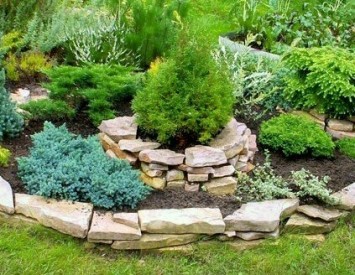
The most common type of flower beds today remains a flower garden, made in the form of a geometric shape and framed by stones. He is short enough in creating, easy to use, but there is an important nuance - all plants should bloom at one time. Otherwise, its advantages and durability of use contribute to the aesthetic design of the site.

Selection of stones for arbia
Stone flower garden - quite practical, budget and original solution. Such a material will allow decorating a flat terrain, and for its installation, additional concreting and the preparation of the base will not be required. Thanks to this, the visual filling of the site will be neat and the flower bed will not take much space. Consider the main types of stone that are used to decorate the flower bed:
- Limestone is a natural material with a porous structure that happens in different shades. It is perfectly growing at it, and it is suitable for creating an improvised container, inside which can plant plants.
- Sandstone is a fairly simple variant of the design of flower beds. This material has many color solutions and the original texture, it misses the air well and can serve at the cottage for a long time.
- Tuf or travertine is a popular variety of limestone. It is suitable for disembarking soil plants that grow on a stone and an aesthetically shared it.
- Slate or Gneis - has a flat stone that can easily be created by the walls of the vertical flower beds. It has a natural blue, purple or green color, which is well harmonized with a shared garden landscape.
- Granite - it is permissible to apply it as decorative inserts, since it has an acidifying property.
- Pebbles - common material for laying a flower garden. Stone flower beds in the photo with such a stone are distinguished by accuracy and simplicity in work, due to which it is possible to make a flower garden without difficulty.
- Basalt is an original stone that allows you to create unique and varied effects when decorating flower beds.
- Dolomite is a rock, which is widespread as a diverse stone. It is used for the external facing of the flower bed walls and has a variable color color.

The main requirements for the placement of the flower bed
When building flower beds in the garden plot, it is necessary to take into account some of the rules of placement and broken flower bed. This will create a harmonious and neat composition that will last long time. The basic requirements include such:
- the stone flowerbed should be located in the central part of the garden or near the wall of the house, so as not to prevent free movement and decorate the territory;
- the selection of vegetation for the flower garden should be carried out with the conditions of the zone where the flower bed will be located: humidity, illumination, etc.;
- flowerba should have a good ground filling and a simple form;
- to increase the service life, it is recommended to construct one large flower bed, instead of several small, if it does not re-with the landscape concept.

Traditional flower bed: phased instruction
Planning actions, how to make a flowerbed from stones yourself, it is advisable to consider a number of such factors as: the type of flower garden, the variety of vegetation, the quality of the soil, the placement of flower beds on the site and its size. From this will depend on the design process of construction. Consider below what actions will make a neat and simple flower garden.
- On the outer border of the planned flower garden, we drive pegs, limiting its perimeter.
- The inner and outer line needs to be outline with chalk or flour.
- Using shovels, dig a ditch of 300x200 mm.
- In the base of the perimeter, you must lay out large cobblestones, trying to put them as close as possible.

- Each stone from a number should be carefully tumped.
- After the stone hedge fell tightly, proceed to the lays down of the 2nd row of stones, while they need to be knocked out as close as possible to each other.
- Place flat cobblestones at the corners of the future flower beds.
- To create your own drainage, the first 5 rows need to be laid without cement mortar.

- After laying the stones, stretch the caprony thread, fixing it behind the stakes. This will allow you to determine the upper boundary of the stone fence.

10. We mix the solution in accordance with the instructions applied to the cement.
11. When the wall has a height of 15 cm, it is possible to apply concrete dough on the inner surface. This will create the visibility of seamless stone masonry.
12. Cold stones with a hammer so that they "sat down" as close as possible.
13. Leave the stone fence to the 3rd day.

14. When the laying is dry, proceed to the rash of fertile black soil and disembarking the necessary vegetation.

Flowerba is ready. To create an aesthetic species, you can enlist its decorative mulch. Such a flower garden will give the summer site a unique look and harmoniously fit into the garden design.
The ideas of the design and construction of flower beds can be seen on the fragment:
Alpine slide: step-by-step guide
The most popular view of the stone flower beds today is a mountaineering. This type of flower garden is a wild "island" of the mountain landscape, which can be equipped in any garden. In addition, with it, it is possible to successfully disguise the hill, formed subsequently disposal of construction waste, etc.

In order to create a neat alpine slide that meets the main requirements of the stylistics, it is necessary to follow such instructions:
- Proper placement of the Alpinaria is the key to the success of the event. It is desirable to build a design in a sunny garden in a sunny place, which will be well visible from all sides.
- Then the vegetation should be competent. In the case of an alpine slide, a low-speed plant with a small root system will be the optimal option. Among the representatives can be highlighted: heather, spicy herbs, carnations, catifice, Badan, Edelweiss.

- After selecting the terrain and plants, you can move to the definition of the size of the alpinearia. It should take into account the boundaries, shape and summing up the garden tracks towards the flower bed.
- Since the alpine slide requires high humidity, it is very important to take care of a drainage layer that can output moisture residue. To do this, in the place of the flower garden, you need to dug a ditch of a 50 cm depth.
- Fill the gravel with gravel, brick or rubble fragments.

6. From above the drainage layer, it is necessary to shake the geotextile layer to which the sand layer should be applied, and then the soil layer.
7. Alpinarium can be built on drainage. There are no strict rules or requirements for its formation, here the main role is assigned fantasy.
8. Pebbles, shungit, shell and granite are optimally suitable as stones.
9. The location of the stones is of great importance, as this is reflected on the strength of the structure. For this, at the base of the Alpinaria, large cobblestones must be put, and small decorative pebbles are laid out on top of them. When laying stone components, be sure to leave a place under vegetation.
10. Fall off the base with fertile soil by 10-15 cm.
11. Getting Started by Plant Plant: Perennial shrubs are planted, then the herbs, and at the end - flower tubers.

Step-by-step instructions for creating an alpine slide presented on video: