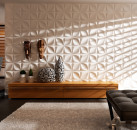
Lime is a popular material for wall decoration, which has disinfectant properties, not subject to fungus and mold. Most often, this type of finish is found in public places, where the coating resistant to wiping and mechanical exposure is necessary.
Content
General information about lime
Lime is a mixture of substances that are a firing product of limestone rocks. On the shelves of the stores most often found a comedian smooth lime and a flush path. Lime destroys all microorganisms falling on it, and therefore is the most hygienic type of finish. In addition, it has a high indicator of moisture resistance and strength. When the lime coating completely dries out, a film is formed on it, which provides such a limestone resistance. Another advantage of lime is its low price compared to other types of finishing materials.

There are disadvantages of lime. If the Master does not know how to make lime, and makes the solution in the wrong proportion, then bubbles, divorces and stripes will appear on the treated surface. An excessively liquid solution will not give the desired color on the wall, and too thick when drying will begin to bubble and disappear. Avoid this simply - to breed the lime strictly following the instructions and in the desired proportion.
The scope of application of lime
- In construction, lime is used as a plasticizer of cement solutions. It prevents the crack to crack and binds it well. In plaster mixtures is an indispensable ingredient. Helps the coating to hold on stone and wooden surfaces. For this purpose, only hated lime is used.
- Gardening is used to treat trees and reduce acidity in the soil. For whitewashing trees, lime mixed with copper vitrios.

- In industry, lime is treated with animal skins, it soften and disinfect water.
- In everyday life, lime is used to whitewash various surfaces - walls, ceilings, furnaces, etc.
- In medicine, chlorine lime for disinfection of rooms, appliances and water is used.
Proportions of lime breeding and its consumption
The proportions of the dilution of lime depend on the type of material used. On the shelves of the stores are exhibited Lime Negarent and Hairted Lime Pushonka. How to breed the second type of news read below. As for the arrangement of the lime and application of a chlorine solution, this information is in a separate section of the same name.
Lime Pushonka Haireda is sold in two versions - powder or liquid dough. And the same configuration is divorced in a ratio of 3: 1, that is, 3 liters of water per 1 kg of powder or dough. As a result, it turns out about 8 kg whipping, which is enough for processing 12 m 2 Surfaces. Consumption will increase if you break brickwork.

Another method of calculating how to dilute the haired lime is correct - proceed from the total quadrature of the treated surface. For this, every 2.5 m 2 Take 500 g of lime and 750 ml of water.
Consumption depends not only on the type of surface covered, but also from the materials used to whiten - tassels, sprayers or others. Optimal materials for blissing materials will also be discussed in a separate section. As for the cost of work, then lime is not at all expensive material, which will make finishing events not expensive.
How to dilute lime harated
The process of breeding lime on one side looks pretty simple, but, nevertheless, has some important nuances:
- Lime is mixed with small portions, it is not necessary to immediately connect a large amount of powder or dough with water. The maximum allowable value of the water in this time is 1 l per 2 kg of lime.
- When water and lime are mixed, a chemical reaction begins, the product of which is heat. Therefore, it is best to fill the powder with cold water.
- The mixture is thoroughly stirred and another liter of water is added, stirred again. So act until the entire required moisture is linged.
- The diluted and thoroughly stirred mixture is left to estimate for 24 hours.
- At this time, 2 kg of salts in 1 liter of water are suited in another container and stirred to completely dissolve the salt. Prepare this solution is best after the expiration of the lime of lime, otherwise the salt will fall over the day and it will have to interfere again.
- When the lime solution is ready, salt water is poured into it and interfere. The mixture is diluted with a small amount of water to bring to the desired thickness.
- Salted water and lime are mixed again and left for another 24 hours.
- Salt in lime is added so that it is less erased and remained on hand and clothing when touched after drying. They are carried away and without a salt solution, for this, the lime needs only to be diluted with water and give to settle throughout the day.

How to quench lime
Negarent lime is used as a binding additive for plasters and various cement solutions. It gives material with plasticity and make it a bundle with the basis more strong. But for the surfaces of the surfaces, the oversized lime is not suitable. Optimally for this purpose to purchase the finished powder or dough pulp. If it was bought by the next lime for whitewash, it was not difficult to pay off.
To repay the lime with your own hands in the conditions of residential premises is simple and not dangerous. In industrial enterprises, a special pit is often used for this process, in which powder and water fall asleep in the desired proportion. The amount of water added depends on what should be obtained as a result - thick or milk-like.
Lime quenching period is 24 hours, but to optimally withstand it 36 \u200b\u200bhours. For quenching it will take the lime, water itself and any long object for stirring. It is necessary to work in glasses, respirator and tarpaulin suit. It is impossible to get droplets of the solution to the skin, as it will damage them.
Capacity for quenching is taken clean and without traces of corrosion. The size and depth depends on the amount of material. The lime powder is poured into the container and poured with water in a ratio of 1: 1 - per 1 liter of water - 1 kg of lime. Negarent lime allocates a large amount of heat when interacting with water, the temperature reaches 150 seconds, so it should be accurately carried out.

You should also know that the lime in the quenching boils and sprinkles, but it must be constantly stirred. The active processes in the mixture take place for 5-30 minutes, and all this time, the lime is mixed with a long item. It is because such thorough means of protection are needed, as described above.
When the processes in the lime stopped and she "calmed down", it is considered redeemed, but the work is still very early to work. The capacitance is covered with a lid, put in a dark cool place and leave for 2-3 weeks, in some cases the lime is withstanding up to 4 weeks. Remedy required Lime will perfectly fall on any surface.
Before use, repressed lime is bred by water. Here the proportion is selected arbitrarily. The signal is that lime is ready, serves a dense white mark on a stick, which stirred a solution during dilution. An average of 1 kg of a hawed mixture is 10 liters ready to work bliss.
How to make a chlorine lime
Chlorine lime is a well-known disinfectant called chloric. It is widely used in household conditions, in industry, medical facilities and in public places requiring high-quality bacteriological treatment. The chlorine lime is divorced in different ways, it all depends on the purpose of its use.
For disinfection of premises, 30 g of chlorine lime to 1 liter of water is added during cleaning. This solution is purified by dirt, fungi and mold, while the surface is flimulated with such a solution will be sterile clean.
To remove the smell of urine, cats and dogs also effectively apply chlorine lime. But it is necessary to take into account that the chlorine negatively affects the health of animals, its smell is annoying sensitive receptors in the respiratory organs of four-legged pets and violates the sentence. Therefore, it is not recommended to use chlorine lime in places of domestic habitat. But if the homemade pet "Heritated" in the wrong place, then the chlorine boldly apply. For this, it is bred with water in a ratio of 1:10 and wipe the source of the smell with this solution. It is necessary to work in gloves to protect the skin of the hands from chemical burns. Before work, the reaction of the chlorine solution is checked in an invisible place.
Apply chlorine lime for bleaching linen. Chlorine effectively copes with yellowed things and complex stains, but the use is allowed only for white things. In this case, there is no need to breed the powders, as special liquid products are sold for whitening. Use them in such a proportion that is specified on the package. The linen is pre-soaked, and then erased in the usual way - with hands or in a typewriter.
Warning: When working with chlorine, it is necessary to observe all security measures. This substance burns the mucous membranes and skin cover, as a result, ulcers and swelling occur. If the chlorine got on the skin or mucous membranes, it is necessary to thoroughly rinse the place of damage to water and consult a doctor, in case of expressed wounds on it.
What additives are mixed to lime
Divorced lime before applying on the walls is refined by adding various substances to it. As such additives, there is a liquid glass, salt, soap, glue, flour, milk, egg squirrels and colors for paints. Colors for paints are perfectly combined with lime and allow you to give it any shade.

Adding linseed oil into the whores it makes it more suitable for the processing of very smooth surfaces, which is badly covered with paint. Glue and salt make whipping knitting, after drying it does not leave traces when touched. If you comply with the adhesion of glue or salt and the ring in the lime, then it turns out an excellent material for internal work in a residential building. According to the cost, the use of lime is more profitable than painting the walls of water-emulsion paint or other types of materials, and many of them even exceed in quality and disinfecting properties.
Preparation of the surface under whitewash
If there is a divorced lime in stock, then half of the case has already been done, now it remains only to prepare the surface and choose tools for blissing. The rules for the preparation of the surface and deposition of the blots are simple:
- It should not be fatty and rusty spots. All traces before applying the blots must be removed.
- No defects. Small irregularities of the walls are eliminated by putty.
- After applying to the surface of the blots, exclude all drafts and protect the room from direct sunlight.
- On the white lime, the surface does not apply a chalk layer, otherwise the divorces will appear and stains.
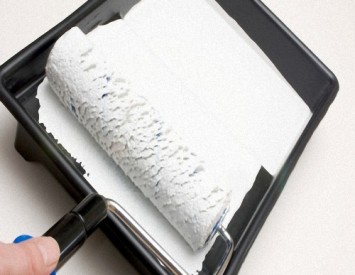
One of the most important moments in the whitewash is the choice of the correct tool for this process. There are several options. The most popular tool for whitewings, which has established itself for many years - a special brush. A tool that in no case cannot be used - roller. The first layer of whitewashing, imposed by a roller, falls well, but when applied the second layer problems begin, as the whitewashes stretch behind the roller and lags behind the wall.

For walls of bricks, it is optimal to use a brush with natural bristles. To hide the strips that leave the brush, the second layer is applied in the direction of the light stream. Successfully apply paint sprouts. With their help, the lime is exactly laid on the surface, while the consumption is much lower than when working with a brush. Manual paintopults have a long hose, which is convenient to work on high walls and ceilings. Electrical devices in this regard are less convenient, as the power button is located next to the sprayer. Also used for plating walls An ordinary sprayer for plants.