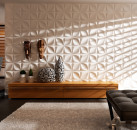
Plastering walls is a difficult process that is often performed after a number of most responsible construction and repair activities. Often, plaster performs a decorative function, so it is at this stage that it is necessary to provide strict horizontal or vertical of the surface, as well as the highest level of attractiveness.
Content
In order for the surface to look really worthily, you should pay attention to the technology of plastering, as well as a number of other issues related to this process.
Of course, it is the wet plaster that is the most popular option for finishing the walls, and it should be borne in mind that he does not have serious flaws. Practice shows that plasterboard sheets are increasingly used to align the walls and the like solutions. Of course, a huge range of materials creates a certain problem for professionals and owners, as you choose something one thing is not easy task.
In this article, we will consider in detail all the details of the choice of plastering mixture, as well as analyze the process of finishing the surfaces by this material. It should be borne in mind that today it is not a big problem to create a flat and attractive surface, but the main obstacle to the most attractive result of the finishing work is the technology, as well as in some cases, the quality and other features of the material.

Main features of the use of plaster
To begin with, it is necessary to focus that the plaster of the walls is a sufficiently dirty and time-consuming process, which is not all of the teeth. Of course, the practice shows that the walls of the walls can even conduct inexpresenting newcomers, but it is worth keeping in mind that it is necessary to thoroughly know the process technology, as well as numerous features of the use and application of material. Unfortunately, the plaster is a sufficiently unusual material that may well create problems with workers without visible reasons.
In addition, much depends directly from what is included in the plaster. Often, manufacturers use a wide variety of additives that can significantly affect the finishing process. You can also become a victim of low-quality products, but we will talk about it a little later in this material.
Experts believe that the main advantage of the wet plaster in front of the walls of the walls with plaster panels is an attractive appearance of the surface. However, an attractive externity surface of such plaster is obtained only if all the necessary parameters associated with application technology are met.

It is also important to keep in mind that it is advisable to use wet plaster in small rooms, where such repair work will not take too much time and effort. In turn, dry plaster (drywall and other materials) are activated in large spaces, where with the help of large sheets of the material you can quickly and efficiently make the room attractive. Too uneven walls to align the wet plaster will be extremely difficult, while the hidden sheets easily hide even the coarsest flaws of surfaces.
All the same specialists focus on the fact that it is most important to pay attention to the space in which one or another plaster will be involved. The question is precisely in the irregularities of the walls, the area of \u200b\u200bthe room, as well as in the project, on the basis of which the space is based on. For example, if you need to implement some bold design project (it can be multi-level ceilings, volumetric wall parts and much more), then on the basis of classical plaster something like this will not work. Therefore, it is best to entrust the choice of material professionals that carefully consider existing conditions.

Quality and cost of plaster
To purchase high-quality plaster, follow a whole list of requirements. Often, the owners who want to acquire material pay attention to sufficiently well-known manufacturers engaged in the production of building mixtures and other materials for a long period of time. And this is most likely the most correct decision. Unfortunately, in the market you can find a colossal number of manufacturers of materials for construction and repair, the products of which do not correspond to the necessary parameters. In this case, it is important to remember that the poor-quality products should not be purchased in any conditions. Often, poor-quality plaster is distinguished by a low price, which attracts owners who want to save on a large-scale repair every penny. However, such savings will be too strong, if a short period of time, the surface will begin to deform and turn.
If you compare the plaster with other finishing materials, then wet finish is actually more expensive than the closest competitors. That is why the owners who want to spend the cheapest repair, use plastic panels and even drywall for finishing surfaces. As a result, the appearance of walls and ceilings should be quite attractive. But at the same time it should be borne in mind that only with the help of wet plaster you can get a surface with the original texture, as well as many other effects. Therefore, as we said, wet plaster is indispensable in a number of situations.

Help specialists
- In the event that the process of plastering walls or ceiling is carried out for the first time, it can be confident that some errors in the technology of the mixture will still be shown. Of course, it is often about small shortcomings, which are difficult to call some serious problem. At the same time, it makes sense to draw attention to the fact that this case can be entrusted with professionals who will not only hold a full amount of plastering, but also will give a full guarantee on the quality of their services. Obviously, there is no need to guarantee, but there are many cases in which the plastered surface began to crumble and crack. In this case, experts who conduct work must all this restore and do not require a penny.
- As in the case of the choice of the best plaster, to specialists providing services for the plaster walls, it is necessary to be extremely serious. Often these guys represent certain companies engaged in repair work. It is necessary to make a choice in favor of proven companies that have the maximum number of positive feedback.
- The last advice associated with the involvement of the help of specialists is that with its own-proceedable repair, you can sometimes conduct some consultations with professionals in this industry. It is about the fact that during the process of wall decorations there may be different moments that the newcomer is not always able to fully analyze. In such situations, assistance of consultants who often do not even require any financial rewards. Such people can be found in large building stores, in warehouses and supermarkets associated with the sale of materials for repair and construction. This option is the most optimal, since the owners themselves do the repair process, are convinced of the high quality of the material and the finishing itself. The consultant specialist does only all possible so that employees do not allow inexperience mistakes.
Conducting plaster walls
Preparatory work
Preparation of space for repair is an extremely responsible process from which the result depends largely.
- First of all, you need to make absolutely all things and objects from the room. As you know, the wet stucco creates a lot of problems in terms of pollution of space. Accordingly, the entire room during repair will definitely be dirty and unattractive, which creates a danger to things located in the room. By the way, there are no such problems with a dry plaster. Sometimes the owners make a decision not to make some items (often it is furniture), covering everything you need by plastic film. Lighting tools also need to be removed. Separately, I wanted to say a few words about outdoor coverage. Often in the houses are installed laminate or parquet, which can be easily damaged by building materials. Therefore, it is necessary either to cover the floor by the same film that was previously stated, or flooded the surface with a thick layer of sawdust. All wires in the room must be inlated, as water can get on them.
- The next stage of preparatory work is cleaning the walls. It is necessary to purify the surface to the very base, since any old plaster and other coatings can very quickly come into disrepair, along with the plaster itself. Cleaning walls to the very reason should lead to what ultimately we get a relatively smooth wall without significant drawbacks. For easy removal of whitewashing and old plaster can be useful. The material is applied to the surface, it freezes, after which all covers are extremely easily removed from the wall. For this case, the most ordinary spatula will also come in handy, allowing extremely quickly and comfortably remove the layer of old material.
- If there are old wallpapers on the wall, you need only to go to them, after which it is easy to remove from the surface, or scraping with a metal brush.
- Special attention must be paid to cracks and other flaws, which usually appear after the removal of old plaster or other surfaces. If the crack is small, you can arm a conventional knife and try to expand this flaw slightly, then fill the repair mixture (cement). On top of all such places after applying the mixture, it is necessary to place a plaster grid. If the surface damage is too large, you will have to level the surface with the help of all the same plasters, or try to limit ourselves to the usual cement (but in this case you have to wait until the cement gains strength before carrying out the main finishing works).
- Concrete, brick or stone walls are not the best basis for reliable retention of plaster, therefore it is advisable to create some rubbing on the surface on the surface. For this case, you can use fool's tools, or a small jackhammer. Accordingly, over the entire surface, with about the same step, a beep is created, which provides simply the perfect connection. It should be unambiguously to remember that it is not necessary to turn the wall into a completely broken surface, sufficiently few small recesses, in which the plaster will enter.
- Special attention should be paid to the decoil of wooden walls. Such surfaces are extremely rare, but in some cases the wet plaster is the ideal option for creating an attractive space. In such conditions, the wall surface must be closed with duch. These are small thin boards with sloping along the fibers. Often, instead of this option, a metal mesh is also used, it is stuffed directly on the crude wall (you need to protect the grid from the corrosion action, applying a layer of paint to it).

Arrangement of Mayakov
With the help of lighthouses, it is possible to finishing work without any problems, while providing an ideal vertical (or horizontal, depending on the surface that can be finished) surface. Often the process of installing beacons consists of the following steps:
- With the help of a construction level (preferably long) or the plumb is checked the verticality of the wall.
- After that, we take the dowel and scored them in the corners in the room - one by one above, and one at the bottom. There is a line between these elements, which will perform a level function.
- Analyzing the location of the fishing line, you can install lighthouses. They are metal elements (profiles), which are advisable to fix the wall with small gulls of the solution. Thus, profiles are simply pressed into the solution, providing such a position that the wall surface will make the surface of the plaster as smooth as possible. While the solution did not type the strength, it is possible to freely experiment with the position of the profiles, but it is not worth tightening with this process too much. Profiles should come into contact with the above fishing line, but it should not move it. The step between the beacons should be 1-1.5 m.
- In addition, horizontal lighthouses will also be needed, the location of which is based on the same above technology. To prevent any deviations, even the most minimum, it is worth paying attention to the use of a classic construction level. This is an indispensable tool that allows you to provide complete quality control.
Now, when lighthouses are installed, we can safely begin the process of preparing the plaster mixture. Often it is an extremely simple process that is described in detail in the documentation from the resource manufacturer.
Mortar for plastering and appliances
To begin with, it is worth noting the fact that today the following solutions for plastering walls are actively used:
- Cement mortar consisting of 1 part of cement and 3 parts of sand.
- A lime solution consisting of 1 part of the lime material and 3 parts of the sand.
- A cement-lime solution consisting of 1 part of cement, 5 parts of sand, as well as 1 parts of a lime solution.
- A gypsum-limestone consisting of 3 parts of the limestone test and 1 part of dry gypsum.

The technique of applying plaster on the surface consists of the following steps:
- The first layer was called "spray". For this case, we need a sufficiently liquid solution that you just need to dig on the wall surface. It is enough to make small shuffles (from a short distance from the wall) to the cell, to which the solution is taken. It is worth remembering that if the shuffles are too squeezed, the mixture is simply sprinkled on the surface, and then the result will be sufficiently substantial. Often, peculiar handhes that appear on the wall surface should form a layer whose thickness is not more than 9 mm - for wooden surfaces, as well as up to 5 mm for brick and concrete walls. It is better to make a spray evenly that the surface quality becomes actually high.
- The second layer is the main in this process. The consistency of the solution must be somewhat curved than in the case of a spray. The thickness of the second layer must be limited to 10 mm. If the wall is too smooth, then the layer may be thinner. Application of the solution occurs with a wide spatula. Often this layer is applied in 2 approaches, since its total thickness is quite large. If we have a really wide spatula, it is necessary to pay attention to the fact that the level alignment can be made between beacons, but this concerns only the topmost points of the layer, and additionally align the surface will still have to.
- The third layer is often referred to as the finish or corrupt. The thing is that this particular layer ensures the maximum smooth surface. Most often for this process, a mixture with fine-grained sand is activated. With this situation, the wall surface is almost smooth. If the sand, which is, is too large, you can sift it using a grid with small cells. This layer is advisable to apply on a moisturized surface. If the second layer is reduced, then you can arm a conventional painting brush and moisten the walls with water.
It should be borne in mind that the prepared mixture must be used in the repair process for an hour, since after this period the material will start to lose its basic properties, and then the wall decoration will be a huge problem, which is unlikely to succeed.
The most recent step of this process is that it is necessary to arm a grater that allows you to clean the surface of the wall. Even if it seems that the surface and after the decoration is perfectly smooth, the grout is still needed. This process should be carried out slowly, paying attention even to the most minor flaws of the surface. Experts recommend strongly pressing the grater to the wall so that all the disadvantages of the surface are guaranteed to be eliminated. Of course, it is not necessary to overdo it in this process.