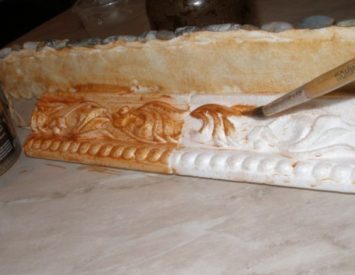
In creating a beautiful interior, it is important to take into account every detail and a trifle. For example, walls, ceiling and floor will not look like a complete composition, if not paying due attention to the design of plinths. In this article we will tell how to paint the plinth.
Content
What paints are suitable for finishing the plinths
Paint for plinth should be chosen according to what material it is made. For example, if you want to paint the wooden floor plinth, you can take a simple veil. It impresses wood, protects it from moisture and microorganisms, but does not hide the natural texture and drawing. The same applies to the transparent varnishes on an alkyd basis. The oil paint in this case is considered not the best option due to long drying, unpleasant odor and short life.
To paint plastic plinth, it is best to use acrylic compositions. The only feature of the finishing of such a material is the method of applying paints - for this it is more convenient to use aerosol cans. Tassel leaves on the smooth plastic surface of the divorces that look inactively.
How to paint the foam plinth? For this purpose, there are a number of different compositions:
- Water-dispersion paint - inexpensive, economical and eco-friendly material, suitable for both polyurethane and polyurethane. The main advantages of its availability and simplicity of application. Minus - instability to moisture. Wipe the plinth is a wet rag, otherwise the paint will wash.
- A good embodiment, which can paint the ceiling plinth of foam, is the water-emulsion acrylic paint. It is also not very expensive, it is characterized by a rich color palette and resistance to a wet environment. Painted by this paint plinth can be wiping with a damp cloth.
- For premises with elevated humidity, paints with latex filler are best suitable. They do not fade for a long time, create a very durable film, which does not crack, does not let water, is not afraid of a sharp change of temperatures. Latex compositions are good painting the plinth in the kitchens and bathrooms.
- Even more resistant to negative surrounding factors are silicone paints. They possess enviable durability, but also have no shelter.

Features and advantages of acrylic paints
Since in our article we will talk about painting the plinths acrylic compositions, let's understand why you should use them.
Acrylic paints are distinguished by good adhesive properties, low water absorption and ecological purity. They are safe for human health, as water acts as a solvent-based water.
In the construction market, the compositions are represented by a huge number of shades. You can find bright or pastel tones of any gamma, and if you decide to paint the ceiling plinth of gold color of gold, it is quite possible to purchase it.
Acrylic compositions are suitable not only for internal works, but may well be used for exterior decoration. You can apply them to many surfaces, for example, on concrete, plastic, plaster, wood, polystyrene foam. Such paints are capable of grabbing even with a metal, if it was pre-covered with primer. You can separate the surfaces previously painted by enamels, oil or water-emulsion compositions.
It is easy to work with acrylic paints, in the process of finishing, you can use brushes, rollers or paintopult. Hyded, the material creates a solid film on the surface, which protects the metal from damage, rotting, corrosion. This film is not afraid of moisture, ultraviolet rays, high and low temperatures.
The versatility of acrylic paints allows them to be used almost everywhere: in any rooms and on any surfaces. We give in the form of a list the main advantages of such compositions:
- The high elasticity of the film that is formed on the painted surface does not crack under the action of temperatures and physical influences. Paint creates a solid and very durable coating, which serves 15-20 years.
- During the entire operational period, the material does not lose color and attractiveness. The reason for this is the resistance of paint to ultraviolet rays.
- The ability to withstand strong heating and frost allows the use of material in outdoor work.
- Careful over the painted surface is very easy. Since the paint is not afraid of water, pollution can be laundered with a wet cloth. It is worth noting that acrylic paint is not afraid of the actions of many chemicals, so that in the process of cleaning, you can use different detergents.
- The painted surface is obtained beautiful, neat, has a pleasant glossy shine and a smooth texture.
- The process of application does not require complex skills. The composition is easy to work, for staining the surface you can use the most convenient tool for you.
- Acrylic paints are well adhere to almost any surfaces, quickly dry, do not have a sharp unpleasant odor. They are environmentally friendly, fireproof.

Why do you need to paint the plinth
Plinth, both outdoor and ceiling, it is worth painting for many reasons:
- If the product is made of foam, it is strongly subject to damage. Often, defects may be discovered immediately after purchase, since even in conditions of not too careful transportation on the material there are small scratches, dents, etc. With bright lighting, such shortcomings are very noticeable, and the paint will help them hide them.
- Foam plinths are standardly white. If the ceiling is light, the plinth looks appropriate. If the surface is painted in any shade, except for white, then the plinth will stand out on its background.
- The structure of foam plastic loose, with bright light they slightly shine, and this is not very beautiful. Paint will make items more neat and aesthetic.
- Fontoam plinths over time yellowing or darken from dust from them. Of course, it is ugly, and against the background of the white ceiling, such an edging will be unprofitable. The layer of paint will protect products from such consequences.
- Dust, stacked on the painted surface, will not be difficult to erase or wash off. Unpainted plinth of foam sprout completely fails due to the porous structure.
- In the installation process, joints are formed between fragments of the plinth, which, must be said, are very noticeable with bright lighting. So that the plinth is neat and with the form of a monolithic part, the joints must be embedded, and then paint the entire surface.
- Wooden plinths need painting no less than foam. Wood generally very capricious material. It is susceptible to rotting, does not like moisture and water, can be deformed from drying out, damage to parasites. Protect it will help a layer of paint.
- Plinket painting pursues not only practical, but also decorative purposes. For example, even the most expensive and luxurious stretch ceiling will not look exquisitely and noble, if you do not paint the ceiling plinth.
You can engage in decorating the plinth, both before and after it is installed. When better - the question is controversial. It is most convenient to paint the product before mounting, because then you don't have to climb a ladder, stand there for hours, rubing my head. You also do not have to worry about how to paint the ceiling plinth, not staining the walls. The minus of such a method is that after installing the plinths between fragments, joints will be noticeable. They will be subsequently painted separately, and this can lead to the difference of shades.
The second option is the finishing of the plinth after their installation. Technically, it is more difficult, requires more time and labor. In the process of work, it is necessary to show accuracy, trying not to get the paint on the walls themselves or the ceiling. But the surface of the plinth in this case will have a uniform and identical tint, the place of the joints will not attract attention.
If you decide to paint the ceiling and the plinth into the same color, then do it at the same time before you begin the finish finish of the walls and the floor.

The process of painting the plinth acrylic paint
Before painting the plinth on the floor either on the ceiling, you need to prepare for work. Paint perfectly will only fall on a flat surface, and to make it such, you need to sharpen dents, scratches, other damage. It is necessary to smear and align the place of the joints. Putclone is chosen according to the material. For foam, any fine-grained finishing composition or silicone sealant is suitable. For wood it is better to choose a special putty on wood.
Preparatory work can be described as a sequence of stages:
- Prepare a putty, a container for its dilution, a soft sponge or a rag, vessel with water and a small flexible rubber spatula.
- Apply a little composition on the tool and squeeze the defect either the junction, having spent the spatula along the seam. Tool press to the surface sufficiently tight, but without excess pressure.
- With the help of a wet sponge or cloth, erase excess material.
- To close the joints in the corners, you can generally do without a spatula and apply a solution with your finger - so more convenient. Just before that, in hand, you must wear a glove.
- In this way, not only seams and dents are close, but also the gaps between the plinth and the adjacent surface: floor, wall or ceiling.
- After a while, the solution should dry, after which it is grinding in shallow emery paper.
Separated surface can be painted.
Paint is applied to a pre-cleaned surface. We can also cover the primer plinth.
The painting technology itself depends on what stage you decide to do this work. If the plinth is not yet installed, it is easiest to paint with the help of an aerosol cylinder or spray gun - then the composition will fall evenly, the color will be uniform, there will be no smears on the surface. Before such work on the floor, you need to lay a film or newspaper. Then, putting the plinth vertically and holding it with his hand, cover the product from all sides by a uniform paint layer. If there is no collapse, the same can be done with a brush. Then install the plinth in the same vertical position until it dies.
If you decide to paint the fixed plinth, it is necessary to do it carefully. So as not to be staining the adjacent surfaces, on them along the entire plinth you need to stick a greater tape. In such work, the paintopult is uncomfortable, so you have to use a brush or a small roller.
Some are afraid to spoil the glued wallpaper with painting scotch. In this case, an alternative can be a flat plastic sheet. It needs to be kept his hand near the painted area, and the second hand draw paint on the plinth. In this way, the plinth is processed over the entire surface.
To obtain a more uniform hue, it is desirable to apply the paint in 2 layers. Before that, the first layer is necessary to allow to dry.