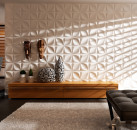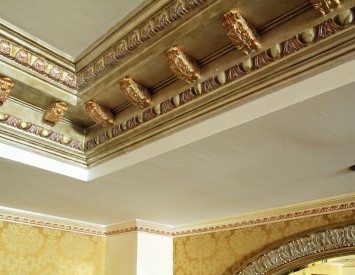
Modern trends in the world of design and mortar decor are developing with rapid pace and more and more finishing materials appear on sale. One of these was the molding (translated from the English - "cast part") - the plane's overhead is usually convex, which has transverse sections. The initial purpose of this product was to protect the surface of the wall of destruction under the influence of the severity of furniture. Then the use of this element gained a wider spectrum.
Content
Application Molding
Today, molding functions are to decorate the premises, zoning, as well as protection of the surface from various types of mechanical damage. Applying this element, you can diversify the door decor, walls, ceiling, fireplace. In general, it is possible to distinguish such molding functions:
- He is able to transform the interior, give the room a stylish and exquisite view.
- With this material, you can split the wall surface into individual sections.
- Applying molding, you can create rectangular, square, round forms. Space, therefore, will be divided into zones, each of which will have a certain purpose. For an additional effect, each section can be painted separately.
- In addition, such a detail is able to disguise the poor-quality finish or non-psychic elements of the interior.
- Molding will protect the finish as plinths, create a complete transition and make the appearance of the room more accurate.

Moldnig is also called frames for mirrors, eaves, plinths, racks for paintings. Eaves can be different in width, reaching several dozen centimeters, as well as have the most diverse shape. They are:
- stucco;
- convex;
- concave.
Applying such item in the interior, you can visually change the size of the room. Painted in the shade with walls cornis visually lifts the ceiling. If it is necessary to achieve the opposite effect, then in one color scheme there must be eaves and ceiling, and the walls have another palette.

Plinths from wood and plastic are popular. However, it is possible to use molding from wood only under the condition of absolutely smooth walls. But the plastic product can be adjusted under the surface shape. If there is a tile in the room, then molding from a similar material will be a good combination. Also, with molding, you can disguise the jack between the window and the wall. The window acquires a more completed and expressive look. Preferably thus finish the outside of the room.
The doors framed by molding will look. Its direct destination in this case is to hide the jack between the wall and the door frame. In addition, the product also performs a decorative function. You need to choose molding in this case from the same material from which the door is made.
Molding photo:

A successful solution will be molding as decor. This product can replace stucco. By virtue of a fairly high cost, the interior decoration is not available in this way. In addition, the masters in this area there are few. Using a molding can decorate the room stucco details for all tastes, as well as hide the irregularities of the walls, the asymmetry of the room to mask the pipes and risers.
Another original way to use this element is the creation of such a designer raisin as a fiscal. To do this, wallpapers are glued onto the wall, the glass is mounted on top, then molding. As a result, it turns out imitation of the window with a beautiful scenery. How much it costs to paint the molding in this case will be entirely dependent on the designer idea of \u200b\u200bthe author.

Molding Material Materials
For the manufacture of moldings, a wide variety of materials use, among whom are popular as:
- marble;
- gypsum;
- metal;
- polystyrene;
- wood.
Each type of material has its own characteristics. Gypsum is a natural raw material, but it is necessary to consider that he crumbs and is afraid of moisture. Also to establish a laying of plaster need to contact a specialist, which will significantly affect the cost.
Polyurethane and polystyrene - varieties of foam. The first consists of almost imperceptible granules, the second - from more pronounced. These materials have an advantage in price, they can be installed on their own. When choosing any of the options, you should pay attention to the fact that it does not crumble and had a homogeneous surface. Polyurethane is the most used material. It is easy to stain in any tint room suitable for interior.

In the manufacture of molding is often used wood. The most popular breeds used to create decorative elements:
- poplar;
- alder;
- spruce;
- oak;
- red tree;
- yew;
- maple.
The tree will help create a classic aristocratic style, this type of material is distinguished by strength and easy enough to handle. But it has a high cost, and also does not have enough moisture resistance.

Originality in the design of the room will bring color moldings. With their help, it is possible to reproduce the structure of natural wood, also vegetable and floral motifs, create a variety of geometric patterns. Properly selected product color will benefit the design of the room. In addition, painting molding from polyurethane will not work.
Molding so that he had an attractive appearance and good safety, it is necessary to paint. This prevents the climb of the pores of the dirt, and the product itself becomes easier in care. If necessary, it will not be difficult to wash with any detergent. Even if the desired color is white, paint molding is still needed.
Required materials for the implementation of the process:
- Paint for this product.
- Moldings polyurethane.
- Decorative plaster.
- Acrylic-based primer.
- Brush and a small spatula.

Choose paint
Before painting molding and choose the optimal coloring composition, the following recommendations should be taken into account:
- To process such an element, latex, water-emulsion, acrylic and mosaic paint is suitable.
- You can also use decorative plaster, the application technology of which does not have differences from paint.
- It is not necessary to use oil substances, since for their drying it will take a lot of time, they do not differ in environmental cleanliness and inferior on decorative indicators to other types of compositions.

Step-by-step instruction on coloring molding
To create an original and aesthetic design of the dwelling, you need to prepare a sketch, attach molding and paint it in accordance with certain requirements. So, the method of this process looks like this:
- At the first stage we select the necessary palette. The original shade of the polyurethane product on the ceiling will have gray. If the desired color is white, in this case, in white paint should be added a little yellow. It will also successfully look like products, painted paint with a small addition of color close to the shade of the walls.
- Next glue molding to the surface of the wall. It follows the already existing decorative coating - wallpaper, paint, plaster. Otherwise, the polyurethane element will not hold on.
- For gluing you need to use two types of glue. The first is a special composition for fastening the product itself. It has the ability to penetrate enough enough and provide a solid connection. The second form is intended for the processing of the jacks between the elements.
- In the process, it should be noted that glue for molding has quite strong properties, gluing happens almost instantly. Then, in the case of any error, the product is no longer possible to adjust in the required direction.
- After decorative elements are glued, you should pay attention to the joints. First process them with the second type of adhesive composition. Then the brinks need to sand and sharpen, using the acrylic-based putty for this. At this stage of the process, special attention should be paid, since after applying paint, even small roughness will be noticeable.
- Next we applied the primer. We choose this material based on acrylic. Such primer has the ability to deeply penetrate the product pores. If we work with porous material, such as polyurethane, this feature is quite relevant. Only subject to the full filling of pores, the paint will be very well based on the basis.
- After that, using a painting brush, proceed to staining the molding. Learning how to paint polyurethane molding, pay attention to the layer thickness. When painting should apply a substance with a dense layer, since in this case the surface becomes more relief.
- At the final stage, with a spatula of small sizes or brushes cover the product with decorative plaster. For fragments from polyurethane, the best option will be the coating with the effect of gold or pearl.
- Also for final finishing, Special painting formulations are approaching. Their use will make it possible to imitate the surface of the old tree, weathered stone, gold, etc.

Molding use will provide an opportunity to place an apartment or a house with minimal cost and get the maximum effect. Applying this element, you can visually create the effect of palace stucco, hide unsightly sections of the surface of the walls, visually "lift" the ceiling or vice versa to make it below. The range of use depends only on the borders of the fantasy.
Technology Painting Relief Finishing Materials in the "Dry Brush" style is presented in Video: